







Diaspora as an attempt to name an experience
Eva Yakubovska points out that the term “diaspora” itself is not unambiguous today. She recalls that recently, when publishing an announcement for an event, she received a message about the Verkhovna Rada’s alleged adoption of a definition of the Ukrainian diaspora as “global Ukrainianism”, but she found no confirmation of this. Instead, she says, official discourse more often refers to “Ukrainians abroad”.
“I think this is an attempt to distinguish their experience,” says Yakubovska, emphasising that the issue of distance is key to understanding the diaspora. According to her, the Ukrainian community in Canada or the United States is fundamentally different from the same community in Berlin, both in terms of geography and historical context.
She recalls the experience of earlier waves of emigration during the Iron Curtain era, when some Ukrainians lived with the feeling that “Ukraine no longer exists” and that it needed to be “built and preserved here”. Today, the situation is different, but, as Yakubovska emphasises, the modern experience does not repeat the past, instead having a certain resonance with what happened before.
Why it is too early to talk about the diaspora
Tetyana Havrysh suggests looking at the situation from the perspective of time. In her opinion, it is still impossible to talk about a diaspora as a fully formed phenomenon today, because migration is ongoing. “We can only talk about the diaspora years from now. This issue is currently in progress, and we cannot talk about it definitively because migration is continuing,” she notes.
Havrysh emphasises that after 2022, Ukrainians will remain in constant motion, both within the country and beyond its borders. Some people will return, unable to bear the loss of social ties, while others will be forced to migrate again due to the loss of territory. She draws particular attention to unprecedented internal mixing: before 2014, only about 30% of Ukrainians crossed the borders of their Region, whereas today this experience has become widespread.
“Today, Kharkiv has, so to speak, a Kupyansk diaspora,” notes Havrysh, adding that hundreds of thousands of internally displaced people live in the city, many of whom had never been there before. It is this multi-layered experience, in her view, that makes any definitive conclusions premature: “It is probably too early to talk about a diaspora as such.”
Culture as a way to restore a sense of home
The practical dimension of these processes is clearly visible in the cultural life of cities. Olha Donik says that when she became the manager of the Actor’s House theatre in Zaporizhzhya in 2022, she immediately faced the need to work with a new audience — people who had left their homes and come to the city.
“When we started to resume theatre activities, we realised that a significant part of our audience had left,” she says. In response, the theatre began to look for new formats of interaction, going beyond its usual space.
Donik recalls that the first steps were dictated by an understanding of people’s basic needs: “They had no time for theatre — everyone was simply trying to survive and settle into their new lives.” That is why the team created a small children’s play and decided to stage it not in the theatre itself, but in municipal libraries located in residential areas.
“We realised that only by going beyond our usual theatre space could we establish a connection with this audience,” she concludes, adding that this experience became the basis for further work with new communities.
Kharkiv and the danger of imposed identities
When speaking about Kharkiv, Tetyana Havrysh reacts sharply to the rhetoric of “fostering love” for the city. She recalls a moment when she heard the mayor say, “We teach them to love Kharkiv,” and admits: “My hands and feet just went cold at that moment.” He was referring to people who had moved to the city from villages and other cities across the country.
In her opinion, such logic is dangerous, especially in a Region with a long history of Russian cultural influence and weakened cultural institutions. Instead of imposing identity, she argues, it is important to create an environment in which people find each other on their own. “People will always find each other. It is very important to create conditions for this process to happen organically.”
Berlin: from “convenient presence” to political and cultural visibility
The experience of the Ukrainian community in Berlin, as described by Eva Yakubovska, shows how the war has radically changed not only the number of Ukrainians in Europe, but also the very logic of their presence. While in 2021 there were about 136,000 Ukrainians living in Germany, after the start of the full-scale invasion this figure rose to over a million. However, as Yakubovska points out, the number itself does not capture the essence of the change. Until 2022, the Ukrainian community in Berlin was largely inconspicuous, often integrated according to the principle of “do not disturb”. Ukrainians existed in the urban space, but rarely articulated themselves as a distinct political or cultural entity. “We were very convenient,” Yakubovska notes, referring to a willingness not to conflict, not to demand, and not to be too vocal in defending their identity.
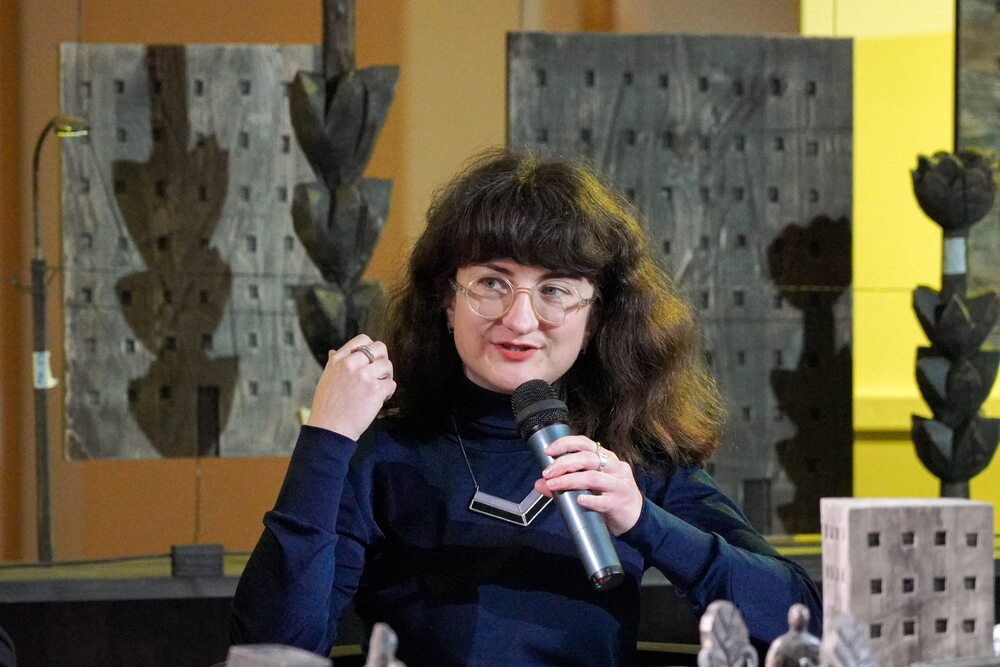
The full-scale war destroyed this model. The mass presence of Ukrainians, combined with a sense of existential threat, forced the community out of the shadows. Protests, marches, cultural events, public discussions, and lawsuits all became part of a new experience. Particularly telling were situations related to the ban on Ukrainian symbols on 8–9 May, as well as attempts to equate the victim with the aggressor.
“We realised that we have not only a moral right, but also a legal one,” says Yakubovska. This realisation became a turning point: Ukrainians began to see themselves not as temporary guests, but as part of the civil society of their host country, capable of influencing the rules of the game. This was especially significant given that the Ukrainian diaspora is the second largest in Germany after the Turkish diaspora.
At the same time, this process was not painless. Tensions emerged within the community between different waves of migration and different experiences — between those who had lived in Germany for years and those who arrived in 2022, as well as between the politically active and those simply trying to survive. However, according to Yakubovska, it was precisely these conflicts that signalled a living process of community formation rather than its imitation.
She emphasises the decolonisation dimension of this experience. It is not only about confronting Russian narratives in the German public sphere, but also about internal work — overcoming the habit of invisibility. “It is the right to be uncomfortable, the right to be loud, the right to call things by their names,” she stresses.
In this sense, Berlin becomes a laboratory for a new type of Ukrainian presence — not assimilated to the point of disappearance, yet not confined to an ethnic ghetto. It is a space where Ukrainian identity ceases to be a private matter and enters the public sphere as a political position, a cultural gesture, and a form of solidarity.