





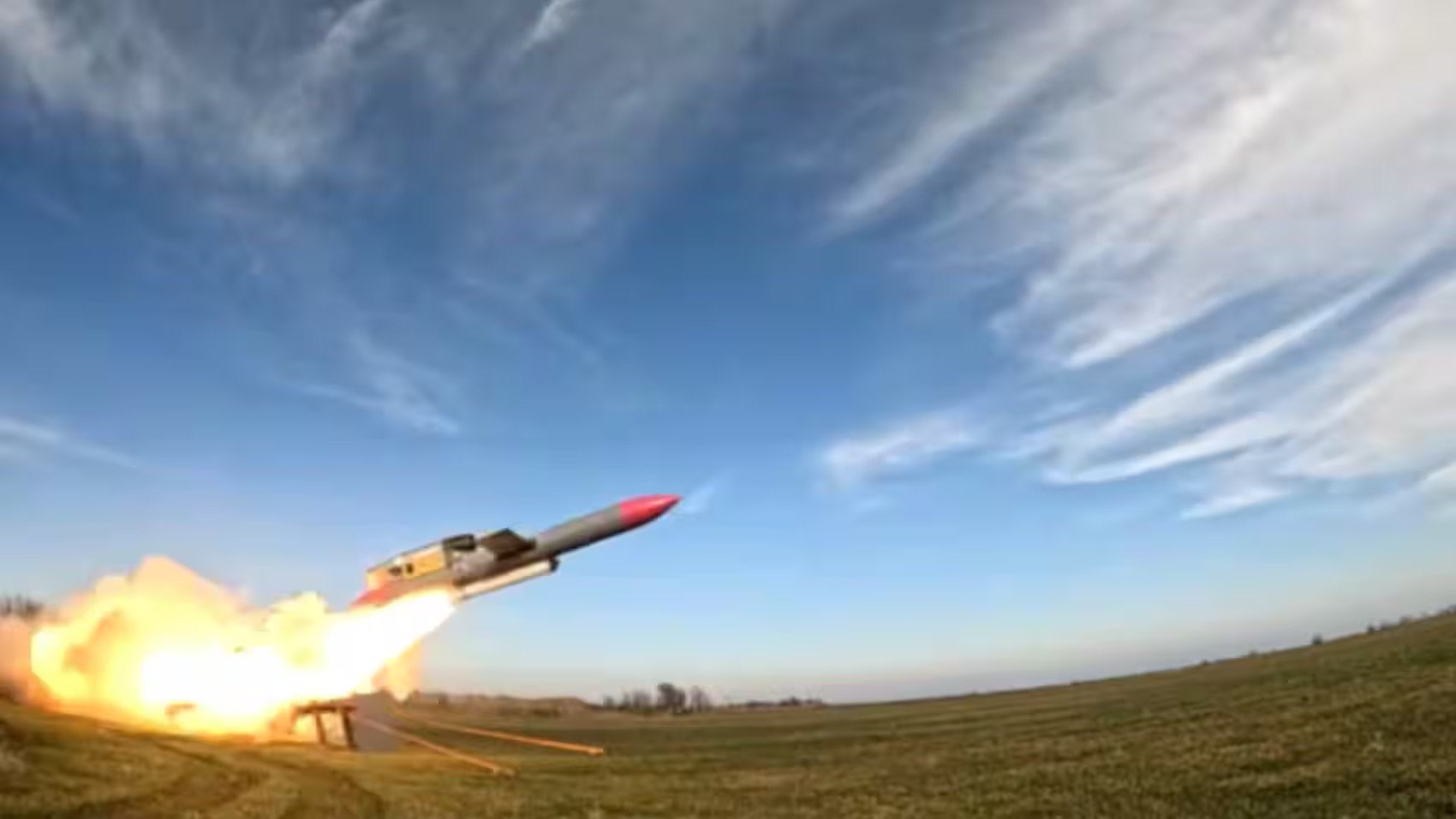
The Flamingo performs precisely the role for which heavy subsonic aircraft are designed — approaching industrial targets in formation, exploiting their vulnerability to disruption and shutdown. The zone of total destruction from its one-tonne warhead — equivalent in destructive power to two half-tonne FAB bombs — extends to 30 metres. The zone of severe destruction, where overpressure can penetrate solid brickwork, collapse floors and reduce hangars to rubble, reaches 100 metres. In practice, this is sufficient. In an electro-stamping workshop such as those used for Iskander production, such a strike would likely ignite fires fuelled by titanium powder, industrial lubricants and specialised chemicals.
In Kotluban, at the arsenal, rockets ignited and began to detonate following a similar strike. At the FSB border post near Armyansk, a headquarters building was hit, shearing off the corner where communications antennas were located, with debris falling onto nearby vessels. That alone is enough to paralyse operations at such a facility.
Admittedly, it is a heavy missile, clearly visible on radar and, in theory, should be intercepted. However, in practice, even light aircraft carrying improvised payloads and operating on autopilot should also be shot down — yet they are not. The same applies to the old Soviet Strizh drones: large, highly visible targets that nevertheless manage to reach airfields associated with the nuclear triad in Saratov.
The pattern is clear. Over the course of a week, strikes systematically targeted the Leningrad Region, including three ports handling gas and oil transhipments — fires there reportedly remain uncontrolled. Now, a further strike has reached a location more than a thousand kilometres to the south, on the Volga.
A vast theatre of operations creates persistent challenges. Redeploying limited air defence assets between St Petersburg, Moscow and Belgorod is inherently difficult. Distinguishing between decoy systems such as MALD — capable of generating electronic interference — and an actual Flamingo missile adds further complexity. Combat operations are difficult by nature, particularly when losses accumulate: in one week alone, 17 air defence systems and a dozen observation posts — ranging from lookout positions to radar stations and divisional command posts — have reportedly been destroyed.
The defence forces struck directly at the city’s industrial hub, where two major defence enterprises — PromSintez JSC and Polymer JSC — are located behind a single perimeter. Governor Fedorishchev, however, promptly adopted a dismissive tone, claiming the attack had been ‘unsuccessful’ and caused no damage. Yet local residents had already circulated footage of the strikes, and from early morning police blocked access from Lenin Street leading to the industrial sites. Such extensive cordoning suggests the damage was far from negligible.
To understand why Chapaevsk represents such a significant target, it is necessary to consider its macroeconomic role, allocated budgets and logistical importance. Promsintez is one of the principal and oldest manufacturers of industrial explosives in Russia and the CIS. The enterprise produces TNT, RDX, ammonium nitrate and nitrobenzene. The neighbouring Polymer facility uses this raw material to manufacture munitions. In other words, this cluster supplies the essential military-grade chemicals used to fill aerial bombs and missiles. There may be hundreds of thousands of empty cast-iron shells in the Russian Federation, but without explosives from Chapaevsk they are little more than inert metal.
The strategy of targeting bottlenecks and striking critical nodes appears to be yielding results. High-value assets have been affected — from a 200-million-rouble icebreaker to major processing facilities, military chemical production and a key oil terminal that has reportedly been burning for several days. These are costly and difficult to replace.
This leads to the central issue: the scale of the losses. In recent years, approximately 4.7 billion roubles were reportedly invested in the modernisation and development of the Chapaevsk priority development zone, aimed at expanding production capacity and logistics around this chemical cluster. Promsintez itself generates around 2.5 billion roubles in annual revenue, underscoring the high value and specialised nature of the facility.
The site contains complex nitration reactors, imported cooling systems and advanced automation equipment. Damage from a one-tonne warhead is therefore not limited to structural destruction that can be quickly repaired. Rather, it involves the loss of specialised equipment, the replacement of which — under sanctions — would cost billions of roubles and require months, if not years, to procure via indirect supply channels. It is highly likely that such critical damage has occurred.
Equally notable is the consistency of the strikes. Promsintez was targeted just a week earlier, on 22 March, when drones penetrated the roof and caused a fire. The strike was not random: it hit the area of Workshop No. 3 — a central part of the plant. In the summer of 2023, this same workshop was the site of a nitrogen pipeline explosion during repairs, which killed six workers. It is a key synthesis line. The earlier strike appears to have served to probe air defences, disrupt production and confirm targeting coordinates. The subsequent missile strike has now reinforced that effect.
Striking a chemical plant more than a thousand kilometres from the border with heavy weaponry, and systematically degrading critical TNT production lines, reflects a broader strategy focused on logistics. While tactical advances on the battlefield may continue, the destruction of essential explosive production has the potential to constrain them over time.
Heavy missile warfare across a vast theatre — larger than the European Union — continues, and losses are being incurred on both sides. However, strikes are increasingly directed at strategically important industrial facilities. At the same time, there are indications that comparable facilities on the opposing side remain largely beyond reach. This is reflected in the growing frequency of long-range strikes, including the use of Neptune and Flamingo systems, alongside large-scale drone operations reportedly involving up to 250 UAVs per night, as well as damage to high-value assets in the Baltic region.