





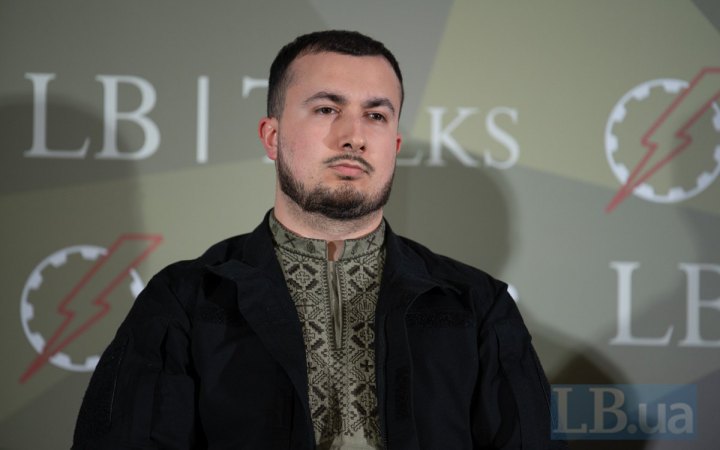
Volodymyr Zelenskyy has appointed Davyd Aloian, Deputy Secretary of Ukraine’s National Security and Defence Council, as head of the Interagency Commission on Military-Technical Co-operation Policy and Export Control. The relevant decree was signed by the President on 15 September 2026.
The interagency commission is a working body under the NSDC that co-ordinates the activities of executive authorities in the field of state export control and military-technical co-operation.
In particular, as part of exporting Ukrainian weapons to partner-country markets, the Interagency Commission on Military-Technical Co-operation reviews applications from defence companies to supply their products abroad. One of the commission’s key areas of work is also co-operation with international partners within the Drone Deal framework.
“In this context, the Drone Deal is one of the practical mechanisms for developing Ukraine’s defence industry abroad — through the procurement of Ukrainian weapons, joint production and long-term technological co-operation,” the NSDC notes.
Previously, the commission was headed by Yevhenii Ostrianskyi, whom Zelenskyy appointed to the post on 3 December 2025.
What We Know About Davyd Aloian
In 2021, Davyd Aloian earned a Master’s degree in International Economic Relations from the Vadym Hetman Kyiv National Economic University. While studying, he was engaged in entrepreneurial activity. He later worked at the Kyiv branch of the American logistics company Everest TS LLC.
In 2021, he joined the team at Ukraine’s Ministry for Strategic Industries. He progressed from lead specialist in the department for investment attraction, public-private partnerships and state investment projects to acting head of the Directorate for European and Euro-Atlantic Integration and Multilateral Co-operation.
In April 2025, he was appointed Deputy Minister for Strategic Industries of Ukraine for European integration, where he oversaw issues related to the development of the defence-industrial complex, production localisation, international co-operation and strategic planning.
On 8 September 2025, Aloian was appointed Deputy Secretary of the NSDC of Ukraine.
As a reminder, on 1 July the Cabinet of Ministers adopted a resolution intended to launch an accelerated procedure for exporting weapons. However, as of today, the process has still not been launched. Arms manufacturers are still waiting for the Ministry of Defence to provide a list of critical items that cannot be sold abroad, and manufacturers still do not understand how the Drone Deal procedure — which was supposed to set the framework for which countries weapons can be sold to — will work.
In particular, Ihor Fedirko, Executive Director of the Ukrainian Council of Arms Manufacturers, claims that as of August 2026, since the resolution was adopted, the private defence sector has concluded only up to ten small export contracts. In addition, he says, only one joint venture of a Ukrainian manufacturer abroad is actually operating. At the same time, under the mechanism provided for by Resolution No. 875, as of August not a single permit had been issued.
The Council of Arms Manufacturers also believes that provisions on the export permit fee require revision, including its advance payment even before the contract is fulfilled, as well as conditions that create barriers to test shipments. According to the organisation, the permit fee may amount to 20–30%.
In an interview with LB.ua, Anastasiia Mishkina, Executive Director of Technological Forces of Ukraine, an association of private defence-technology manufacturers, also stressed that the rate for Ukrainian arms exporters is far too high.
Read alsoForces Ukraine executive director on broken fast track and expectations from Defence Ministry
“20–30% of the value of an export contract is too much and economically unjustified, in our view. An overwhelming majority within TSU has said the rate should be zero. The so-called fast track decision was meant to make exports administratively easier, but these rates make them economically unprofitable. Because the price on the global market is set not by the manufacturer but by the market and competition. And this additional fee eats up all the earnings, and the contract is highly likely to go to another manufacturer. In other words, through our own regulations we are giving competitors abroad a price advantage,” she said.
Mishkina added that the association proposes setting a zero rate at the outset, and before introducing any other rate, first calculating possible scenarios.