





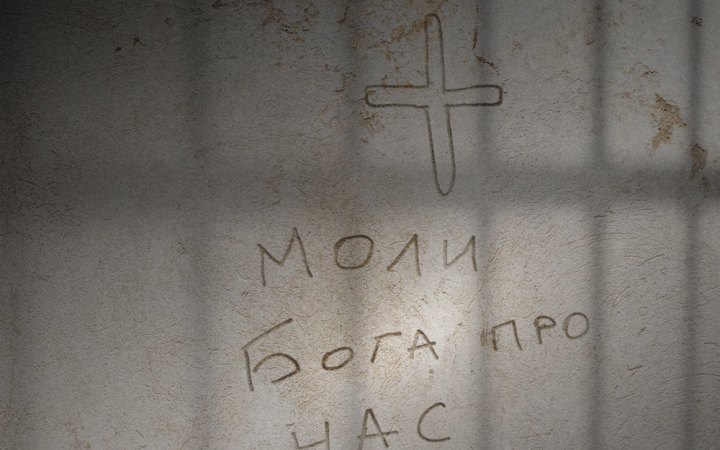
After the start of the full-scale invasion, Russian occupation forces and affiliated armed formations of the so-called LPR/DPR significantly intensified religious persecution of clergy and worshippers in the temporarily occupied territories. Victims are unlawfully imprisoned, subjected to sexual and psychological pressure, tortured, while churches are closed and looted; Ukrainian dioceses are forcibly merged into the Russian Orthodox Church or simply destroyed.
This is stated in a report, “Who Is Your God? Religious Terror in the Temporarily Occupied Territories”, prepared by teams from the International Partnership for Human Rights (IPHR) together with the NGO Truth Hounds.
The study is based on the results of 12 in-depth interviews with clergy who faced persecution during the occupation, as well as 21 interviews with civilians who witnessed or were directly affected by religious terror, mostly in Kharkiv and Kherson regions.
Most of the interviewed respondents among religious figures represented the Ukrainian Orthodox Church (UOC, Moscow Patriarchate) and the Orthodox Church of Ukraine (OCU); one was a representative of the Evangelical Christian Baptists (ECB) community. Eight interviewees were imprisoned in 11 places of detention in the occupied territories of Kherson and Kharkiv regions, Crimea and Russia.
Eight of the 12 interviewed religious figures experienced unlawful detention, groundless searches, torture and varying degrees of psychological pressure because of their religious activity and affiliation. As the study notes, some clergy were taken directly from places of worship. These detentions were often accompanied by physical violence.
“I saw them (Russian soldiers) running onto the church grounds through the main entrance. There were six or seven of them. I didn’t make out who they were — special forces or the National Guard (units of the Russian forces). They ran up to me and pointed assault rifles at me. First they told me to lie on the ground, then to stand up. When, in response to their phrase ‘call the priest’, I said it was me, one of them hit me in the head with his rifle. A Buryat (a Russian soldier of Asian appearance) shouted that I wanted to open UNA-UNSO here, and that my wife wanted to run a Ukrainian home school. And he hit me in the head again with tactical gloves. Then they put a bag over my head, handcuffed my hands behind my back and led me to the car,” — from the testimony of an affected UOC priest from Kherson region.
Read also“Behind the wall, women screamed and children cried”
Seven of them were subjected to physical violence used by Russian soldiers to punish, intimidate, humiliate, and force clergy to cooperate, renounce their clerical rank and their beliefs. In most cases they were beaten with hands, feet and improvised objects, and electric shocks were used. These forms of physical pressure were often combined.
“They shocked me again. And then he [a Russian soldier] told me to write to dictation. He dictated — I wrote. When it came to renouncing my rank, I told them it was a sham and that this letter had no force. But they didn’t care,” — from the testimony of an affected archdeacon of the UOC MP from Kherson.
In addition, five of the 12 interviewed clergy were subjected to conflict-related sexual violence (CRSV). They reported threats and attempted anal rape using foreign objects.
“They had an artificial phallus on the shelf. It looked like something from sex shops; it was big, about 20–25 centimetres — exaggerated, flesh-coloured, maybe pink-beige. They threw me on the floor and started pulling my trousers down, unfastened my belt. I realised they were going to rape me. I begged them not to do it. They lifted me up and sat me down. They said now I should tell the camera about the children of Donbas,” — from the testimony of an affected archdeacon of the UOC MP from Kherson.
The occupation forces persecuted not only religious figures, but also worshippers and volunteers who helped the local population with humanitarian needs. Churches often became hubs for such gatherings, where people could receive food, medicines, hygiene products and other basic necessities. However, as the report notes, this activity was also persecuted by the occupiers.
Thus, a resident of Kherson who cooked food and cared for animals at a humanitarian hub based at an evangelical church was imprisoned for 60 days. During interrogations, Russian soldiers questioned her about her faith and her work in the church.
According to another woman’s testimony, the church also sheltered children from an orphanage, whom Russian soldiers later returned to the institution. Later, some of the children were taken to other occupied territories and to Russia.
The second part of the report discusses faith as “the last available means of psychological self-regulation, inner support and resilience in conditions of complete uncertainty and fear for one’s life, the horror of physical and psychological suffering, and the inability to protect oneself and control the situation” for civilian detainees who are not religious figures and do not identify their affiliation with any particular religious denomination. Interviewed respondents told researchers that words from prayers were often scratched into cell walls, or that when someone was taken for interrogation, other victims would begin praying for him/her. And Russian soldiers often used this faith in God as a tool of pressure and intimidation.
For example, the report mentions cases in which occupation forces made them pray aloud before mock executions or physical violence.
“They took us out of the city, started pulling us out one by one, cutting the tape off our hands, lined everyone up and said: ‘pray, you bastards’,” — from the testimony of a victim from Kherson.
As the report notes, the documented and analysed cases are not isolated excesses. The nature of the events, their systematic character and scale point to a deliberate policy by the occupation authorities aimed at establishing total religious control and eliminating “undesirable” religious communities in the temporarily occupied territories.
As the report’s conclusions state, Russian occupiers “carry out truly shocking, in their cruelty, forms of physical and psychological violence against the spiritual leaders and worshippers of these communities. IPHR interviewees who were affected suffered beatings, strangulation, electric shocks, sexual violence, as well as threats of maiming, rape and death. They were imprisoned in inhuman conditions without access to a toilet and hygiene products, adequate food, water and medicines, in an atmosphere of uncertainty, fear and total violence…” In addition, “Russian occupation forces used the victims’ faith in God and religious beliefs as a tool of psychological pressure, intimidation and humiliation”.
The authors of the report indicate that such actions violate international humanitarian law and fundamental human rights, including freedom of religion, freedom of expression, and the prohibition of torture.
“Depending on the circumstances of specific episodes, they may also constitute war crimes and crimes against humanity, such as persecution, unlawful deprivation of liberty, torture, rape and other forms of sexual violence, inhuman treatment, outrages upon personal dignity and the looting of property,” the human rights defenders conclude.
The interviews were conducted by documenters from the civil society organisations IPHR, Truth Hounds, Blue Bird, YurFem and Fight for Right during 2023–2026.
The report will be presented on 9 November at 16:00 at the Sheptytsky Centre of the Ukrainian Catholic University, Lviv.