





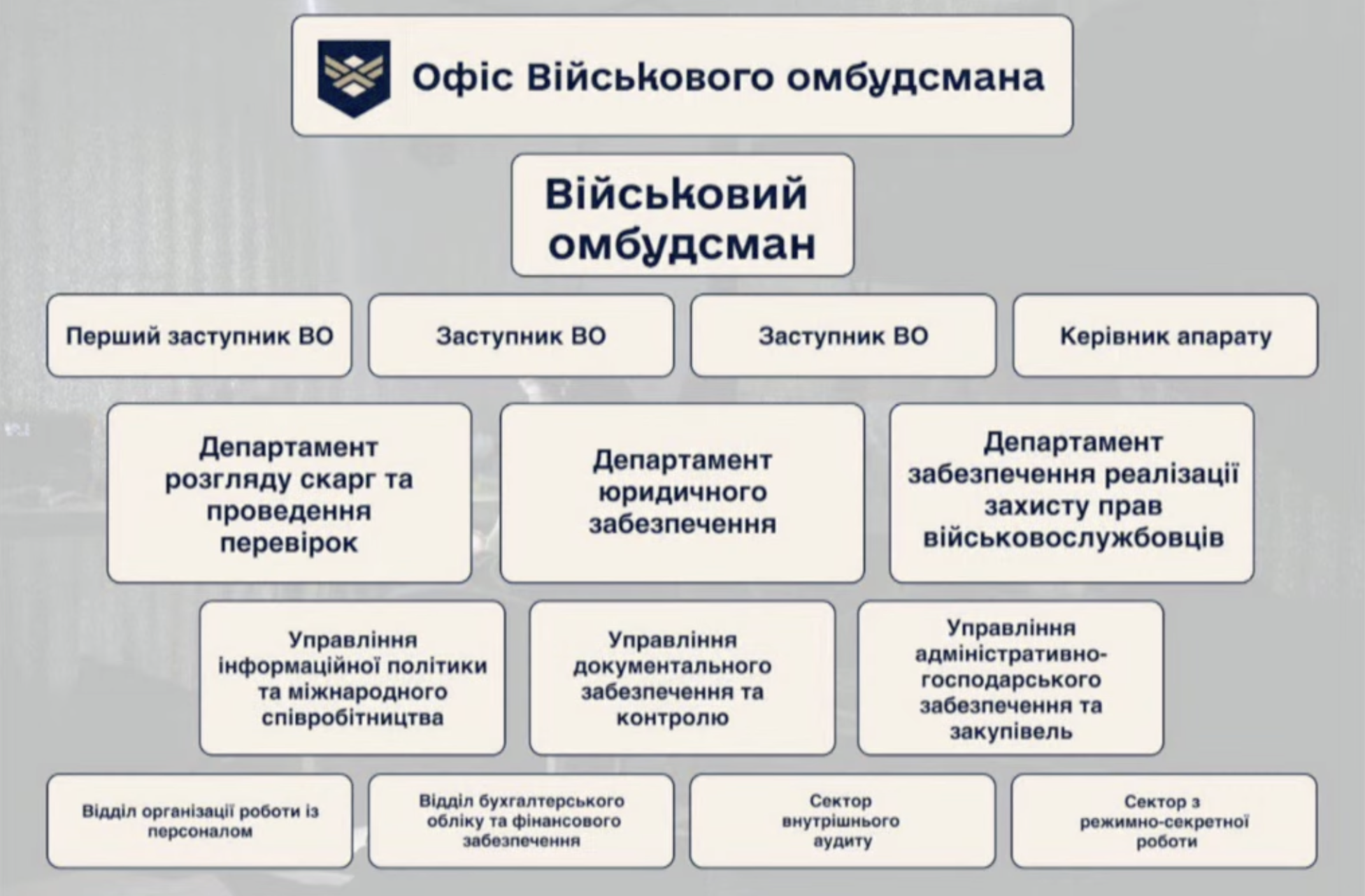
What will the structure of the Office be and how many people will work there?
The structure will look like this. However, Olha Reshetylova does not rule out that it may change over time, as some departments will have a significantly heavier workload than others.
Currently, the Office can afford to employ about 80 people, while it needs 150.
“Like other institutions and authorities, we are working with a limited budget. This year, the Office has 43 million hryvnias less than we requested. This means that we will not be able to recruit the maximum number of staff,” explained the military ombudsperson.
The Office plans to request changes to the budget, as there is a lot of work to be done, according to the head of the Office. On Saturday and Sunday alone, the team received 320 requests. On average, Reshetylova says, they receive 110-130 requests every day. They expect that after the launch, there will be even more.
What is the difference between a Presidential Commissioner and a Military Ombudsman?
“The Presidential Commissioner is essentially an adviser with a consultative role. Back then, we opened an email inbox and tried to process appeals, passing information [to senior command] and studying systemic problems,” Reshetylova explains.
The Ombudsman’s Office will consider complaints, not general appeals. It has 10 days to review them. In cases involving a threat to a serviceman’s life or health, the deadline is three days.
How inspections will be initiated
After reviewing a complaint, the Office may initiate an inspection if necessary. According to Ruslan Tsyhankov, First Deputy Military Ombudsman, the inspected party, a military unit or a military governing body — will be formally notified of this decision.
Inspections may be either on-site or remote.
“During inspections, we have the authority to access the necessary documents and inspect locations. This can be compared to how internal service inspections are conducted within the Ministry of Defence,” Tsyhankov said.
The standard inspection period is 30 days, with a possible extension to 60 days.
“Such cases will be very rare. The law allows this only when we are dealing with a long-term, systemic issue that requires in-depth analysis,” the First Deputy noted.
The final conclusions are forwarded to the military unit or the relevant military authority so they can respond and address the problem.
What happens if a military unit does not respond?
Under the law, the Military Ombudsman should be able to hold officials administratively liable through the courts.
However, parliament has not yet passed the legislation granting these expanded powers.
“This law has been blocked by a large number of amendments from MPs. Many of them have nothing to do with the Military Ombudsman’s Office or the rights of servicemen. MPs are trying to resolve their own interests here,” Reshetylova said.
What leverage does the Office have now, without the administrative liability law?
Administrative liability is a last resort, the Military Ombudsman says. Officials also face reputational risks.
“That is exactly what they should be trying to avoid,” Reshetylova stressed.
At present, the Office’s main tools are advocacy and oversight, ensuring that senior command takes note of conclusions and that they are actually implemented.
“There are negative examples — commanders who deliberately refuse to comply with the Ombudsman’s decisions because they believe they are ‘the law and God’. Senior command has questions for such commanders, but no personnel decisions have yet been made. Once we have the appropriate instruments, it will be our task to hold them accountable,” she explained.
Tsyhankov added that the team can also refer materials to other institutions and use mechanisms beyond administrative liability.
“So I don’t think this will be a major problem for now. Until the law is adopted, we will use other existing legal instruments,” he said.
Who can file complaints with the Military Ombudsman’s Office?
The primary subjects of the law are servicemen themselves and issues related to their military service, Tsyhankov emphasised.
Complaints may be submitted by servicemen, as well as by members of other law enforcement agencies involved in combat operations, and by legal representatives of servicemen.
The law does not cover issues concerning family members of servicemen unless they directly affect the serviceman’s rights or conditions of service.
“However, we understand that some coordination will still take place in the interests of family members. We will respond, propose legislative initiatives, or resolve issues on a case-by-case basis,” Tsyhankov explained.
Where to submit a complaint
Complaints are currently accepted via email at [email protected].
A chatbot is expected to launch soon. A hotline is planned by March.
The Office is also in contact with the developers of the Army+ app to enable complaints to be submitted there as well.
“We ask for patience and a bit of trust. We are working at full capacity. Not everything can be done instantly,” the Military Ombudsman added.