







The Ukrainian Arms Council together with CORE Team recruitment company publish a systematic study of the labour market in Ukraine’s defence industry. The survey covers 27 manufacturers. Key findings:
The market grows
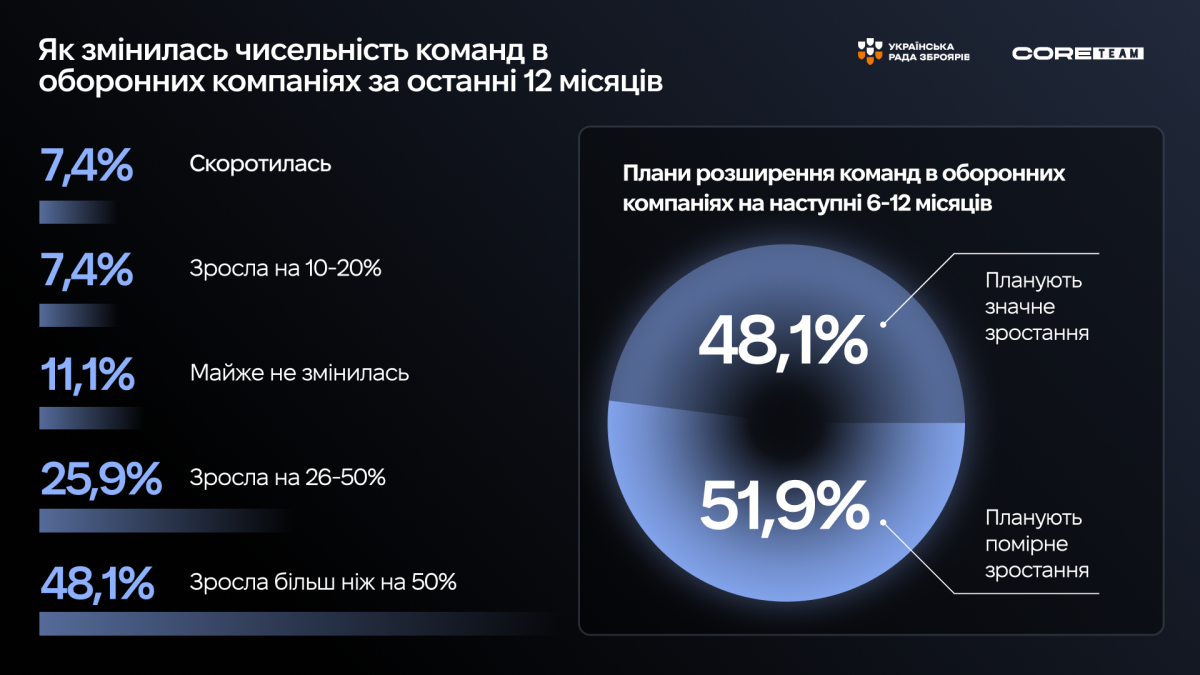
74% of surveyed companies grow by at least 25% over the past 12 months, and nearly half - 48% - double or more. None of the 27 companies plan to freeze hiring.
According to CORE Team, employment in defence tech increases by 2–4 times compared to the start of the full-scale war. The fastest growth happens in UAV, electronic warfare, and ground robotic systems segments.
100% of surveyed companies plan to hire in the next 6–12 months.
But people are still in short supply
89% of companies revise salaries over the past year, with a typical increase of 10–20%. However, none report that hiring becomes easier afterward.
52% say hiring becomes harder, while another 37% see no improvement.
The main issue is not salaries, but a shortage of qualified professionals: 44% of companies identify this as the core problem. Another 33% cite competition between companies for the same limited talent pool.
The median time to fill a technical vacancy is 1–2 months, while about 30% take longer.
Read alsoA constant engineering race: How Ukraine’s DefenseTech labour market works — and whether open exports can help
Most in-demand roles
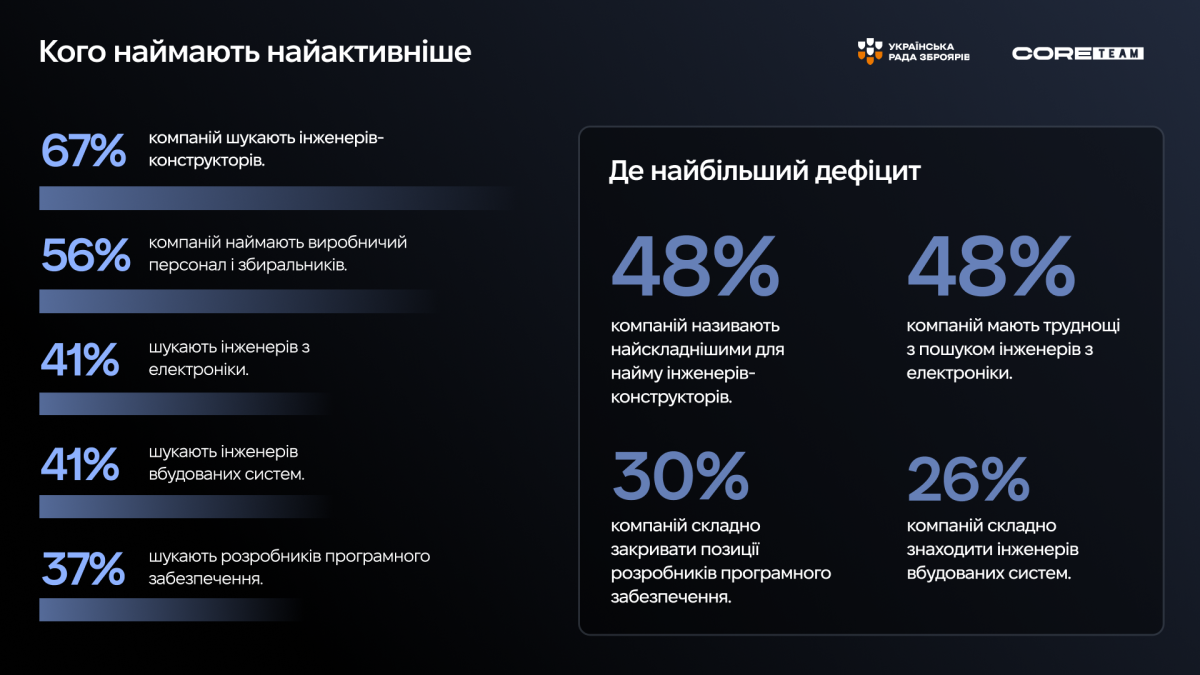
Design engineers and electronics engineers are simultaneously the most popular and the most shortage-hit roles: every second company names them as the hardest to hire. According to Work.ua data cited in the study, only 9% of defence industry vacancies are suitable for people without experience, compared to 45% across the general labour market.
Reservation as the dominant motivation
One of the key findings is the shift in motivation. As one respondent noted: “In 2023 it was about idea and mission; now it is primarily about having military reservation.”
74% of companies use reservation as an employment incentive. According to Work.ua, 9 out of 10 defence industry vacancies include it, while across the wider market it appears in only 12%.
Competitive but uneven salaries
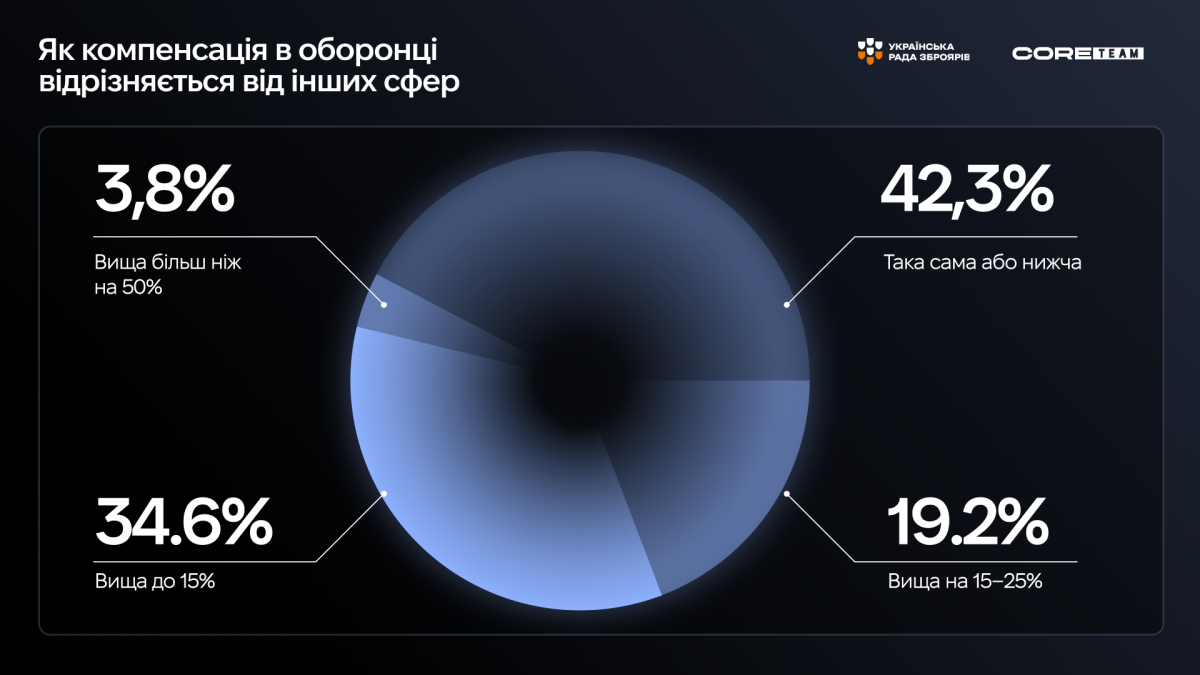
42% of companies pay at or below market level. Pay is concentrated in narrow niches: embedded systems, electronics, and RF/EW engineers. According to CORE Team, embedded and RF/EW engineers earn $4,000–8,000.
What the market needs
Two equally critical needs, each cited by 56% of respondents: more engineers and more predictable demand for orders. 48% call for stronger cooperation with universities, while 41% want more retraining programmes.
At the same time, according to Work.ua data, only 9% of defence industry vacancies are suitable for candidates without experience, compared to around 45% across the general labour market.
As LB.ua reported earlier, universities still lag behind the market, forcing companies to train and develop talent internally.