





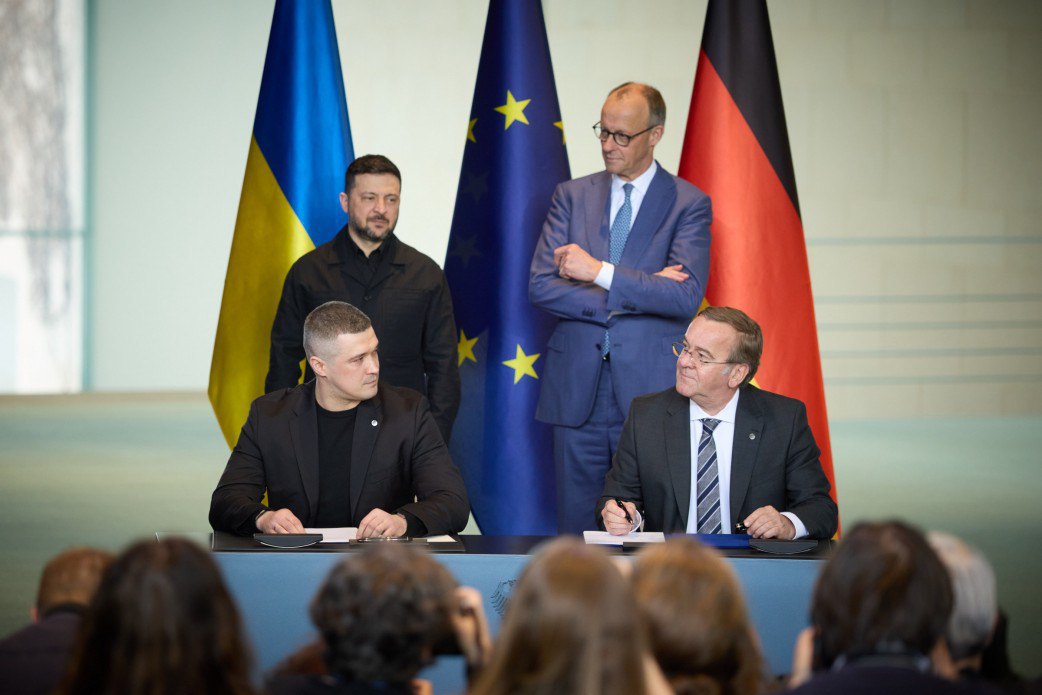
Germany has allocated €281 million for the joint production of the Anubis unmanned system and its counterpart, the Seth-X-G. German officials have spoken of “thousands of units” without providing specific figures.
If the budget is divided by the planned volume, the cost of a single drone comes to between €50,000 and €100,000, depending on the configuration and the share of more advanced versions with a range of up to 1,600 km.
What’s under the bonnet?
Anubis is not just another “flying moped” assembled from garage parts. It is a full-fledged light cruise missile for the budget-conscious that has gained the intelligence of very expensive Western systems.
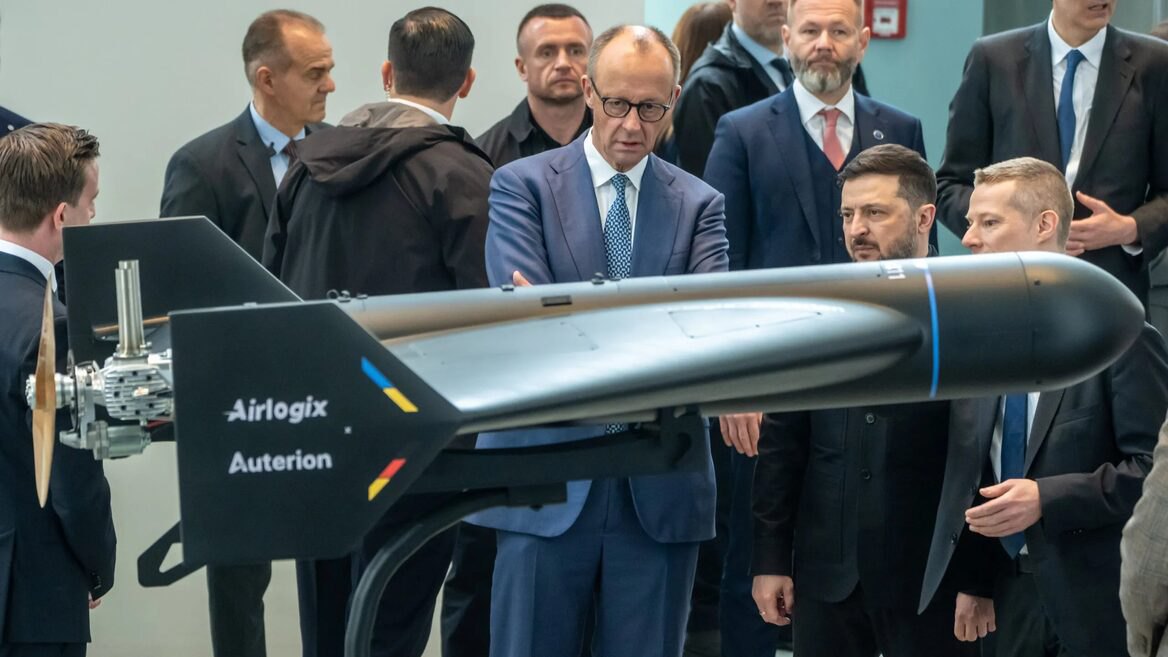
The development was made possible through collaboration between the Ukrainian company Airlogix and the Western software giant Auterion, which specialises in drone software. The main advantage of this drone is its complete autonomy on the final leg of the flight.
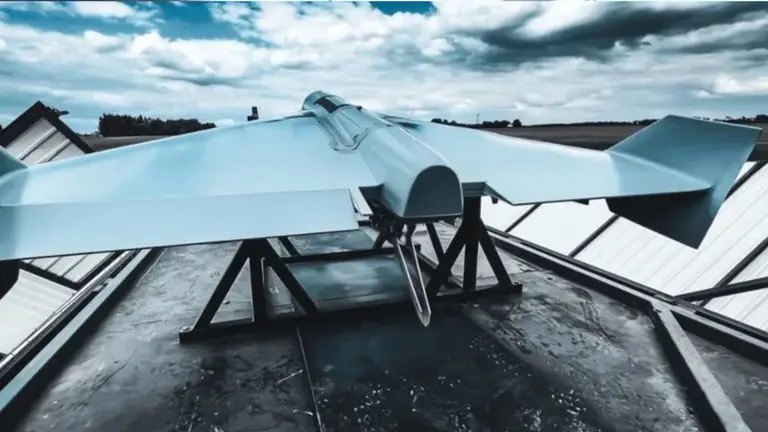
The UAV locates the target using its electro-optical station, locks on, and performs a guaranteed dive attack — even under complete radio-electronic jamming.
The drone’s airframe uses an X-wing or delta-wing configuration and was designed according to the “stealth for the poor” principle. Special composite materials and an optimised aerodynamic shape keep its radar signature to a minimum.
To older Russian radars it appears as an ordinary bird, while even modern radars that do detect it often have too little time left to intercept.
The warhead of the drone deserves special attention. It carries up to 45–50 kg of explosives, while the most advanced versions have a strategic range of up to 1,600 kilometres.
Such a warhead can do much more than shred an antenna with shrapnel — it is capable of piercing the reinforced roof of a command post or turning an arched aircraft shelter into a blazing inferno. This gives significant tactical flexibility: Ukrainian forces can strike deep in the operational rear and overload Russian air defences over strategically important facilities.
Hunting for UAV Operators
Limiting Anubis solely to destroying air defence systems would be a serious underestimation of its capabilities. In recent times, this weapon has been used with exceptional precision against pinpoint targets in urban areas and field shelters.
Recently, the Ukrainian Unmanned Systems Forces released striking footage from the Zaporizhya direction. An Anubis drone struck precisely on a Russian reconnaissance drone operators’ position. The Russians have learned to hide their crews in basements or on the ground floors of sturdy concrete buildings, placing antennas on the roofs. Conventional artillery often only destroys the upper floors and peppers the antennas with cluster munitions, leaving the operators alive. Thanks to its machine vision, Anubis can fly directly into the correct window or doorway. A thermobaric or high-explosive blast in a confined space leaves no chance for either the control equipment or the crew. This is highly effective work that instantly blinds the Russian army across the entire sector of the front.
How They Break the Air Defence Umbrella
The true effectiveness of Anubis is shown in swarm tactics that follow a strict echeloned structure. The first stage is opening the air defence umbrella. Cheap decoy drones similar to MALD are sent into the sky to simulate a missile corridor. Their sole task is to imitate a massed attack, forcing Russian Pantsir, Tor and Buk systems to activate their radars and expend their ammunition.
Read alsoA patched-up quilt of Russia’s air defence: why the country’s skies have turned into a sieve
As soon as Russian air defence systems light up on radio reconnaissance screens and fire their first salvos of missiles, Anubis drones quietly enter the battle. They fly at extremely low altitudes, hugging the terrain folds, and strike directly at radars and launchers that have dropped their guard. This is classic suppression of enemy air defences (SEAD). Once the eyes and teeth of the Russian air defence umbrella are completely burnt out, the main wave of Ukrainian long-range drones calmly flies through the breach. They head hundreds of kilometres deep into Russian territory to set ablaze oil depots, alcohol plants, facilities producing special fats, and military-industrial complex workshops.
Production Base Beyond Reach of Any Iskander
The most impressive aspect of this story is the logistics and localisation. The Russian army attacks Ukrainian industrial zones with ballistic missiles almost every night in an attempt to stop weapons production. With the Anubis project, this tactic will not work.
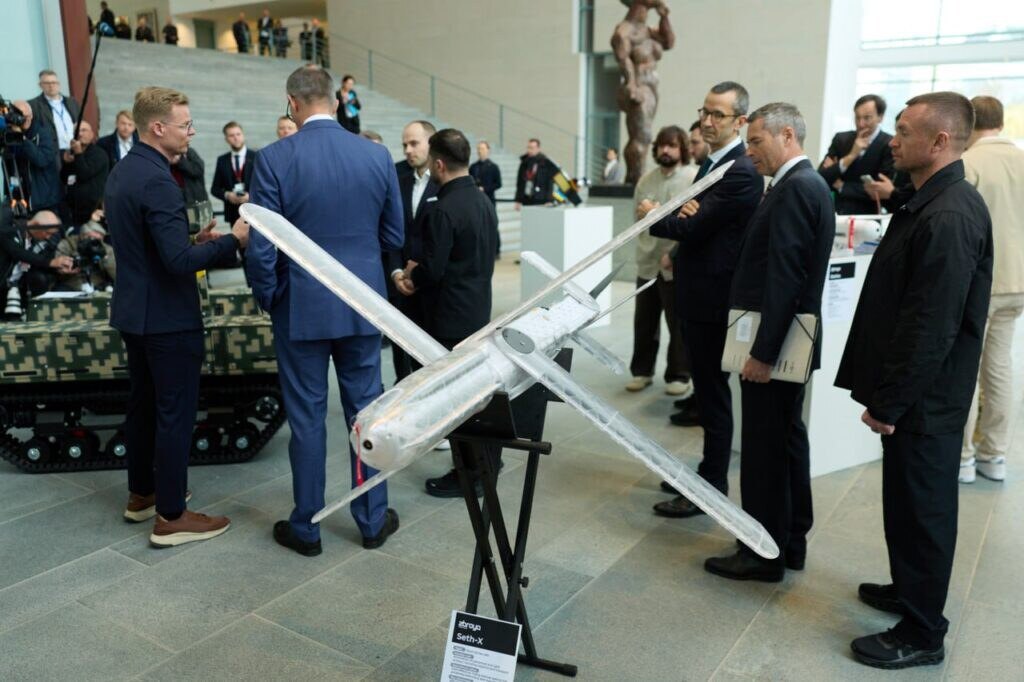
Serial production of these drones has been fully relocated to Germany. In February 2026, the joint venture Auterion Airlogix Joint Venture GmbH was established. Recognising the potential of this weapon, Berlin has already funded and contracted the production of thousands of these drones for the needs of the Ukrainian Defence Forces.
The production line, capable of delivering thousands of units per year, is located under the reliable protection of NATO and German export legislation. Russian Iskanders and Kinzhals simply cannot reach it. Even if they could, a strike on German territory would mean the guaranteed entry of the Alliance into the war.
Ukraine has secured an uninterrupted supply channel of high-tech weapons, protected at 100%.
The Arithmetic of Attrition
The most satisfying aspect of this technological war is its economic dimension. One S-400 surface-to-air missile costs over a million dollars. A Pantsir missile costs tens of thousands. The production cost of a single Anubis is roughly in the same range as a Pantsir missile, yet the strategic damage it inflicts is far greater. While Russia’s economy has been in decline for the past year, the EU remains stable and continues to increase defence spending.
When the Russian army is forced to expend million-dollar missiles to intercept the drones — often unsuccessfully, as shooting down a composite, highly autonomous UAV is extremely difficult — it is effectively bankrupting itself. Ukraine is pushing Russia’s air defence system into a deep financial and logistical deficit, rapidly depleting stockpiles that the Russian military-industrial complex cannot replenish quickly enough due to sanctions on critical microelectronics, strikes on explosives and solid fuel production, and attacks on electronics factories.
Anubis has become an effective tool for breaking Russia’s A2/AD (anti-access/area denial) system. While Moscow presents its leadership with optimistic graphs showing an “impenetrable shield” over the country, these drones are systematically destroying Russian air defence systems in the operational rear and eliminating UAV operators in grey-zone areas. This is precisely why we are seeing such major fires at oil refineries and defence plants more than 1,000 kilometres inside Russian territory. And these strikes will only intensify as mid-strike capabilities continue to scale up with European production.