






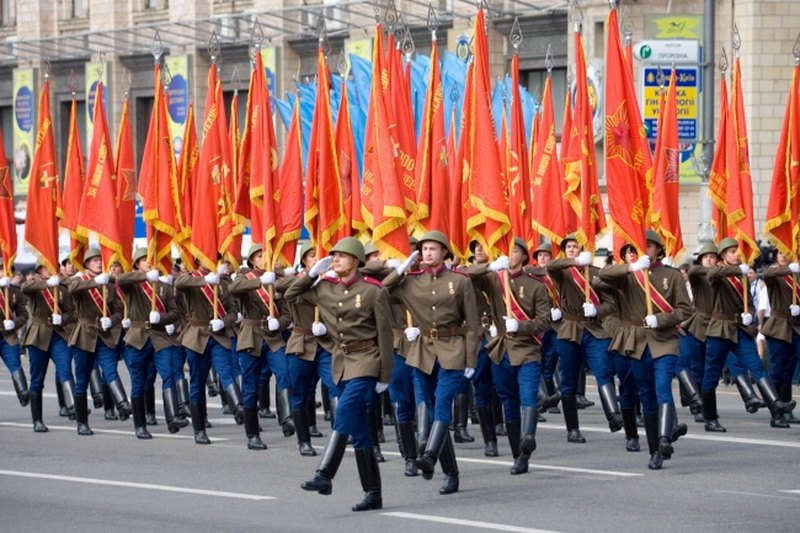
A date separate from the rest of the world
Soviet myth-making began with the date marking the end of World War II. In Europe, that date is 8 May. In the USSR and modern Russia, it has always been the following day — 9 May.
Yet the Berlin garrison surrendered on 2 May, and combat in the German capital ended that same day, including fighting around the Reich Chancellery, which had already been captured by the Red Army. Germany’s surrender itself took place on 7 May at 2:41 a.m. at Allied headquarters in Reims.
The following day, on 8 May at almost 11 p.m., the Act of Unconditional Surrender was signed in a suburb of Berlin by German Field Marshal Wilhelm Keitel. In Western historiography, Keitel’s signature is regarded as the ratification of the document drafted the previous day in Reims. That is why Europe commemorates the ratification date.
As for the actual end of World War II, it came on 2 September 1945, when the act of Japan’s surrender was signed aboard the American battleship USS Missouri (BB-63) in Tokyo Bay.
Interestingly, after Germany’s surrender, the USSR never formally signed a peace treaty with Germany, meaning the war technically continued. Only on 21 January 1955 did the Presidium of the Supreme Soviet of the USSR adopt a resolution formally ending the state of war.
So why, among such a range of dates, was 9 May declared “Victory Day”?
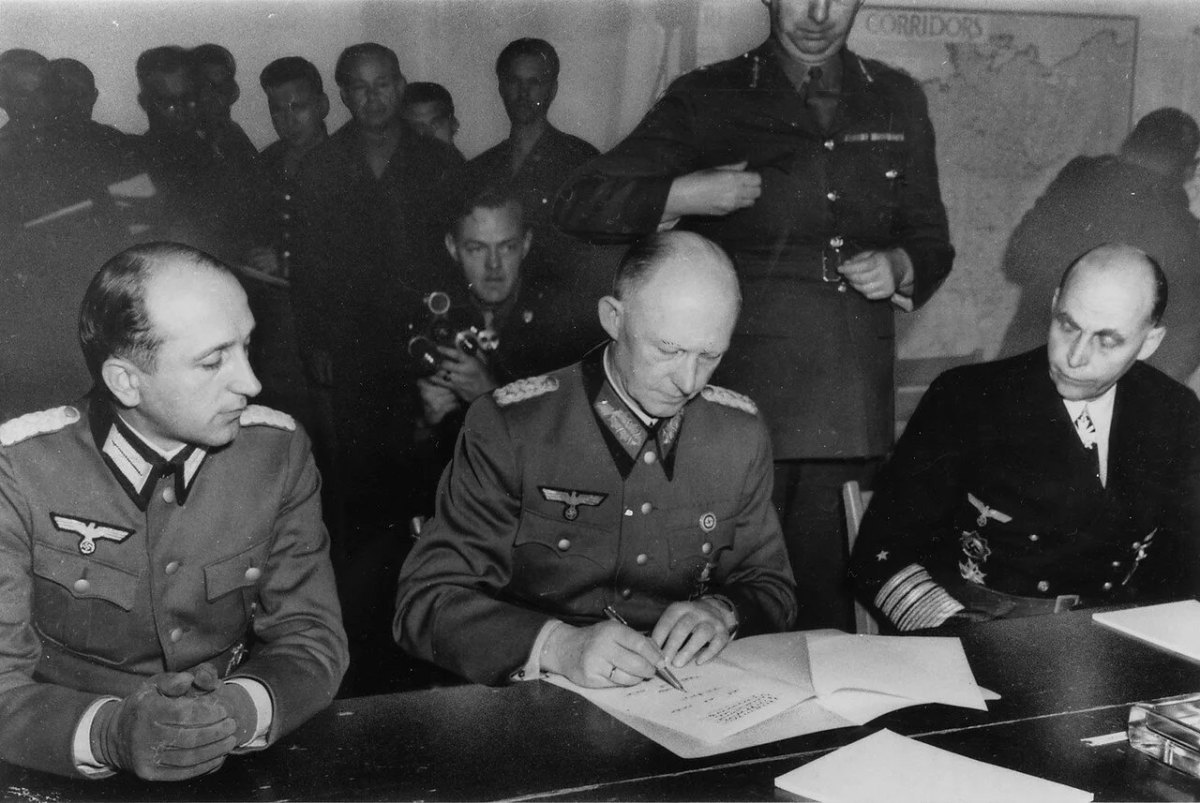
“By a resolution of the Presidium of the Supreme Soviet of the USSR, 9 May was declared the official Victory Day. That is how the date entered both Soviet historiography and the Soviet calendar. There are several explanations as to why 9 May was chosen instead of 8 May. One is that a new day had already begun in Moscow when Germany’s act of surrender came into force and news of it reached Soviet territory. The same happened with Japan’s surrender. It took place on 2 September, but in the Soviet Union it was announced on the 3rd. I think this is largely explained by how the Soviet bureaucratic apparatus functioned,” comments Yana Prymachenko.
But the issue was not merely bureaucratic. According to Prymachenko, having a war-ending date separate from the rest of the world also aligned with Soviet ideology, which was built around the idea of the Soviet Union’s exceptionalism. The USSR was a country where the Bolshevik coup of 1917 was treated as the beginning of a new historical era. Victory over Nazism likewise had to be distinct — unlike anyone else’s, including in the calendar itself. This framework fit neatly with the idea of Russian messianism revived during the 1941–1945 German-Soviet war. As a result, the USSR distanced itself from its allies and the rest of the world by choosing to celebrate victory on 9 May.
Brezhnev and his “spiritual staples”
Initially, the Supreme Soviet of the USSR established two public holidays: 9 May as Victory Day over Nazi Germany and 3 September as Victory Day over Japan. Those exact formulations appeared in the official decree. However, by 1947, both dates had become ordinary working days again.
9 May was restored as an official holiday in 1965. On 8 May that year, a ceremonial gathering took place in the Kremlin, where General Secretary Leonid Brezhnev delivered a speech about the Soviet people’s great victory. From then on, 9 May was elevated to the central event of the Soviet historical calendar.
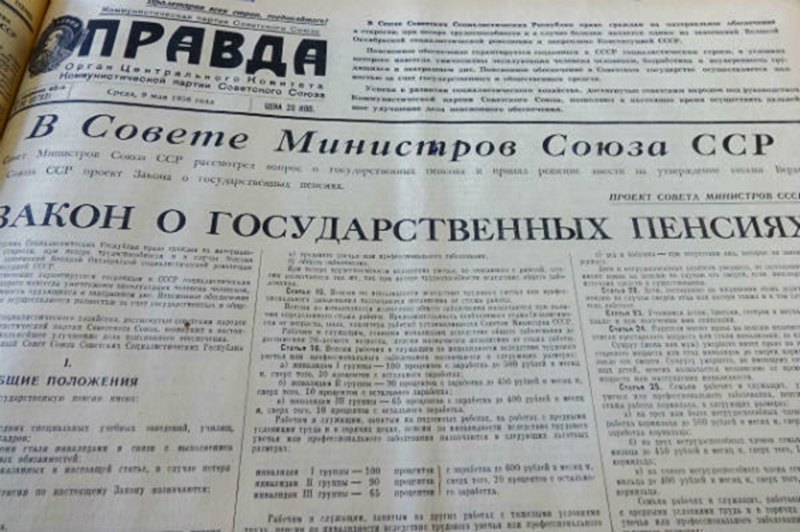
As for 3 September, the date faded into obscurity. “The Far Eastern segment of the war was far less prominent in public discourse and was mostly studied by historians. Soviet society was deliberately discouraged from focusing on victory over Japan because it had been secured by the atomic bombings of Atomic bombings of Hiroshima and Nagasaki carried out by the United States. That marked the beginning of the nuclear era, and ideologically it was inconvenient for the USSR to draw attention to the fact that America had possessed a military advantage,” the historian explains.
Brezhnev’s speech proclaimed a course toward building a “new historical community — the Soviet people”. At the same time, a strategic decision was made to construct this “Soviet people” identity specifically around 9 May. Why? Because the pre-war history of the Soviet Union was associated with famine, brutal labour and mass repression. The achievements of collectivisation and industrialisation remained questionable given the human cost they demanded. In essence, the USSR’s only truly significant contribution to world history was presented as victory over an absolute evil — Nazi Germany. That victory carried global significance, and the Soviet Union used it as major political capital.
In his speech, Leonid Brezhnev listed all 15 Soviet republics and stressed that the victor in the war was the Soviet people, united thanks to the “wise Leninist national policy”. Around such narratives — and around the date of 9 May itself — a new Soviet identity began to take shape. The Russian Civil War was unsuitable for this role because its course differed too greatly across the vast territories of the former Russian Empire. “That is precisely why a new date and a new reference point were needed. Every nation has such a reference point, often called a ‘founding myth’. For the USSR, that ‘founding myth’ became the Victory — with a capital V! — and 9 May acquired a sacred meaning,” says Yana Prymachenko.
The countries of the so-called Eastern Bloc, which were forced to adopt communist ideology after 1945, largely followed the Soviet line. The only leader to pursue a relatively independent policy from Moscow was Josip Broz Tito. Even he, however, aligned himself with the USSR on matters related to victory celebrations and 9 May commemorations. To this day, 9 May continues to be observed in Belarus, Georgia, Moldova, Kazakhstan, Kyrgyzstan, Armenia, Uzbekistan, Tajikistan, Turkmenistan, Azerbaijan, as well as in Serbia, North Macedonia and Bosnia and Herzegovina.
Only recently — during Russia’s full-scale invasion — did Ukraine fully break with the Soviet tradition. Since 2024, Ukraine has marked only one date: 8 May as the Day of Remembrance and Victory over Nazism in World War II.
“Generals’ truth” versus “frontline truth”
In the early 1950s, war invalids — the Soviet-era term for disabled veterans — disappeared from the streets of Moscow and Leningrad. This primarily affected large cities open to foreign visitors. The reason was simple, though chillingly pragmatic: disabled veterans did not fit the image of the triumphant Soviet soldier-victor.
People with amputations and severe injuries, especially those without relatives to care for them, were sent to institutions in remote northern regions and Siberia. The most infamous facility was located on Valaam Island in the northern part of Lake Ladoga. There, in former monastery buildings, war heroes whose lives and health had been sacrificed for victory spent their final years.
“Utilitarian attitudes toward people were typical of the Soviet totalitarian regime, which valued only the strong and healthy. Human beings were treated as just another resource, like minerals. The Soviet system viewed anyone who could not be used as labour negatively,” notes Yana Prymachenko.
Former Red Army soldiers who had lost all their limbs and were completely incapacitated were cruelly nicknamed “samovars” in these institutions. Staff treatment was often horrific. For example, residents could be taken outside for fresh air and then left in the rain or wind. Mortality caused by neglect in such facilities was high, but Soviet authorities showed little concern.
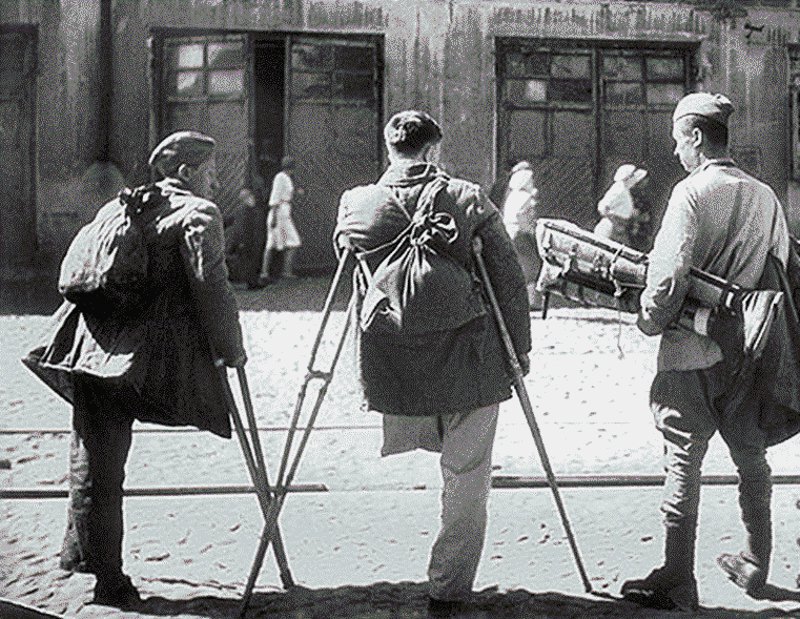
War invalids were an unwelcome reminder of the price the USSR had paid in World War II — or rather, the price Soviet citizens had paid for Stalin’s so-called “military genius”. That is why, in 1947, 9 May was stripped of its holiday status and once again became an ordinary working day. The country lay in ruins, millions never returned from the war or came back physically and psychologically scarred, and countless children had lost their parents. The regime preferred not to remind people of the bitter cost of this victory.
Moreover, Soviet soldiers had seen Europe firsthand. The contrast between living standards there and the supposed “communist paradise” was striking. Meanwhile, the USSR entered another period of ideological tightening: the Zhdanovshchina campaign targeted artists and intellectuals, while the fight against “rootless cosmopolitanism” intensified. Soviet Jews were spared further repression — including the notorious Doctors' plot, in which Jews were the primary accused — only because of Joseph Stalin’s death in 1953. Until then, veterans and Soviet society, which had endured the hardships of war and hoped for liberalisation, received a clear signal: no change was coming. The Soviet regime had no intention of making concessions.
When 9 May celebrations returned after 1965, the commemoration was built not around repentance or remembrance of the dead. “Despite the symbolic minute of silence and flower-laying ceremonies at the ‘eternal flame’, the military parade remained central. True, it was not held every year. But in any case, the ‘frontline truth’ of ordinary soldiers gave way to the ‘truth of the generals’, who interpreted events in a format convenient for the authorities. By then, the generation that had directly fought in the war was gradually disappearing — either dying or simply growing old,” says Yana Prymachenko.
She adds: “After 1945, the USSR had more than ten thousand Heroes of the Soviet Union. There were also many recipients of the Order of Glory — a decoration for privates and sergeants that stylistically resembled the Cross of Saint George. Incidentally, this similarity was no accident. Stalin skillfully incorporated Russian imperial symbolism into Soviet discourse. The Order of Glory was awarded for exceptional bravery on the battlefield, and its recipients enjoyed enormous public respect. Interestingly, on 9 May 1945 another award was established, also resembling the Saint George cross stylistically, called the ‘Medal for Victory over Germany in the Great Patriotic War of 1941–1945’. This medal was most commonly awarded to employees of the NKVD,” the historian explains.
The “frontline truth” about the war functioned in the USSR as a form of counter-memory opposed to official memory, around which an entire ideological infrastructure had been built. Soviet dissidents adopted this counter-memory in the 1960s. Among them was Viktor Nekrasov, author of In the Trenches of Stalingrad, written as truthfully as the conditions of the time allowed. Yet resisting a totalitarian state remained extraordinarily difficult in any case.
“Soviet Nike”
Yana Prymachenko offers the following observation: “The communist regime replaced religion itself. It had its own ‘holy trinity’ — Karl Marx, Friedrich Engels and Vladimir Lenin. There was worship of sacred relics and pilgrimage: anyone visiting Moscow was expected to visit the Mausoleum containing Lenin’s body. The Party demanded fanatical faith in communist ideals and sacrificial devotion… There was even its own ‘god’ — the ‘father of nations’, Generalissimo of Victory, Comrade Stalin. After Stalin’s death and the denunciation of his cult of personality, the place of ‘god’ remained vacant. In the 1960s, it was occupied by a kind of Soviet Nike — the Great Victory, with its own apostles: nameless soldiers lying in mass graves.
At the same time, the special value of these soldiers lay precisely in the fact that they were dead. That meant the state could speak on their behalf, having appropriated the symbolic capital of victory over Nazism and created a quasi-religious cult. For any army in the world, identifying a fallen soldier remains a priority because the memory of that person belongs to the family. In the Soviet Union, however, individual memory was expropriated, and the ‘unknown soldiers’ became a kind of Gogolian dead souls, serving the cult of victory.
The cult of victory was also reinforced through memorial mass graves in many Soviet cities and the almost ubiquitous eternal flame. The idea behind this symbolism emerged within the Soviet Communist Party apparatus, though it drew on much older international practices. For example, the first monument to an unknown soldier was erected in Denmark in 1849.
In its more modern form, however, the eternal flame and the image of the unknown soldier were borrowed by Soviet authorities from European memorial traditions. Today, the oldest Eternal Flame is considered to be the one at the Tomb of the Unknown Soldier beneath the Arc de Triomphe in Paris. It was lit in 1921 in honour of those killed in World War I.
Military parades were popular and frequently staged in the USSR during the 1920s and 1930s. But the annual 9 May military parade was actually a post-Soviet innovation. During the Soviet era, parades were generally held once every five years for major anniversary dates. These occasions were also typically marked by the release of a new landmark war film. Cinema, in fact, played a central role in sustaining the cult of victory.
Over time, however, society began to tire of it all because the holiday’s meaning had been completely hollowed out. The sense of purpose and sacredness disappeared, leaving only ritual behind. By the mid-1970s — quite soon after Leonid Brezhnev’s landmark speech — public attitudes toward events dedicated to 9 May had become purely formalistic. By that point, the cult of victory had effectively run out of steam.
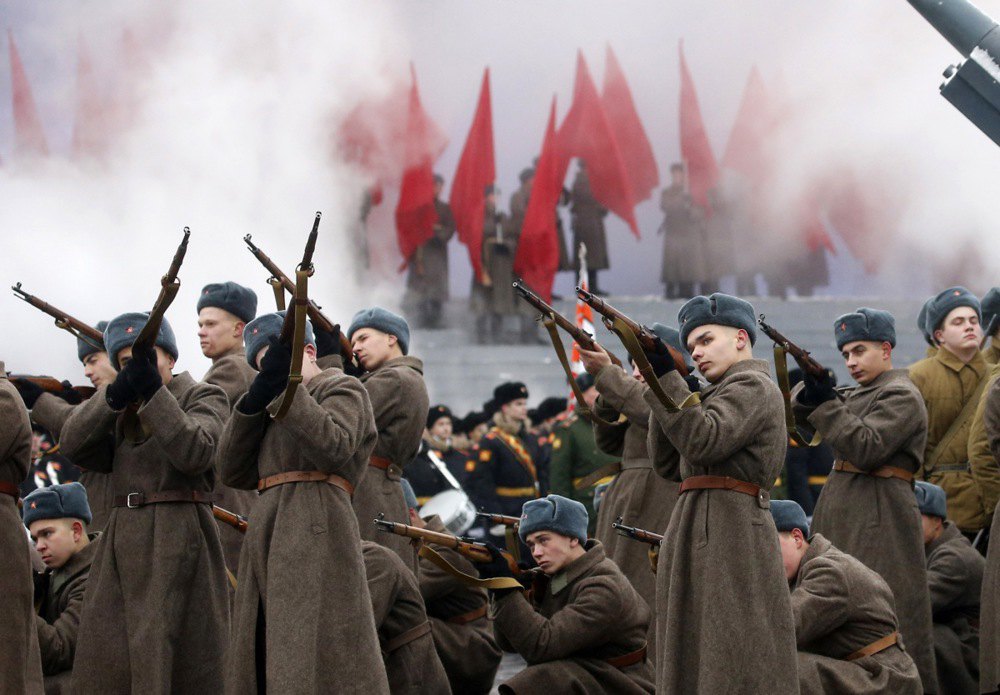
Beginning in 2005, Russia revived the old ritual — based on Soviet templates, but reimagined through a postmodern lens. During this period, Russia once again aggressively promoted the victory cult. The spread of Saint George ribbons, for example, served as a reminder to the West of who had supposedly defeated Nazi Germany. Of course, this was manipulative, because victory over Nazism was the result of the collective efforts of the Allies: the USSR, the United States, Britain and France. But this inconvenient truth was simply discarded by Putin-era propaganda.
In contrast to official state ceremonies, the Immortal Regiment march emerged in Russia in 2012 as a grassroots initiative. Its aim was to oppose individual memory to pompous and depersonalised parades. Instead of participating in the carnival-like “victory frenzy”, people were encouraged to carry portraits of relatives killed in the war and join a mourning procession. It was, in essence, an attempt to return memory of the dead to families — metaphorically, to give a name back to the “unknown soldier”. Yet this initiative, which initially carried a certain oppositional undertone, was soon absorbed and completely distorted by the Russian state machine.
Read alsoHistorian Volodymyr Vyatrovych: Stopping the Russian military is the key lesson from World War Two for today’s free world
Still, we should not care what rituals the enemy chooses to follow. As Viktoras Muntianas, Speaker of the Lithuanian Seimas from 2006 to 2008, once aptly said: “For us, 8 May is the day of victory over fascism, while 9 May is the day the Soviet occupation began.” Having survived three Holodomors and lost millions to repression and war, Ukraine could easily subscribe to those words — at least regarding part of its territory.
For us, however, Soviet occupation belongs to the past. Now we must defeat the Russian one wherever it still exists — and overcome a modern form of fascism that, in the best traditions of dystopian regimes, disguises itself as its very opposite.