





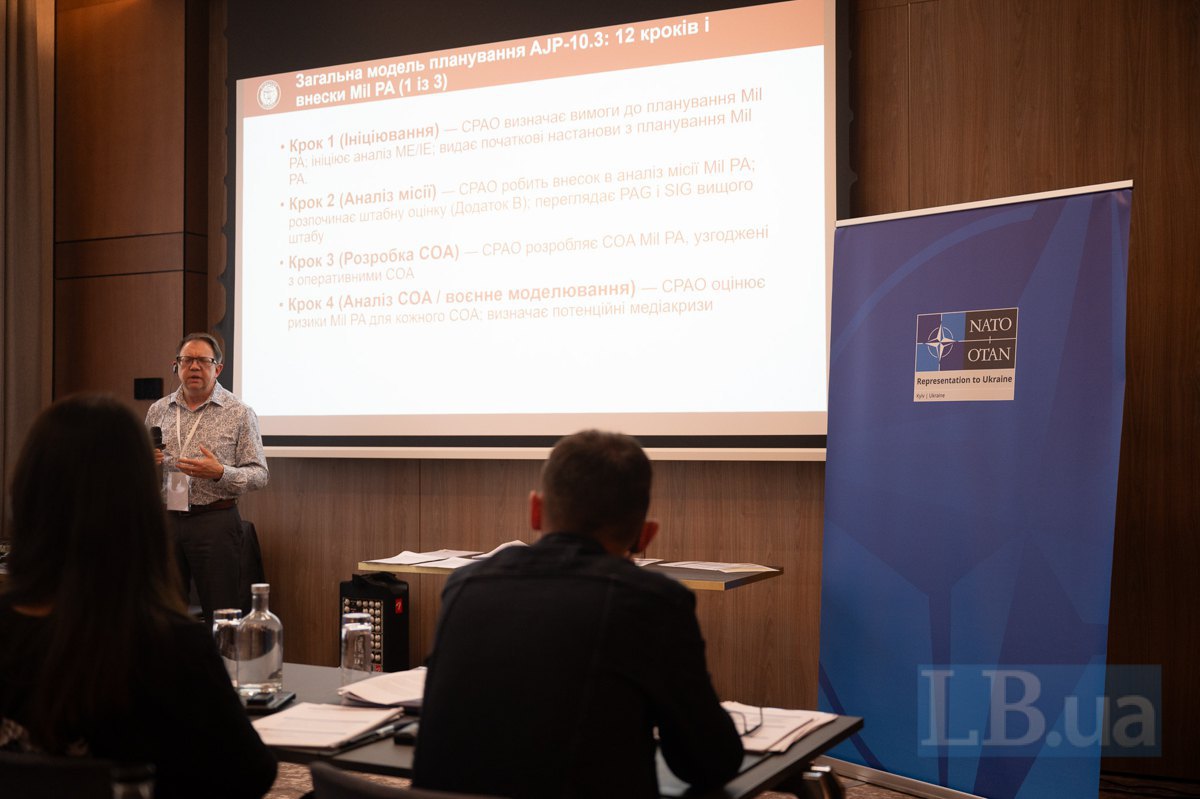
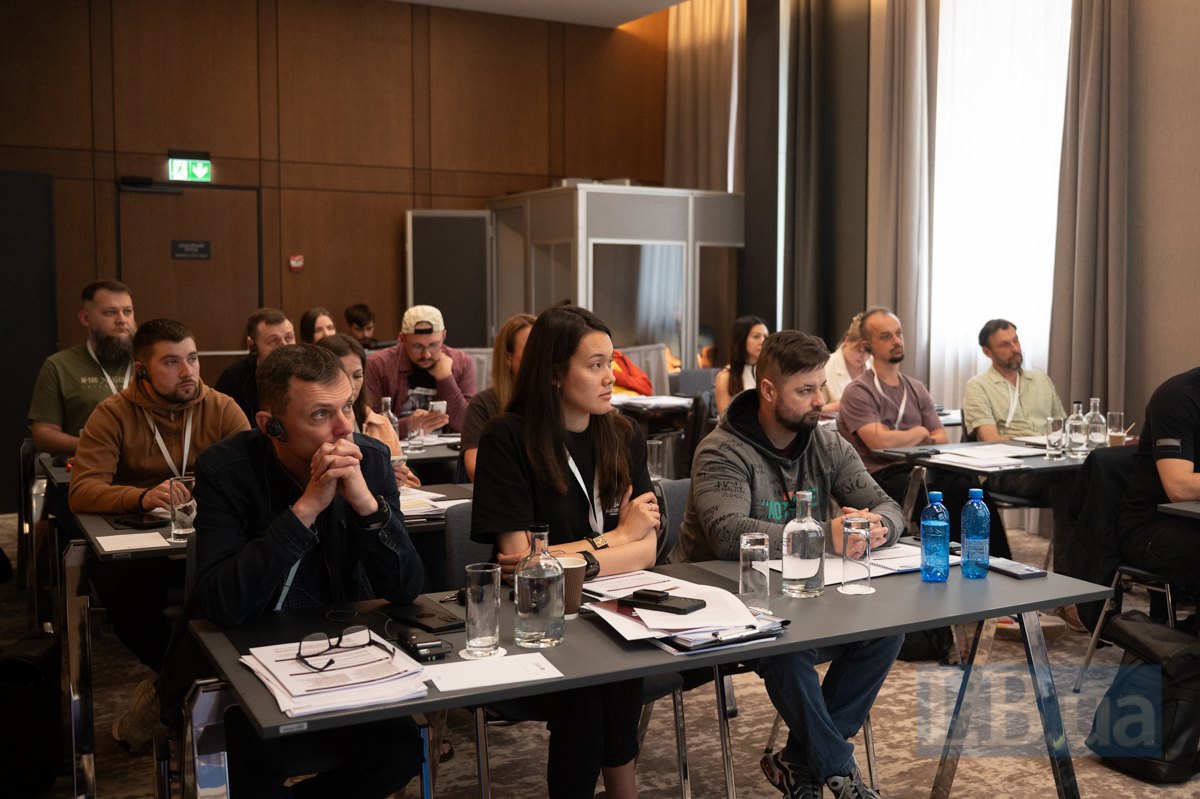
This is the first course in a project that will run over several years. The training programme is funded through the StratCom component of NATO’s Comprehensive Assistance Package for Ukraine. Participants were delegated from units of the Army, the Marine Corps, the Unmanned Systems Forces, the National Guard and other branches. In the future, Ukrainian military educational institutions will be able to organise similar courses independently for their cadets.
Participants are taught the fundamentals of military public affairs work: writing press releases, preparing spokespersons for interviews, conducting interviews, preparing for press conferences, communicating during crises, and producing video and written content. However, this is a NATO course. A significant proportion of Defence Forces press officers are former civilians from diverse professional backgrounds, and not all have prior experience in communications. As a result, different brigades and branches of the Defence Forces often employ different communications approaches, the Ministry of Defence explains. Some focus on advertising-style campaigns and large-scale formats, whilst others prioritise operational reporting videos. These differences often reflect the participants’ civilian professions before joining the military — whether they worked in marketing, public relations, journalism or design.
Joint training with NATO is intended to add standardised and effective information tools to the pressure exerted on Russia on land, at sea and in the air, according to the project’s co-authors at the Ministry of Defence.
“If information is a weapon, then we must use it against the enemy professionally to achieve specific goals,” the Ministry of Defence told us. “Previously, there was only one introductory public relations course. We have now launched a series of courses covering the key areas of strategic communications: strategy, communications planning, content production and distribution, and information environment analysis.”
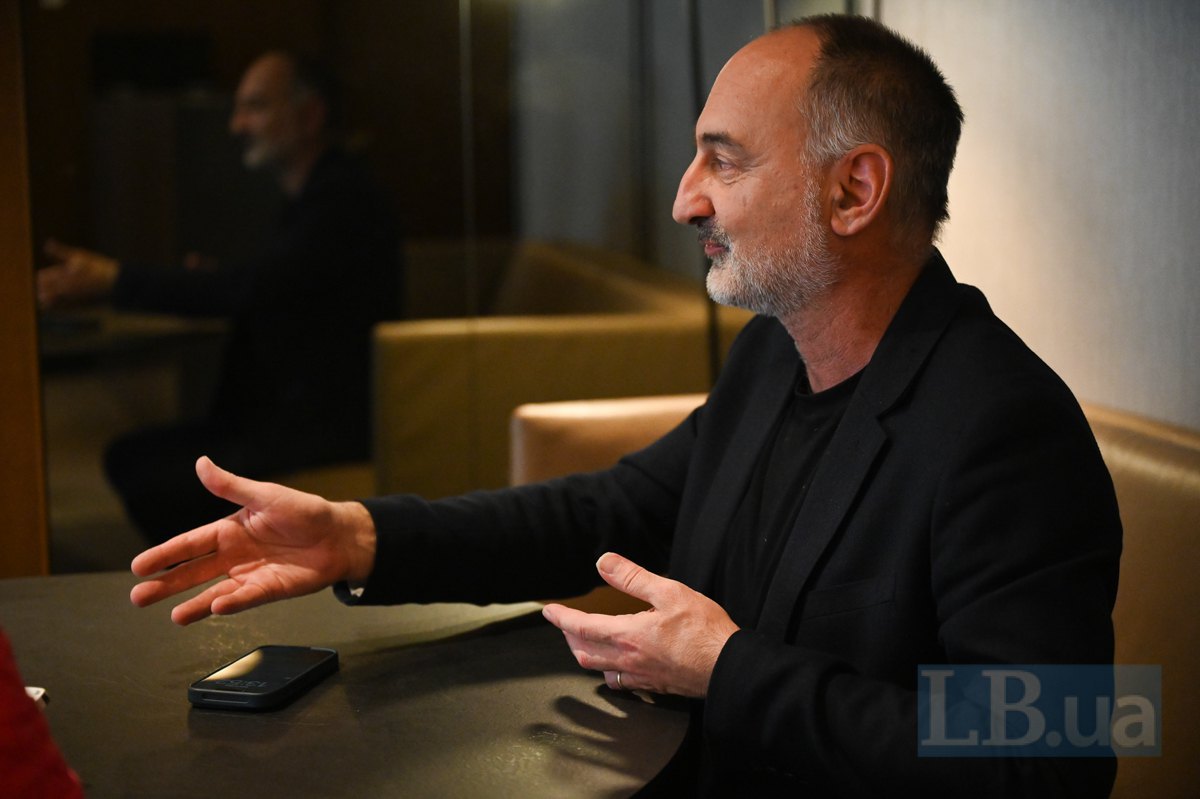
A few questions for Peter Clark, co-organiser of the training in Kyiv and Dean of Academic Affairs at the Academy of Strategic Communications.
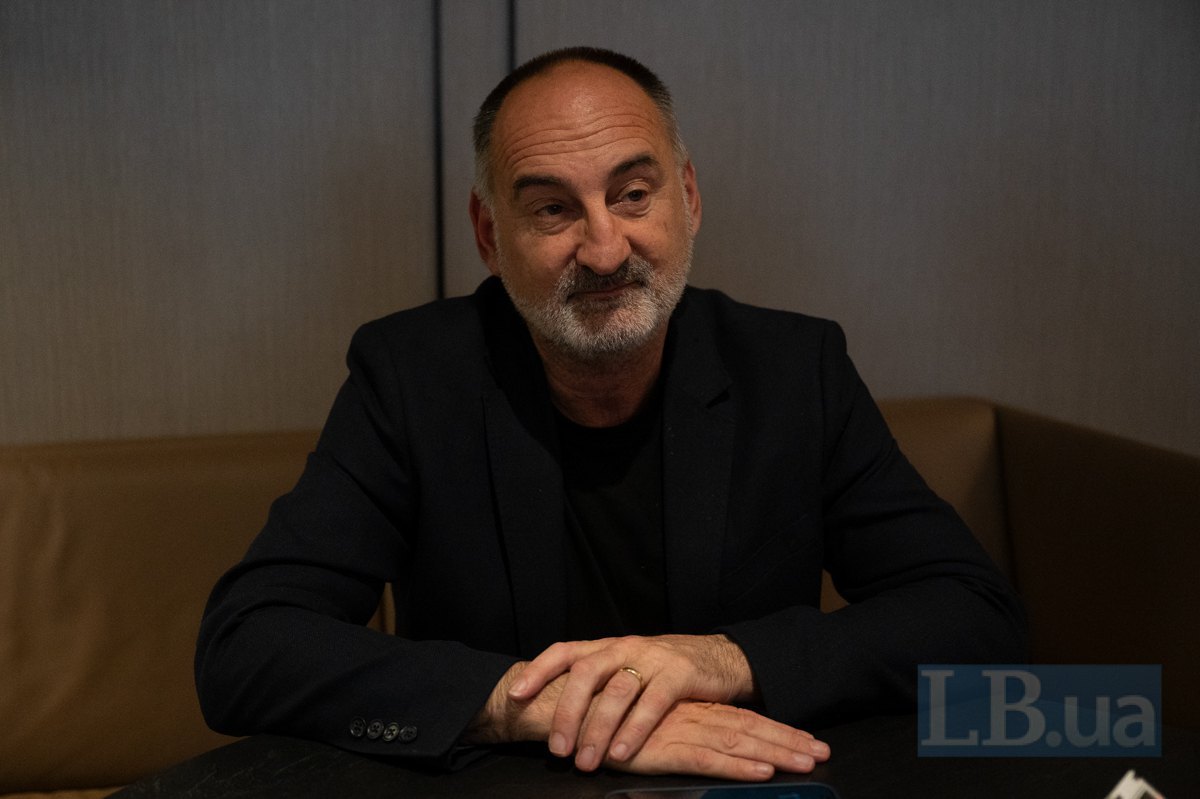
— Mr Clark, why does NATO need this?
— The Allies understand how important Ukraine is to Europe’s defence. And the struggle is not confined to the battlefield. Information operations are an integral part of efforts directed not only against Ukraine but also against the West because of its support for Ukraine. The narrative that Ukraine is losing and Russia is winning is far removed from reality. Ukraine is already highly experienced in operating in the information environment at the tactical level — perhaps even more so than NATO. It has learned this through hard experience. However, when it comes to structures, processes and coordination that can make these efforts more effective, NATO believes it has valuable expertise to offer.
This is a mutually beneficial partnership: on the one hand, NATO contributes its structures and coordination mechanisms; on the other, Ukraine provides experience gained on the battlefield. To be frank, NATO has never fought the kind of tactical war that Ukraine is fighting under conditions of high-intensity conflict. We understand the processes, but Ukraine has direct experience of what it means to be in the trenches — both physically and within the information environment.
Ukraine possesses strong tactical capabilities, but narrative management, if I may put it that way, is less developed than within NATO. This is precisely where NATO has accumulated experience, particularly during operations beyond the Alliance’s borders, including in Afghanistan and Iraq. That is why the opportunity to support high-level coordination of public communications, whilst simultaneously learning from Ukraine’s tactical experience, is so valuable to us.
— And what is Ukraine doing wrong in communications?
— There are certain differences in our approaches. Understanding the constant pressure placed on public communications during a high-intensity war is something we have reflected on extensively and continue to learn from Ukraine. NATO has no experience of conducting communications during a conflict of this intensity. In Britain, for example, the campaign in Afghanistan lasted 13 years, and total British military losses amounted to 457 personnel killed.
British society regarded these losses as extremely heavy. I do not even know how to compare that experience with the situation in Ukraine.
Communication is about achieving an effect, not merely carrying out actions. Although the scale of destruction is far greater and managing information is significantly more complex, the key issue remains the impact on the audience. Whether that audience is the Russian public, Russian military personnel, Ukrainian civilians, European societies or the wider international community — they are all audiences whose perceptions matter.
I can give an example of where things went wrong, although there are many cases where Ukraine achieved the right result even without formal coordination. Soldiers on the front line found the body of a Russian serviceman and his mobile phone. They called his girlfriend, mocked her, and then posted the video online. Within the Russian information space, such content reinforces the image of Ukrainians promoted by the Kremlin. Had they instead called the woman and said, “We are very sorry, but we felt you should know so that you are not left in uncertainty,” the interaction might have prompted her to think: “Perhaps Ukrainians are not as they are portrayed on television.” Instead, the incident reinforced Russian propaganda narratives.
This example illustrates why a strategic understanding of communication is so important. If your objective is to undermine the Kremlin’s portrayal of Ukrainians within Russia, then your actions must not mirror the behaviour that Russian propaganda attributes to Ukrainians. That is difficult when a soldier has suffered losses, is emotionally exhausted or physically wounded, and such actions become an emotional response.
From the point of view of organised communication, we could have handled it differently: “He was a Russian soldier; he was sent to war. We are sorry for your loss. We just wanted to let you know.” The psychological effect would be the same, but it would sound much softer. But this requires coordination. It requires self-control in combat conditions. And most importantly: if you cannot do it properly, then it is better to do nothing at all.
And when you consider that 50% of Russia’s capabilities in the information war are directed specifically at the Russian population, it becomes clear just how important this audience is to them. And any opportunity to undermine their message is crucial — perhaps not directly for Ukraine, but to undermine Putin’s authority and trust in the ‘tsar’s word’.
At the same time, I can cite countless examples where I was struck by how, following Zelenskyy’s speech on the international stage, soldiers on the front line would, almost without coordination, begin spreading messages that reinforced the president’s narrative. They reinforce the message: “We are not losing. Here are our successes.” And they undermine the Russian narrative.
— How successful is Russia in the information war?
— The soldiers themselves reported the incident involving the Russian man’s girlfriend online. And by doing so, they made matters worse. Not only did this end up in the Russian information space, but it also reinforced what Russia is saying on the international stage. After all, you can see it on YouTube, Facebook, Telegram or elsewhere. The problem with social media is that it allows you to reach a lot of people, but when you make a mistake, you also make a mistake in front of a large audience.
That is why information discipline is extremely important. If soldiers and officers understand Russia’s objectives in communication, it helps them to control what they publish so as not to reinforce Russian messages. Otherwise, they are effectively doing Russia’s work for them. And such behaviour, even if it is an isolated incident, becomes a problem, because isolated incidents add up to the bigger picture.
If you look at the Western media, you get the impression that Kyiv is ablaze. Because Russia uses this image to show that Ukraine is losing. Even though it is only a metro station or a building. That is precisely why, on Sunday when I arrived, I posted photos of people drinking coffee. It was the biggest Russian attack since the start of the war, and people still went out for coffee at lunchtime. It is important for the West to understand: you are under attack; the Russians are targeting the civilian population. But at the same time, they are not winning. Putin’s narrative is that Ukraine is losing. And when people think that, they ask: “Why are we continuing to support it?” That is why it is important for people to understand: you are not losing.
I have three instructors here who have never been to Ukraine before. We were travelling by train, and their phones were literally glowing with news alerts. I told them: “You’ll see when we get there.” We left the station, and they were shocked. They’d expected to see the city in flames. “I don’t see any destroyed buildings,” they said. I think we only saw two damaged buildings near the station.
— Was it difficult to find people willing to work in Ukraine?
— All my instructors, or most of them, are former military personnel or members of the NATO civilian combat video team in Afghanistan. And everyone was delighted at the opportunity to help. One said: “This is our chance to do something, not just talk.” Not just ‘I support Ukraine’, but ‘I’m going to Kyiv to train people, which means actually supporting Ukraine’. It was important to all my instructors; not a single one said they wouldn’t go. Even when their wives were worried: ‘But everything’s on fire there, we can see it on the TV’. And the first thing they did upon arrival was to show their wives that the city wasn’t destroyed.
There is enormous support for Ukraine in the West. Yes, there is fatigue. There is fatigue in Ukraine too. But I think it is precisely fatigue, not despair. One of my favourite stories is the words of the Chief of the Defence Staff of the United Kingdom. Immediately after his resignation, he said that if a snail had set off from Rostov-on-Don on 24 February 2022, it would have already crossed Ukraine and would be halfway through Poland. With this, he ironically highlighted the extremely slow advance of Russian troops.
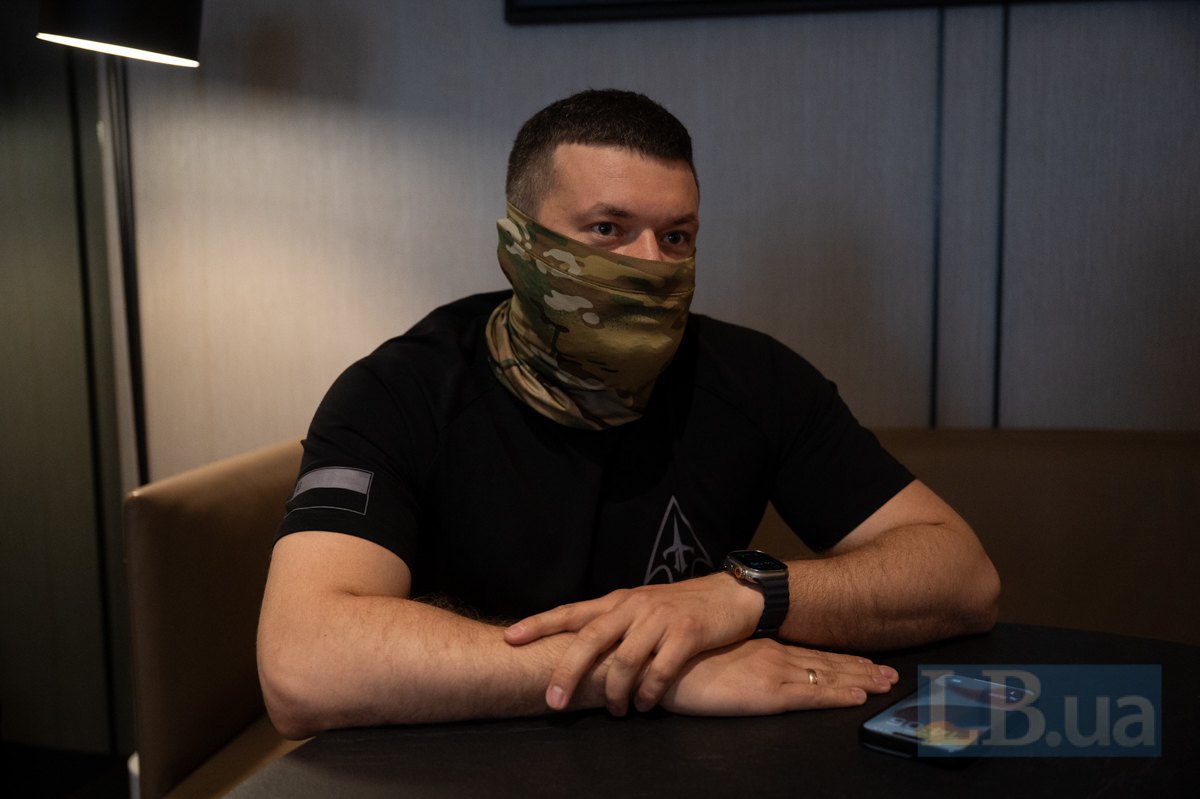
Dmytro Yuki, Head of Communications at the 1st Separate Centre for Unmanned Systems of the Armed Forces, participant in the exercises:
— It’s a very interesting training course. I’m particularly impressed by NATO’s principles. These are systematic, structured exercises. They provide a solid foundation that helps you avoid mistakes later on. On the other hand, we are learning faster now because the war is changing dynamically.
There are certain differences in approach. NATO is an Alliance that acts as a single force under a single brand. Whereas we have many brigades that compete [so to speak] in the media sphere. For the brand, for high-quality personnel. So, in a sense, NATO standards are theory, whereas ours are practice. NATO’s motto, in my opinion, is ‘do no harm’. But we sometimes do things that are a bit cheeky to attract more attention. What the instructors teach is the foundation for us. But we add creativity and a mental twist to it. We are more open, we do much more communication that has a greater emotional component. You can talk a lot about how to work properly, but is there mobilisation in NATO countries, for example? How would they present it?
But their systematic approach can strengthen us. Teach us to prepare for events more quickly and systematically, for example. They organise press briefings for journalists — it’s handy so they don’t get confused by the data on units. Right in front of them is the key information about the unit, its tasks and the most interesting operations. You give people the information — and they understand what to look into. In NATO standards, everything is neatly organised. It’s like a huge warehouse, but you’re armed with a checklist and a scanner, and you know exactly where to find everything.

Inna Kovaliv, Head of Communications at the 67th Mechanised Brigade and course participant:
— The information war is playing its part in the situation; the Russians are pouring huge resources into propaganda, and we must not fall behind. We need to convey the truth about the war to the world, about the heroism of the lads on the front line. But journalists in combat brigades are practitioners; we work with civilian colleagues, take them to the front lines and so on. Here, we’re learning more strategic things: how to create strategic communications and develop a communications policy. It’s all important to understand in terms of the integrity of our work. We need a more structured and comprehensive view of it. So the instructors are structuring our practical knowledge and answering our questions. I’m most interested, for example, in crisis communication: how to act. The need arises constantly. The instructors ask us questions too, and we have lively discussions. They tell us about their public relations principles and ask how things work for us. We share experiences and have a laugh. It’s important for us to learn from their experience, as NATO has already been involved in military conflicts and covered these events. We’re interested in what works in such situations and what doesn’t.
This is how the Ukrainian Ministry of Defence sees it:
This training enables the Ministry of Defence to build a strong network of communications at various levels, explains Colonel Oleksandr Hayn, Director of the Ministry of Defence’s Department of Strategic Communications.
It also helps build a military-media community, as participants from different branches and services, as well as the special services, get to know one another and learn to work together as a single Ukrainian team. We can defeat the Russian military through knowledge, creativity and our teamwork. These courses are attended by military personnel from combat brigades, to whom we teach about communications in wartime, not peacetime. We teach them how, in extreme conditions with minimal time and scarce resources, to tell a story that will resonate with society and align with the unit’s objectives.
This course, like the other eight within the project, has already been included in the Ministry of Defence of Ukraine’s Catalogue of Advanced Training Courses and is run under three educational institutions: the National Defence University, the Military Institute of Kyiv National University named after Shevchenko, and the Zhytomyr Military Institute.
We are starting with mixed groups and will train our trainers in collaboration with brigade communicators. Between 2026 and 2028, the courses will be delivered by NATO instructors, with representatives from our universities gradually becoming involved in teaching.
Our universities will adopt the same course delivery mechanisms used for military personnel from NATO countries. Taken together, this ensures the gradual integration of Ukrainian military universities into the Alliance’s unified education and training environment. Ukraine is pursuing a path of implementing best practices and, even in wartime, is transforming its national regulatory framework to achieve full interoperability with the Alliance not only in terms of calibres and platforms, but also in processes and structures.