





As a result of the Ukrainian strike on the Moscow oil refinery, at least five fire points have been identified. According to preliminary information from the General Staff, the integrated oil refining unit, secondary refining units and the tank farm are on fire.
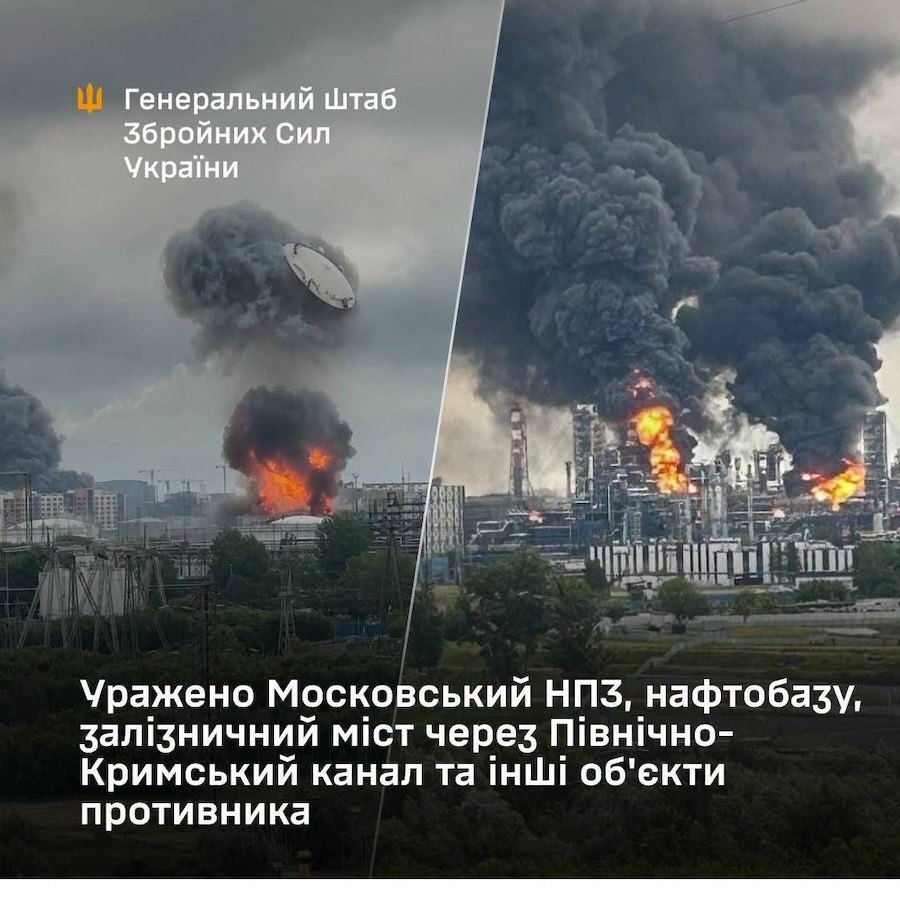
The refinery has a processing capacity of 12 million tonnes of crude oil per year and is used to supply the Russian military.
“The Gukovo oil depot in Rostov Region of the Russian Federation has also been hit. A direct hit and a fire have been recorded at the site. The oil depot is used for the storage and transhipment of fuel and lubricants that support the functioning of the aggressor state’s military and transport infrastructure,” the General Staff reported.
Ukrainian forces have also carried out strikes in the occupied territories of Ukraine. They attacked the road bridge across the Kalk River near Hranitne in Donetsk Region and the railway bridge across the North Crimean Canal near Rozdolne in the temporarily occupied Autonomous Republic of Crimea. According to the General Staff, the occupiers were using these facilities for military transport and to support the logistics of the occupying forces.
A command post near Soledar was struck. Russian fuel and lubricant depots in Mariupol and Pyatypillya in Donetsk Region were also hit, along with a depot for material and technical supplies in the Boykivske area of Donetsk Region.
Furthermore, following additional reconnaissance of previously struck targets used to support the occupying forces, the following results have been confirmed:
On 14 June 2026, following a strike on the Palkino oil pumping station in Yaroslavl Region, Russia, the destruction of seven storage tanks with a total capacity of 95,000 m³ was confirmed.
On 13 June, following a strike on the Kotovsk oil preparation and pumping plant in Volgograd Region, damage to three RVS-2000 storage tanks and a section of the oil pipeline was confirmed.
On 13 June, following an attack on the Tamanneftegaz oil terminal near the village of Volna in Krasnodar Krai, damage to five RVSP-30000 vertical storage tanks was confirmed.
The Security Service of Ukraine (SBU) reported that the Moscow oil refinery is located 15 km from the Kremlin.
“Repeated strikes on the Moscow oil refinery demonstrate that Ukrainian drones are capable of systematically striking the enemy’s most critical strategic targets in the very heart of the Russian Federation. Each such attack forces Russia to spend additional resources on repairs, strengthening its air defences and reorganising its logistics. The SBU will continue to carry out special operations that erode the aggressor’s economic potential and increase the cost of the war for Russia,” the Security Service commented. SBU personnel took part in the strike.
The Unmanned Systems Forces, Special Operations Forces, the Defence Intelligence of Ukraine and a missile brigade also participated in the operation against the facility.
Strikes on the Moscow oil refinery
The first strike on the Moscow oil refinery took place on 16 June. Ukrainian defence forces used drones to target the facility, which supplies fuel to the Russian military. The refinery accounts for more than 38 per cent of fuel consumption in the Moscow region and supplies aviation fuel to Domodedovo, Vnukovo, Sheremetyevo and Zhukovsky airports. Its processing capacity exceeds 12 million tonnes of crude oil per year.
On 17 June, Moscow also repelled an air attack, although no hits were reported. However, during the night and early morning of 18 June, drones penetrated the Russian capital’s multi-layered air defence system and launched a large-scale attack on the refinery.
The President described the strike as a justified response to Russian attacks on Ukrainian cities and communities. He added that the time had come to end the war and that, to achieve this, Russia must take diplomatic steps.