




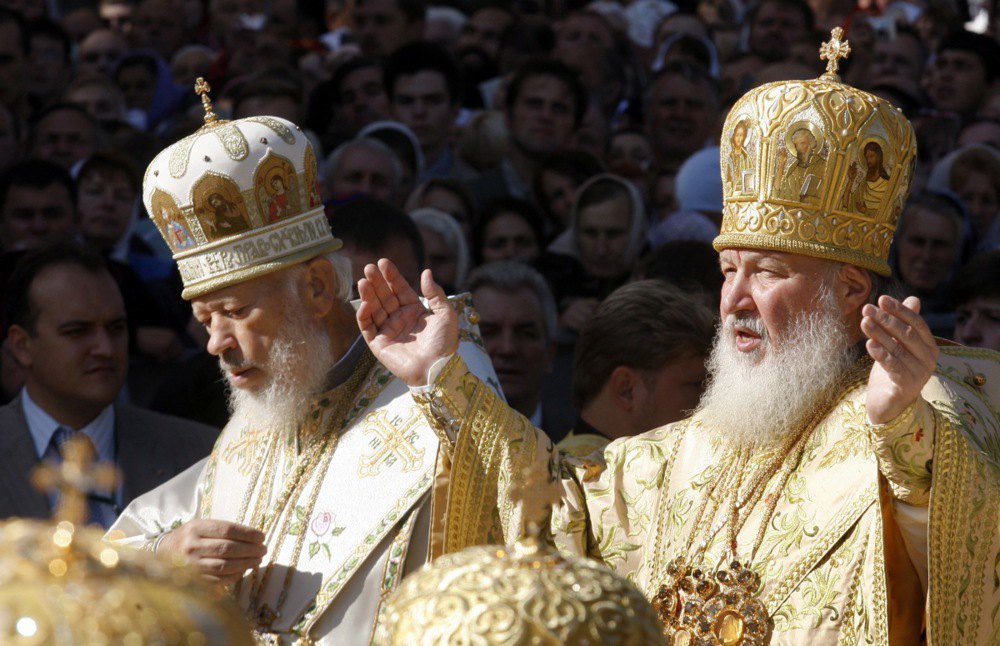
Well, since we have mentioned the ‘bloody’ Patriarch Kirill, it is worth adding that in the early 2000s he was regarded within the Russian Orthodox Church as a highly progressive bishop, a ‘Westerniser’ and even a supporter of Ukrainian autocephaly. This should not come as a surprise, however; the explanation is simple. For a time, Gundyaev hoped to take the See of Kyiv following the death of Metropolitan Volodymyr (who, unfortunately, was not in the best of health). He went to considerable lengths to achieve this.
But that is a story in its own right. I hope that you will soon be able to read the details in my book, which is devoted to the circumstances surrounding Ukraine’s receipt of the Tomos of Autocephaly in 2018 and the events that preceded it — ecclesiastical intrigues, political agreements, international negotiations and internal conflicts. The book is currently in the final stages of preparation.
For now, it is important to note that, for Putin personally, the Kyiv-Pechersk Lavra is a sacred place, a symbol of power not only over Ukraine as a whole but also over Kievan Rus’, the ‘revival’ of which (alongside that of the USSR) he fantasises about in his distorted vision of history.
That is precisely why he personally financed the interior decoration of the Assumption Cathedral following its reconstruction in 2000. Naturally, no such payments from the personal account of citizen V.V. Putin are recorded in any official ledgers, but within church circles this is widely known. The abbot of the Lavra, Metropolitan Pavlo (Lebid) of the Ukrainian Orthodox Church (not the Moscow Patriarchate), was, incidentally, very proud of this and spoke about it at length. He could spend hours describing how the ‘esteemed Vladimir Vladimirovich’ had financed the frescoes. As evidence of this ‘special closeness’, he would point to the obligatory photographs alongside the dictator, which in the early 2000s ‘adorned’ almost every photo exhibition held at the Lavra. These exhibitions were usually organised in the Refectory Church to mark major religious celebrations, such as St Volodymyr’s Day.
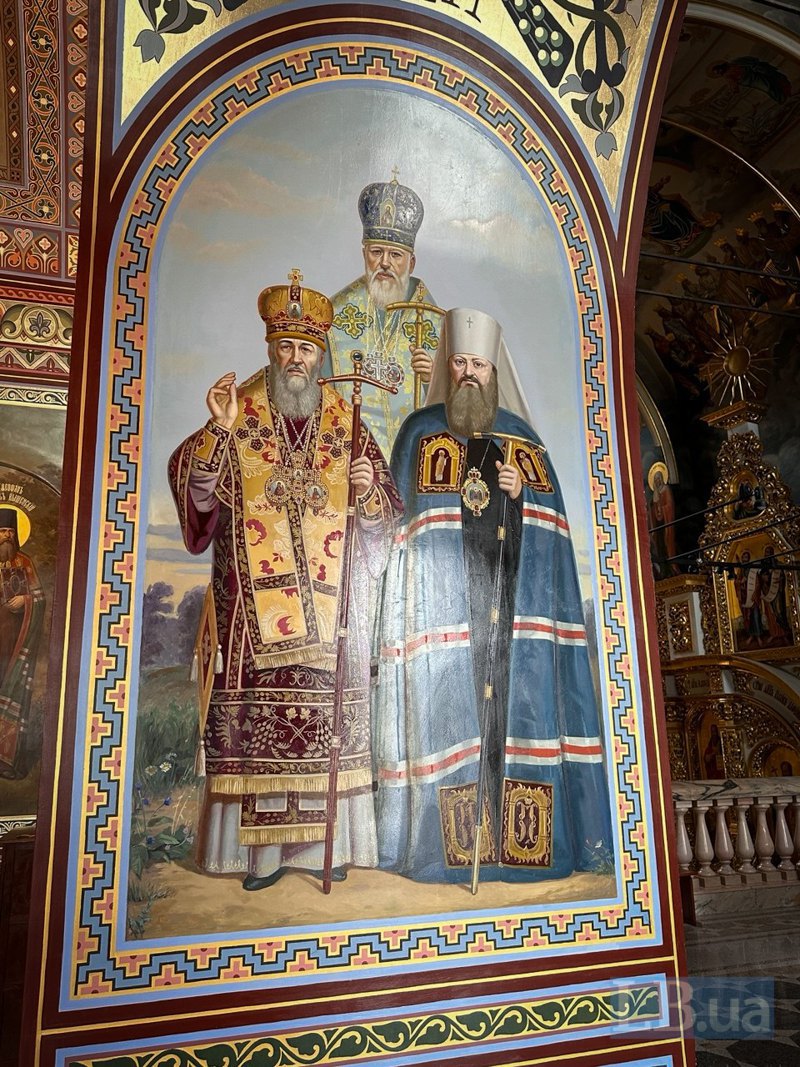
In one such fresco, located on the second floor of the Cathedral, Pavlo depicted himself alongside Metropolitans Volodymyr (Sabodan) and Onufriy (Berezovskyy). Such depictions are common in monasteries; however, the company surrounding them is particularly noteworthy. A significant portion of the second floor is devoted to images of Russian saints from the imperial era. Indeed, the bishops of Belgorod, Rostov, Tmutarakan and numerous others had connections to the Lavra. Most served there before effectively setting off as missionaries from Kyiv to the northern lands, much as graduates of the Kyiv-Mohyla Academy later brought learning and culture to St Petersburg. This, in itself, says a great deal about the Russian Orthodox Church, which has since canonised them.
Against this background, it becomes easier to understand why, in his statement regarding the shelling of the Assumption Cathedral, Bishop Pavlo never once referred to the Russians as aggressors or to Putin as an enemy. According to his account, a ‘missile or some other form of military action…’ struck the cathedral.
In other words, a peaceful missile was apparently travelling through the night from nowhere to nowhere, became tired and decided to stop for a rest — that is roughly how his explanation sounded. Moreover, ‘in Russia, they sympathise with us’ — those were his exact words. According to Pavlo, responsibility for everything lies with the Ukrainian leadership. Few would find that surprising.
He himself, incidentally, is currently undergoing treatment in Transcarpathia. ‘How is that possible?’ one might ask. ‘Has he not been on trial for almost three years — on charges related to inciting inter-ethnic and religious hostility and glorifying the aggressor state?’ Indeed he has. The Pechersk District Court, however, appears to be in no hurry.
In fact, the situation closely resembles the legal disputes surrounding the Lavra itself. The court proceedings between the state and the UOC-MP over the Lower Lavra remain ongoing. I have written about this before: over the past three years, 15 judges have recused themselves from the case. Let me repeat: 15 judges in three years. A coincidence, no doubt.
Something similar is happening in the case of Pavlo (Lebid), where proceedings continue to be skilfully delayed. Although he was initially required to surrender his foreign passports, in December 2025 he was granted permission not only to travel within the village of Voronkiv, where he is effectively under house arrest, and to visit his mother in Rivne Region, but also to attend churches in Kyiv Region (excluding the Lavra). Pavlo actively takes advantage of these permissions and readily boasts about them to those around him.
***
But let us return to the shelling.
During the night between Sunday and Monday, no ‘missile or some other form of military action…’ struck the Assumption Cathedral. The cathedral was deliberately targeted by an enemy Shahed drone. As of today, this has been established as fact by the relevant authorities.
Moreover, a second Shahed was following the same trajectory at around five o’clock in the morning. This is a standard tactic: to repeat a strike on the site of the initial impact in order to maximise destruction and increase casualties among emergency responders.
Admittedly, it veered slightly off course and, rather than striking the Lavra’s bell tower or the unique Gate Church, hit the roof of the Mystetskyi Arsenal instead.
In other words, we can state with certainty that the strike on the Lavra by Russian weapons was deliberate. It was not an accident.
‘Do Not Let Anyone Lay Hands on You’
Clearly, the enemy is already sensing its own weakness and, in what may prove to be its final phase, is attempting to destroy as many iconic sites as possible: museums, organ halls, theatres, churches and concert venues. In short, everything that sustains the spirit of the nation against which it is waging war.
Consequently, we must be prepared for the possibility that such attacks will continue.
During the emergency response following the strike on the Assumption Cathedral on the night of 14–15 June, the Minister of Internal Affairs, Ihor Klymenko, played a key role. He arrived at the scene within minutes. In anticipation of large-scale attacks, senior officials, security forces and emergency services are typically on duty around the clock. Having quickly assessed the situation, he called for additional fire crews. Had there been even a few minutes’ delay, the roof might have collapsed, the flames could have spread to the 25-metre-high wooden iconostasis, and the Assumption Cathedral would likely have required complete reconstruction rather than restoration.
The scale of the damage is already considerable, with restoration costs estimated at 500 million hryvnias. However, the consequences could have been far more severe.
One detail is particularly noteworthy.
The so-called ‘non-Moscow Patriarchate’ branch of the Ukrainian Orthodox Church claims that its monks also took part in extinguishing the fire. As is well known, monks from this branch continue to reside on the grounds of the Lower Lavra.
According to figures provided by the so-called ‘non-Moscow Patriarchate’ branch of the UOC, there are 160 such monks. The reserve places the number at 140, while in reality there are approximately 50 people — genuine monks whose entire lives are bound up with the Lavra. They are in no hurry to join the OCU, knowing that no one is likely to forcibly evict them from the monastery, at least while the legal proceedings remain ongoing. As noted above, those proceedings continue to be delayed.
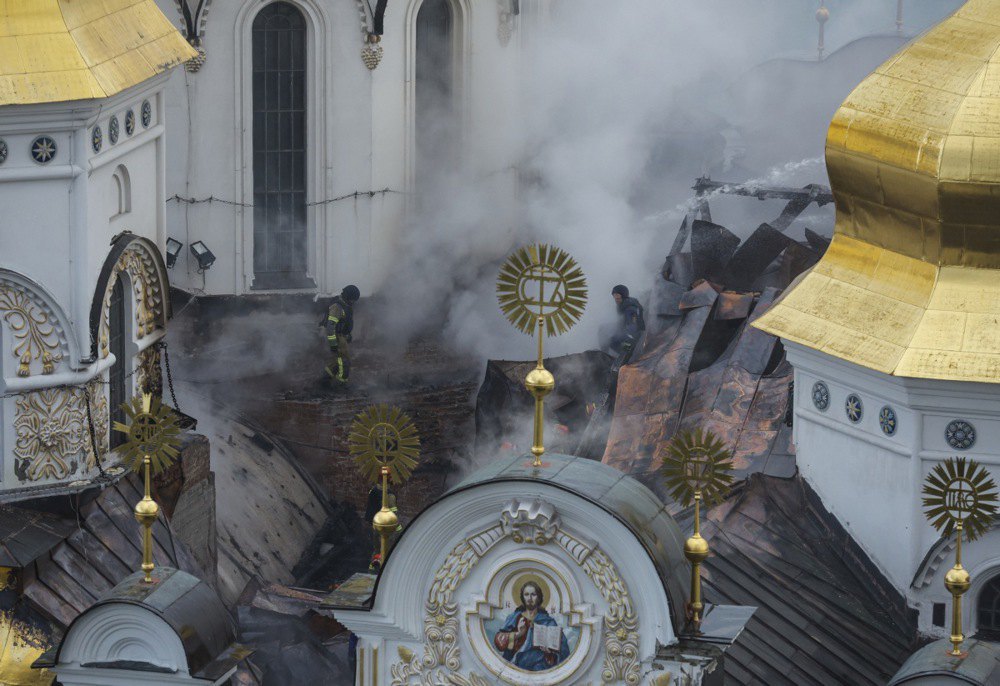
Of those 50, however, only three actually took part in extinguishing the fire. Some witnesses counted five, others two; I counted three. The precise number makes little difference, so let us settle on the middle figure.
Just think about it: only three.
- “The Lavra is my home. How could I not help save it? Yes, we did it together with the OCU — we carried icons, equipment and decorative elements out of the cathedral, rescuing whatever we could from the flames. And what of it if we worked together? How else could it have been done?” says one of them. For obvious reasons, I will not reveal his name.
Where were the others? They were resting.
- “By morning, we were returning to our cells — covered in soot and reeking of smoke. We needed to change our clothes,” one of the OCU monks told Lb.ua. “We looked around and saw that the MP monks had only just finished reading the Morning Rule” — the traditional daily morning service in monasteries — “and were coming out looking completely relaxed, as though nothing had happened.”
***
And finally.
Just a few minutes after the first Shahed struck and the roof of the Assumption Cathedral caught fire, a heavy downpour began over Kyiv.
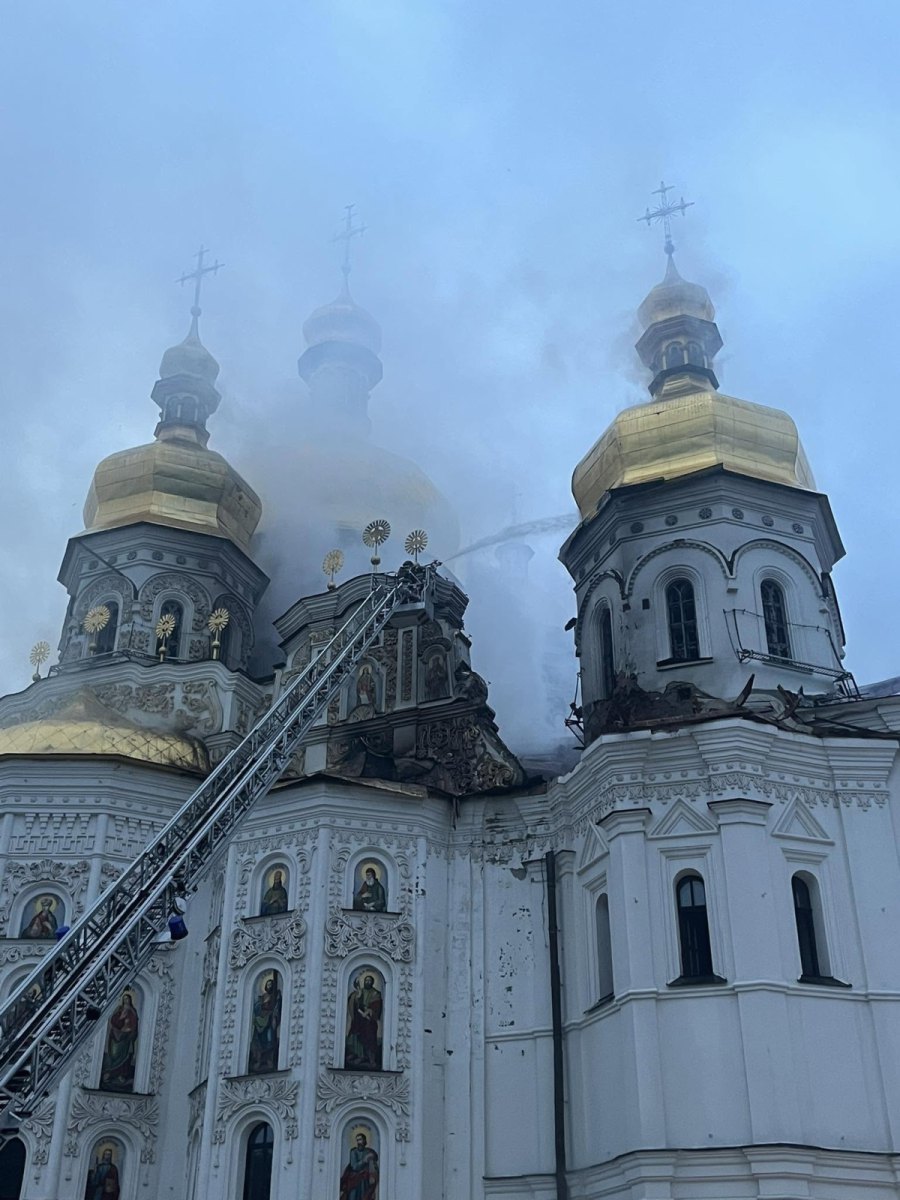
Of course, it would be an exaggeration to claim that the rain alone brought the fire under control — it was the firefighters who battled the flames. Nevertheless, the downpour undoubtedly helped prevent the fire from spreading further.
Even for those who are not believers, the symbolism is difficult to miss. As is the fact that the Lavra has endured.
And it will continue to endure.
As a symbol of our future Victory.