






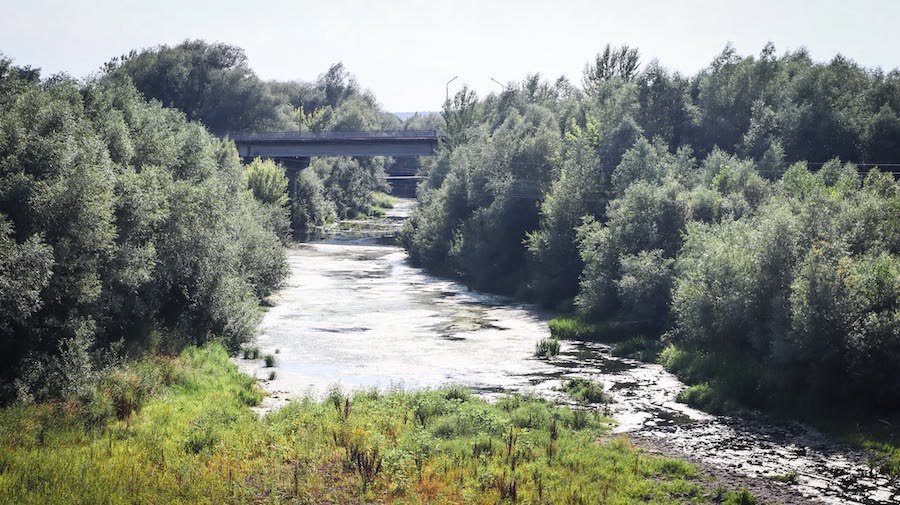
Just a few years ago, the summer decline in river water levels was regarded as a normal seasonal phenomenon. Today, the situation is radically different. We are increasingly talking not about the summer low-water period — a natural phase in a river’s life cycle when water levels fall — but about water scarcity. This is now an extreme hydrological phenomenon in which natural water resources are no longer sufficient to meet the needs of people, the economy and the environment.
And, most importantly, this is no longer an exception. It is a trend.
Climate change is causing prolonged droughts, higher temperatures, insufficient rainfall and increased evaporation, gradually altering the water regime of Ukraine’s rivers. Historically low water levels are being recorded with increasing frequency, river flows are declining, and pressure on water resources is continuing to grow.
According to data from the Ukrainian Hydrometeorological Centre, the most critical situation is being observed on rivers in the Carpathian region, as well as on the tributaries of the Middle Dnipro, the Prypyat and the Southern Bug. At certain hydrological stations on the Dniester, Orava, Rika, Vicha, Turya, Western Bug, Turiya, Styr and Southern Bug rivers, water levels have already fallen below the lowest recorded values for the entire observation period. The scale of the low water levels is reflected in the figures. In the Dniester basin, water levels in July were only 8–19 per cent of normal in some sections, while at monitoring stations in Sambir, Halych and Zalishchyky, the river met the criteria for low water levels. On the Southern Bug, water levels in some tributaries fell to 15–17 per cent of normal.
During July this year, low water levels led to restrictions on special water use for 185 water users in various regions of the country. In August, water-use restrictions were imposed on as many as 294 water users. These are not merely administrative decisions. They indicate that the shortage of water resources is already affecting economic activity.
But Ukraine is far from alone.
This summer, virtually the whole of Europe faced unprecedentedly low water levels. One of the most striking examples was the Danube — Europe’s second-longest river, whose catchment area spans 19 countries. In some sections, water levels fell to record lows.
Due to prolonged drought and a shortage of water flowing in from the Alps, the Danube’s water level in Hungary fell to almost a record low. As a result, several Nazi ships that had been sunk in the Danube during the Second World War became visible once again. In Budapest, the low water level in the Danube also exposed Second World War-era munitions that had been submerged in the river. Removing these dangerous ‘finds’ required the involvement of bomb-disposal experts and restrictions on traffic.
Hungary’s and Romania’s nuclear power sectors have also been put at risk. For the first time in 44 years, Hungary’s sole nuclear power station, Paks, is being phased out due to a record drop in the Danube’s water level. In Romania, a rock face was blasted along a specific stretch of the Danube to increase water flow to the Cernavodă nuclear power station, while there are also plans to sink four barges to raise the river’s water level.
In August 2026, the water level of the Danube in Serbia fell below the historic low recorded in 1909. This led to the suspension of passenger shipping, restrictions on freight transport and the threat of the country’s sole oil refinery being shut down due to a lack of water for its production processes. Problems with shipping and the operation of port infrastructure are also continuing in other European countries.
These events once again confirm that climate change is already transforming the water regime of Europe’s largest rivers.
As this year’s chair of the International Commission for the Protection of the Danube River, Ukraine has initiated the preparation of a joint review of the low-water situation in the countries of the Danube basin. Our aim is to demonstrate that climate change knows no national borders and that the response to these challenges must therefore be developed jointly. Ukraine has proposed preparing a joint review of the consequences of low water levels to highlight the scale of the problem, exchange practical experience in responding to it, and strengthen cooperation on building resilience to climate change.
One of the priorities of Ukraine’s chairmanship of the International Commission for the Protection of the Danube River is also the development of joint approaches to assessing droughts. In particular, we have initiated work to improve the system of indicators used for such assessments. This will facilitate the timely identification of risks, improve the forecasting of their consequences, and support informed management decisions at both national and river basin levels.
The situation on the Dniester is no less telling.
Over the past two years, low water levels have made it impossible to fully fill the Dniester Reservoir. This means that every cubic metre of water is of particular value. Decisions regarding the operating regime of the Dniester Integrated Hydropower Complex determine the water supply to Ukrainian communities, primarily in the Odesa Region, as well as to more than 80 per cent of the population of the Republic of Moldova.
According to the Ukrainian Hydrometeorological Centre, July 2026 was one of the driest months in recent years. Water levels in most rivers in the Ukrainian part of the Dniester basin were only 10–40 per cent of normal, while inflow into the Dniester Reservoir was around 21 per cent of the long-term average. On 8 July, the lowest daily inflow since the reservoir began operating was recorded, and the forecast for August does not indicate any significant rainfall or improvement in the hydrological situation.
Consequently, low water levels — a sign of hydrological drought — have been observed on most rivers in the basin, with water levels falling to 20 per cent or less of the monthly average.
As of 5 August, water levels in many sections had approached their lowest levels for the entire observation period, while in some places they had already fallen below historical lows.
Over the past three months, due to discharges into the lower Dniester, the reservoir’s water level has fallen by almost 3 metres and is approaching its lowest levels ever recorded.
That is precisely why the issue of managing the Dniester’s water resources has long ceased to be a purely technical matter. It has become an issue of international cooperation and shared responsibility.
This year, the Commission on the Sustainable Use and Protection of the Dniester River Basin has already convened four extraordinary meetings to agree on water discharge regimes from the Dniester Integrated Hydropower Complex.
The hydrological situation was deteriorating, and decisions had to be adjusted promptly. Whilst a discharge rate of 100 m³/s was agreed at the penultimate meeting, it was reduced to 85 m³/s at the following meeting. Such decisions are made practically in real time, taking into account inflow forecasts, the river’s actual water level, the drinking water needs of the populations of Ukraine and the Republic of Moldova, and the need to preserve the ecological condition of the Dniester. It was agreed that, should the hydrological situation deteriorate or the inflow into the Dniester Reservoir fall below 50 m³/s, the Commission would convene another extraordinary meeting.
A prime example of international cooperation was the visit by the Moldovan delegation to the Dniester Reservoir and the Khotyn water intake, which took place following an extraordinary meeting of the Commission on the Sustainable Use and Protection of the Dniester River Basin. We invited our colleagues so that they could see for themselves the true scale of the low water levels and their consequences for Ukrainian communities. Open dialogue and a joint assessment of the situation will enable us to continue making informed decisions on the management of the Dniester’s water resources, on which the water supply of millions of people on both sides of the border currently depends.
In such circumstances, data takes on particular importance.
When the river is in full flow, an error in determining water discharge may be almost imperceptible. But when the flow is reduced several-fold, even minor inaccuracies can influence decisions on the allocation of water resources among communities, the economy and natural ecosystems.
That is precisely why developing a modern national water cadastre is not merely an urgent need, but a necessity today.
It is not merely a database of rivers or water bodies. It is a digital system designed to consolidate reliable information on the quantity, quality and use of water resources, ensure transparency in management decision-making, and establish a unified framework for risk forecasting, development planning and adaptation to climate change. In today’s context, the water cadastre is becoming as important an element of critical infrastructure as energy monitoring systems.
According to data from the Accounting Chamber, set out in the Report on the Results of the Audit of ‘Flood Management – Assessment of the Use of Hydrometeorological Data for Disaster Preparedness’, as of the end of 2025, there were 136 meteorological stations, 293 hydrological stations and 48 lake hydrometeorological stations operating in Ukraine.
However, high-quality data is not enough if the management system remains fragmented.
That is precisely why the Ministry has drafted a new bill on water governance. This is not merely a change in terminology, but a new model for managing water resources.
Today, we are effectively rethinking the very approach to water resource management, moving from traditional ‘water management’ to modern water governance.
This means that water is no longer viewed merely as a resource to be used — it is becoming a strategic element of state policy, the management of which is based on European principles, modern digital technologies and reliable data. This involves developing a geoinformation system for the water cadastre, strengthening the river basin management approach, introducing drought and low-water risk management, and restoring the free flow of rivers and natural ecosystems.
This is not merely a reform of the water sector — it is the creation of a new culture of water management that will help Ukraine adapt more effectively to climate change, ensure water security and bring our policies closer to European standards.
Today, water governance is no longer merely a matter of environmental sustainability. It is a matter of water security, economic resilience and the state’s adaptation to a new climatic reality.
The sooner we move from reacting to the consequences to systematic risk management, the more resilient Ukraine will be in the face of the challenges that climate change is already bringing.
The 20th century taught nations to fight for energy independence. The 21st century is making water security an increasingly pressing issue.