





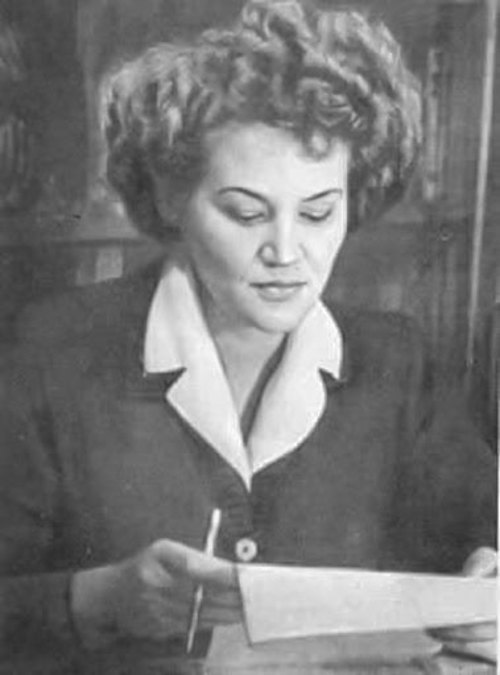
A Fresh Breeze in Kostenko’s Sails from Kyiv and Riga
Interestingly, this particular collection by Lina Kostenko recently made headlines in Ukraine. In early June, Ivan Malkovych visited the poet with publishing house A-BA-BA-HA-LA-MA-HA PR manager Volodymyr Yakovliev. Handing Kostenko a copy of Sails, Malkovych explained that “Volodya bought your book at an auction” and asked her to sign it.
Many readers were moved by the poet’s emotional reaction to the old, yellowed book, which she quickly leafed through: “God, how strange. What an edition… Lord. I think I have a copy somewhere. But there are so many books and manuscripts that I wanted to take out and look through, and I never got around to it. God, it’s such a comedy… I’ve forgotten all these poems.”
There is no need to be surprised that Lina Vasylivna does not remember lines published almost 70 years ago: she is constantly working, with countless other things on her mind. Nor should the collection be dismissed lightly based on Kostenko’s words (“such a comedy”, “I’ve forgotten these poems”): Lina Vasylivna was more likely referring to the “comedy of life” — memories of Soviet realities, the passage of time and changing eras.
In fact, critics and literary scholars held Sails in high regard. Many references could be cited, but it is enough to mention Ivan Dziuba’s essay There Are Poets for Every Era. He devotes only two paragraphs to Kostenko’s debut collection Rays of the Earth (1957), but seven pages to Sails (1958).
First and foremost, Dziuba notes the historical and atmospheric context of those poems: “Judging it [the collection] by the heights reached by Lina Kostenko’s later work, one can find in it traces of the poetic rhetoric of the first years of the post-Stalin Thaw.” At the same time, the critic sees in Kostenko’s lines the beginnings of what would become important in her work and would “remain and deepen”.
Thus, Sails is still worth readers’ attention today — all the more so with the author’s anti-censorship notes. Admirers of Lina Kostenko’s work are well aware of her difficult relationship with censorship. After Rays of the Earth and Sails, only her third collection, Journeys of the Heart (1961), would be published relatively smoothly. This was followed by the typeset edition of The Stellar Integral (1963) being broken up, the cancellation of the publication of a volume in the Poet’s Library series (1966), and the suppression of the collection Princely Mountain (1972).
Overall, thanks to this little book from the museum archive in Riga, we can see how Soviet censorship operated during the early Thaw, explore the reasoning behind its interventions and reflect on the poet’s original intentions.
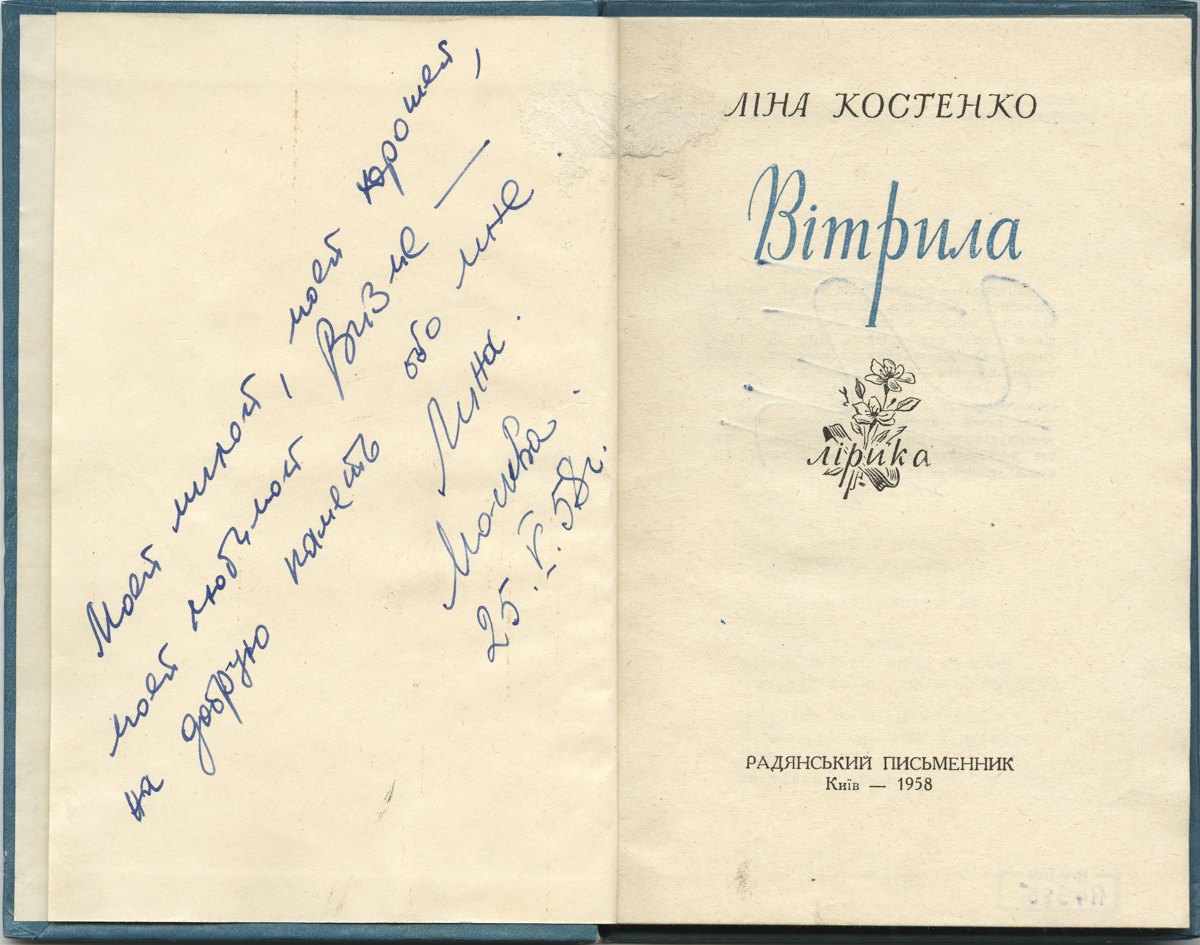
“To my dear Vizma — as a good memory of me. Lina”
The Riga copy of Sails contains four handwritten notes — and one deletion — made by Lina Kostenko.
When we open the book, the first thing we see is the dedication: “To my sweet, my dear, my beloved Vizma — as a good memory of me. Lina. Moscow. 25.V.58”. In her recent poetry collection Wind from Mars (2026), Kostenko writes the place name “moscow” with a lowercase letter. But 70 years ago, times were different.
Kostenko went to Moscow to study at the Maxim Gorky Literature Institute because, at the time, she was under a kind of emotional and creative siege in Kyiv. It was 1952, still under Stalin. It was the dictator’s final year of life — a terrifying and unpredictable time, even more so in Kyiv than in Moscow. After the dictator’s death and the beginning of the Thaw, however, things became safer. The Literature Institute was also one of the main centres of freedom — relative and as extensive as was possible under the Soviet system. People studied there from all over the Soviet Union, including Eastern Europe, which had also found itself behind the “Iron Curtain” after the Second World War.
In her recollections of studying at the Literature Institute, Kostenko says: “I shared a room with Maia Augstkalna, a theatre scholar from Riga, Veste Paas (a film historian, – Ed.) from Estonia, and Vizma Belševica, a Latvian poet.” Her words might give the impression that they lived together for a long time. But the biographies tell a different story: Belševica entered the institute in 1955, while Kostenko graduated in 1956. So this “golden line-up” of roommates existed for just one year — yet how many memories and what a strong creative friendship remained etched in their memories.
Now let us reread Lina’s dedication to Vizma. It sounds remarkably like the family letters and postcards we write to one another. You would never guess that one great poet was writing to another great poet. The words are sincere, warm, simple and intimate. In a word, they were close friends. And young. They still had to become great.
Describing the labour process as an anti-censorship practice
Let us look more closely at the scan — the page on the right, where it says “Lina Kostenko. Sails. Lyrics”. It is clear that something has been emphatically crossed out on the reverse side of the page, somewhere between Sails and Lyrics. We can assume that this was a publisher’s blurb. Here is how it begins:
“Sails is the second collection of poems by the young poet L. Kostenko. The book consists of lyrical poems in which the author truthfully and sincerely celebrates the beauty of her native land, the greatness of the working person, and the depth of the beautiful human feeling of love…”
The reasons for the author’s dissatisfaction are easy to understand — the unmistakable bureaucratic style of Soviet publishing houses: “a collection of poems by a young poet in which the author truthfully celebrates…” The recent A-BA-BA-HA-LA-MA-HA video also shows what bothered the author most here.
Lina Vasylivna began leafing through the book from the end without reading anything aloud. Only when she reached the blurb could she not contain herself: “Heh-heh… ‘the greatness of the working person, the depth of the beautiful human feeling of love’… Oh, God…” She then looked at her interlocutors, slightly bewildered. Let us try to understand the reasons for her dissatisfaction.

To understand this, let us return to Dziuba’s observation about the rhetoric of the first years of the Thaw in Sails. Here is the continuation of his argument: “From a historical perspective, one cannot fail to note the spirit of democracy and respect for the individual reflected in the poems about working people (‘New Construction’, ‘Postbox’, ‘Grape Growers’, ‘Indignation’).” In essence, this is what the blurb was about too, but without the bombast of “the greatness of the working person”.
And behind this lies a separate literary story, which is best explored through the example of Belševica. Her poetic debut came a month before her 17th birthday, in the newspaper Padomju Jaunatne / Soviet Youth (1947), with the poem Zemes atmoda / Awakening of the Earth. At the time, Soviet Latvian critics accused the debutante of almost indecency, because the poetic image of the hills of her native land was associated with a young woman’s breasts. Her second poem, however, was explicitly about the “working person” — Vīrs darvo jumtu / The Man Tarred the Roof. Here we can already see thematic parallels with Kostenko’s New Construction and Postbox, mentioned by Dziuba.
It is therefore worth considering the similarities between the long-term creative strategies and tactics of the two poets under the totalitarian system. Unlike most of their colleagues, they refused to write “locomotive poems” with which collections could begin — poems glorifying Lenin, the Party and the Great October Revolution. For both, the subject of work itself, as a process, and descriptions of the “working person” became the limit of compromise. And in Dziuba’s terms, this was essentially legitimate — an expression of the “spirit of democracy”.
Yet the rebellious poets also sensed an unpleasant element of coercion in this. That is why Lina Kostenko crossed out such a blurb in 1958 and, in 2026, ironically read out its bureaucratically wooden phrase about “the greatness of the working person”, prefacing it with a “heh-heh”. That is also why Vizma Belševica disliked recalling her 1955 debut collection Visu ziemu šogad pavasaris / This Winter, Spring All Year, with its emphasis on a happy future secured by post-war reconstruction.
But time passed. The “dear Party” and its censors now wanted more from poets who were gaining literary strength. Yet both Kostenko and Belševica remained uncompromising. As a result, both faced serious problems with censorship and the publication of their work.
The creator, censorship and poems about war. Who won?
Speaking of war, the theme of the “Great Patriotic War” became another possible area of compromise for Kostenko. Both sides, however, expected something different from it. The authorities wanted a “locomotive” poem with triumphant trumpets. The poet simply created something subtle and unforgettable. The best example is My First Poem, Written in a Trench, which opened the collection On the Banks of the Eternal River, published after 16 years of being banned.
In such cases, the poet clearly outmanoeuvred the censors. Many of her poems about the war are also presented through the eyes of a child. There is none of the ideological conformity desired by those at the top, only exposed nerves, pain and psychological depth, all converging into a broader worldview.
A similar creative gambit with censorship appears in Kostenko’s Sails. Formally, the collection also opens with a poem about war. It is presented through a child’s eyes — quite literally. It begins: “When I was a child, I had / such blue eyes, when I remember them.” And then those eyes become filled with the heavy colours of war…
The same collection contains another poem on the subject of war, Sheaves. Its central message is the same — a prayer that there be no more war. But the story is more unexpected, stark and dramatic. The occupiers move along Ukraine’s devastated roads, laying sheaves of ripe wheat over the tracks to make it easier to walk or drive. And then…
The stranger bent down to the ruts.
He wiped away a tear.
Perhaps he was a peasant…
There might be no wars on this planet
if just one person wept like that.
A humane occupier — and, incidentally, another “working person”… Even on this small, limited example, we nevertheless have a “good German” — just 13 years after the end of that war! And now, 12 years after the beginning of the current war, this in some ways echoes today’s arguments over “good Russians”…
How to circumvent censorship through unconventional stories
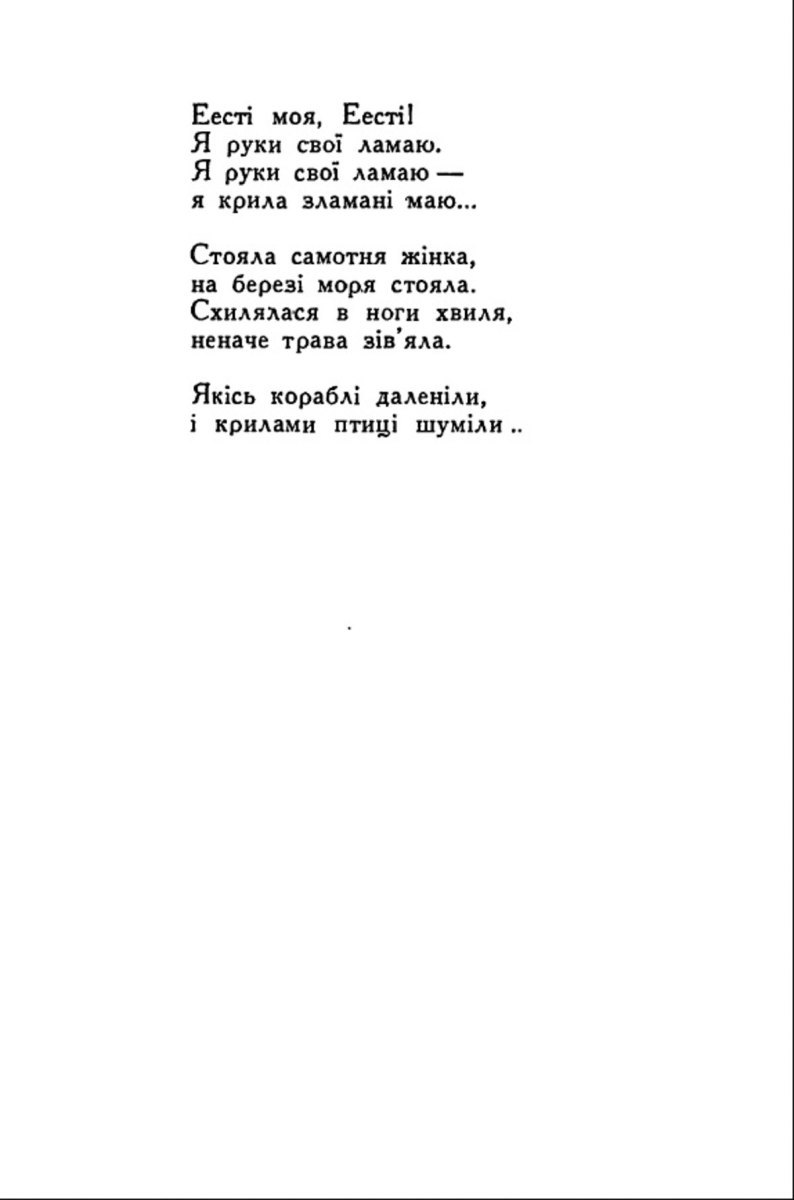
The poem Lydia Koidula in a Foreign Land, which we will come to after Sheaves, is more subversive. But Soviet censorship simply failed to understand it.
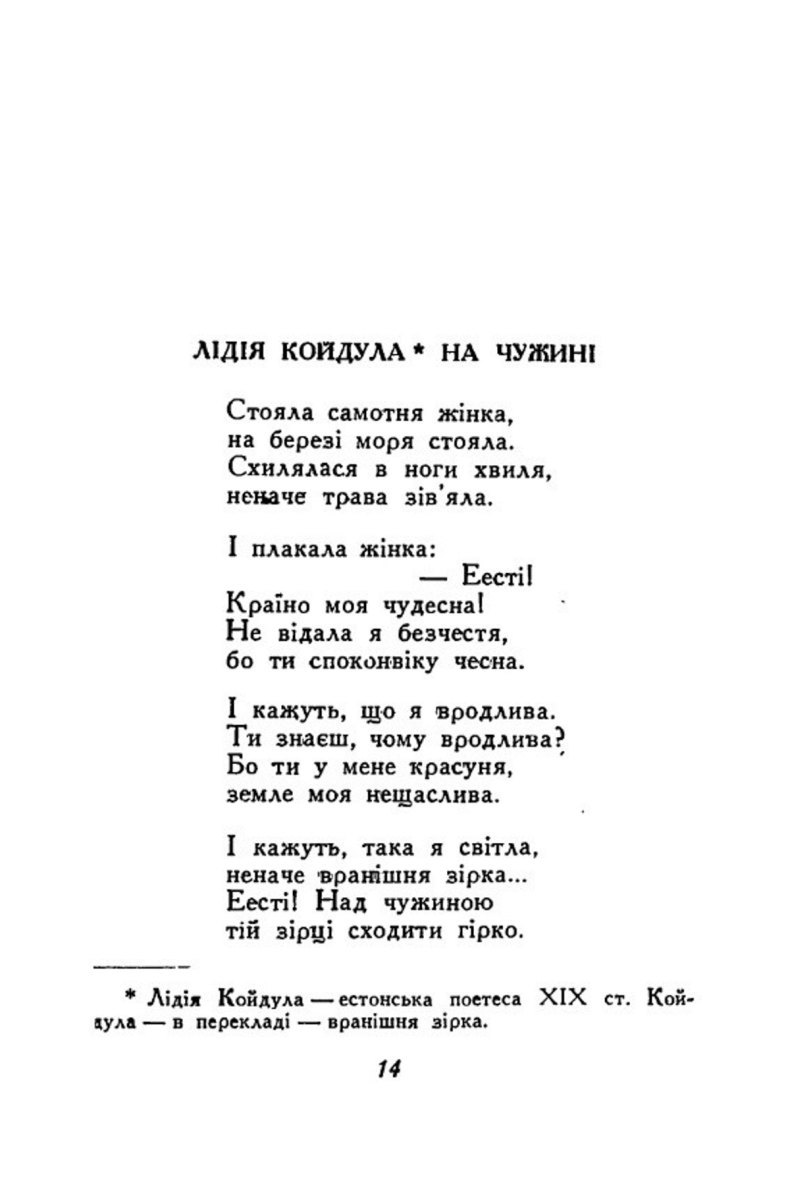
Lydia Koidula (Jannsen, 1843–1886) was one of the foundational figures of Estonian literature: a poet, playwright and Estonia’s first female journalist. She was an extraordinarily captivating person, both creatively and inwardly, as well as physically.
In Kostenko’s poem, Koidula weeps for her wonderful, honest but unhappy homeland, Eesti — the country’s Estonian name. It is bitter for the woman to be in a foreign land: “I break my hands — / I have broken wings” (an early echo of the famous later lines, “A person supposedly cannot fly… / yet has wings”). And the ending: “Some ships were fading into the distance, / and birds rustled their wings…” Mournful, painful lines…
Now for a few details from Koidula’s biography. She was born and lived in Estonia — in Pärnu and Tartu — but after marrying in 1873, she moved with her doctor husband to Kronstadt, where she spent the final 13 years of her life. It is therefore important to understand that the ships in the distance were not “some ships”, but vessels of the Imperial Russian Navy. This history and geography fundamentally change how the sad poem is perceived. After all, even with the transport possibilities of the 19th century, Kronstadt was not so far from Estonia. And, of course, the fortress island was close to St Petersburg, home to a large Estonian diaspora that played a prominent role in the formation of the Estonian nation, just as the Latvian diaspora contributed to the formation of the Latvian nation. (Incidentally, Koidula’s husband was Latvian.)
So the poem is about a very different kind of foreignness and unhappiness for Koidula. The “lonely [in the foreign, Russian Kronstadt] woman” is mourning Eesti, a homeland subjugated by Russia.
It is easy to imagine that the poem emerged from conversations in the Baltic-Ukrainian dormitory room at the Literature Institute. Kostenko’s censors, however, had no such experience in their biographies. That is why they allowed these allusions to pass — obvious to anyone familiar with the context. Kostenko did, however, have something of a safeguard in case more knowledgeable censors came along, particularly those familiar with Kronstadt. In 1876–1878, Koidula and her husband lived farther away in Europe. Admittedly, they stayed in cities far from the sea — Breslau/Wrocław, Strasbourg and Vienna — but still…
Now that we have unpacked some of the censorship contexts and meanings embedded in Sails, we can turn to the anti-censorship corrections made by 28-year-old Lina.
Finding the right path in “Lead Me, Roads…”
For this, let us return to page 12 of the collection, where the poem “Lead Me, Roads, to My Beloved City” appears. It stayed in readers’ and critics’ memories thanks to its aphoristic ending: “Even floating flowers / have roots in the earth.” But those lines were certainly not what Soviet censors found objectionable. Let us look at the entire poem with Kostenko’s corrections (incidentally, the wartime poem Sheaves can also be read in full on the same spread).
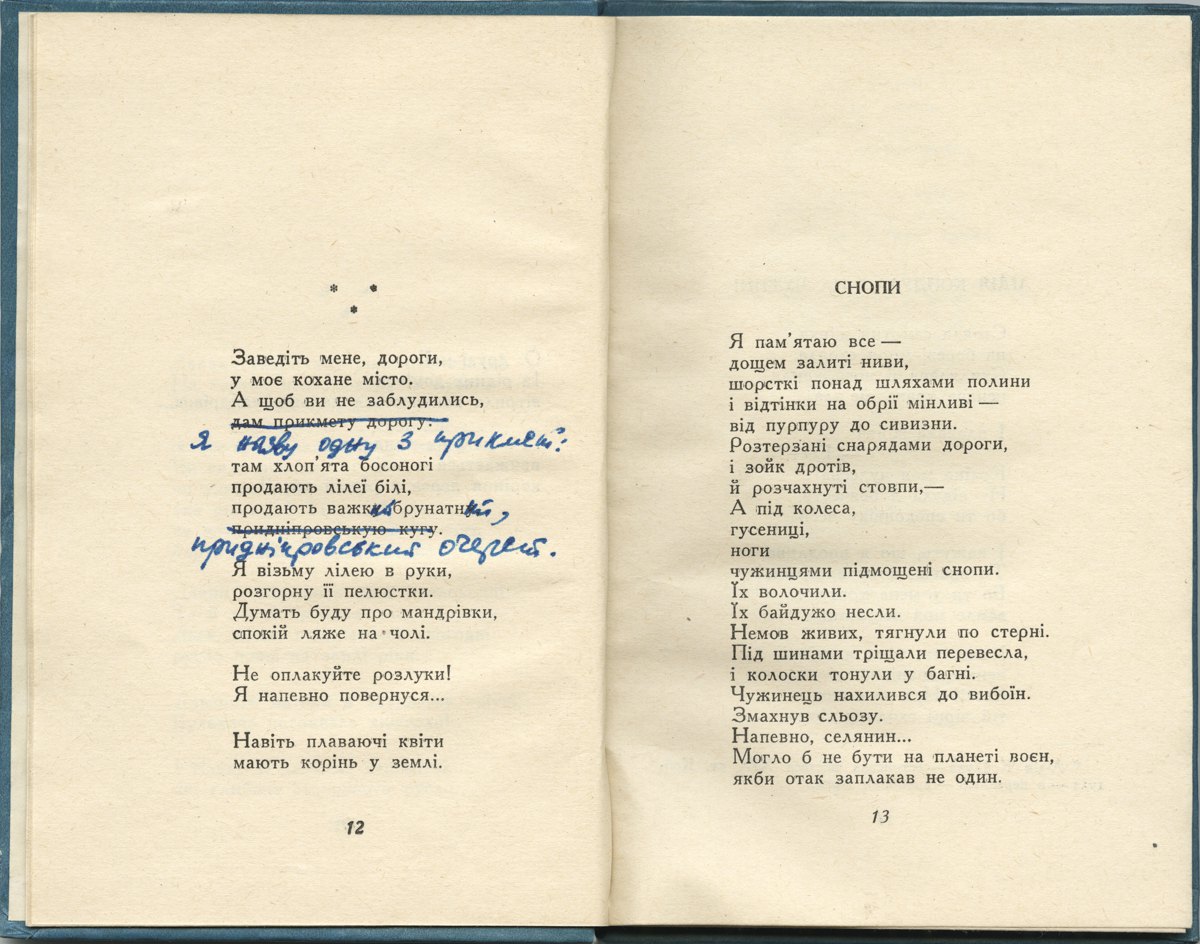
So, the entire poem is centred on the image of the white lily. The other vegetation — cattail — is less beautiful and romantic, more grounded (or water-bound), serving merely as a backdrop, heavy and somewhat dark, so that the lily can shine more brightly.
So why did the censors change Pridniprovskiy reeds to Pridniprovska cattail? A rather mysterious alteration. Well, reeds are reeds, cattails are cattails, and then there are bulrushes, rushes… Across Ukraine, thousands, hundreds of thousands of people confuse these names, almost as if to give pedants an excuse to correct them from time to time: “That’s not a bulrush, it’s a cattail! And that’s not a reed, it’s a rush!”
So what was the point? Where, ultimately, was the subversiveness? Perhaps it lay in the fact that “reed” has a much richer network of associations in folklore and classical literature. There is the magical context — the enchanted reed flute; the rebellious one — reeds as a hiding place for Cossacks and insurgents; and the working one — reeds as roofing material (while in the USSR child labour was prohibited!). “Cattail”, by contrast, is lighter in every sense. Perhaps that was it. But was this enough to demand a change? And is it not too subtle for Soviet censorship — third-level associations, no less?
Still, I can offer another version, an intriguing, almost detective-story explanation, although it too is far from obvious. The real surname of the prominent Ukrainian thinker and writer Vasyl Barka was Ocheret. In 1958, he had only just begun work on his magnum opus, the Holodomor novel The Yellow Prince. But by then he was already well known in émigré circles as a poet, writer, essayist and journalist, and therefore also to the Soviet security services. His novel Paradise (1953) and his work with radio broadcasters that had begun transmitting from the United States were particularly troublesome from an anti-Soviet perspective.
The authorities, however, knew him as Vasyl Barka. He adopted the pseudonym in the 1940s, after escaping German captivity and finding himself behind the front line, both to protect himself and to divert attention from relatives who had remained in the USSR. Yet it is unlikely that his real surname, Ocheret, recorded in official foreign documents, was a secret from Soviet intelligence. The question is whether the Barka-Ocheret identity could have appeared on KGB censorship blacklists by 1958. There is no definitive evidence, but the possibility cannot be ruled out.
There is an interesting detail here for context. Kostenko wrote “Lead Me, Roads” about herself and her native town of Rzhyshchiv. The poem’s final aphorism — “Even floating flowers / have roots in the earth” — expresses her enduring attachment to her homeland. But a watchful censor might also have seen in it a metaphor for the émigré existence of Barka-Ocheret. He was born in Solonytsia near Lubny, on the banks of the Sula River, which flows into the Dnipro a few dozen kilometres away. So could one, in some sense, call him an “Ocheret of the Dnipro”? An intriguing question.
If we return to the poem’s aesthetics, the original version seems more harmonious. “I shall name one of the signs” better maintains the personal structure of the poem through the more even recurrence of “I”. Phonetically, Pridniprovskiy reeds is also more pleasing, with its alliteration, and sounds more natural than the deliberately song-like poetic form Pridniprovska cattail.
What “The Clock on the Old Town Hall” leaves unsaid
Now let us examine the second censored poem in the collection Sails.
Its literary reception by scholar Viacheslav Briukhovetskyi is particularly interesting. In his essay on Lina Kostenko’s work, he uses “The Clock on the Old Town Hall Stopped Long Ago” to illustrate an important point. Discussing the parable-like quality of many of Kostenko’s poems, Briukhovetskyi notes that “her poem very often ends with an aphoristic conclusion, quite often a kind of explicitly stated maxim”.
And it is precisely the poem about the stopped clock that provides the scholar with an example of how the poet sometimes “organically ‘spreads’ it [the aphoristic conclusion] throughout the entire poem”. Although the final emphasis remains clear, it is no longer separable from the poem as a whole. Briukhovetskyi quotes the final three lines in the published version — “because everyone had / has / will have” — which illustrate his point particularly well: for all their aesthetic refinement and emotional power, they cannot quite function as a conclusion.
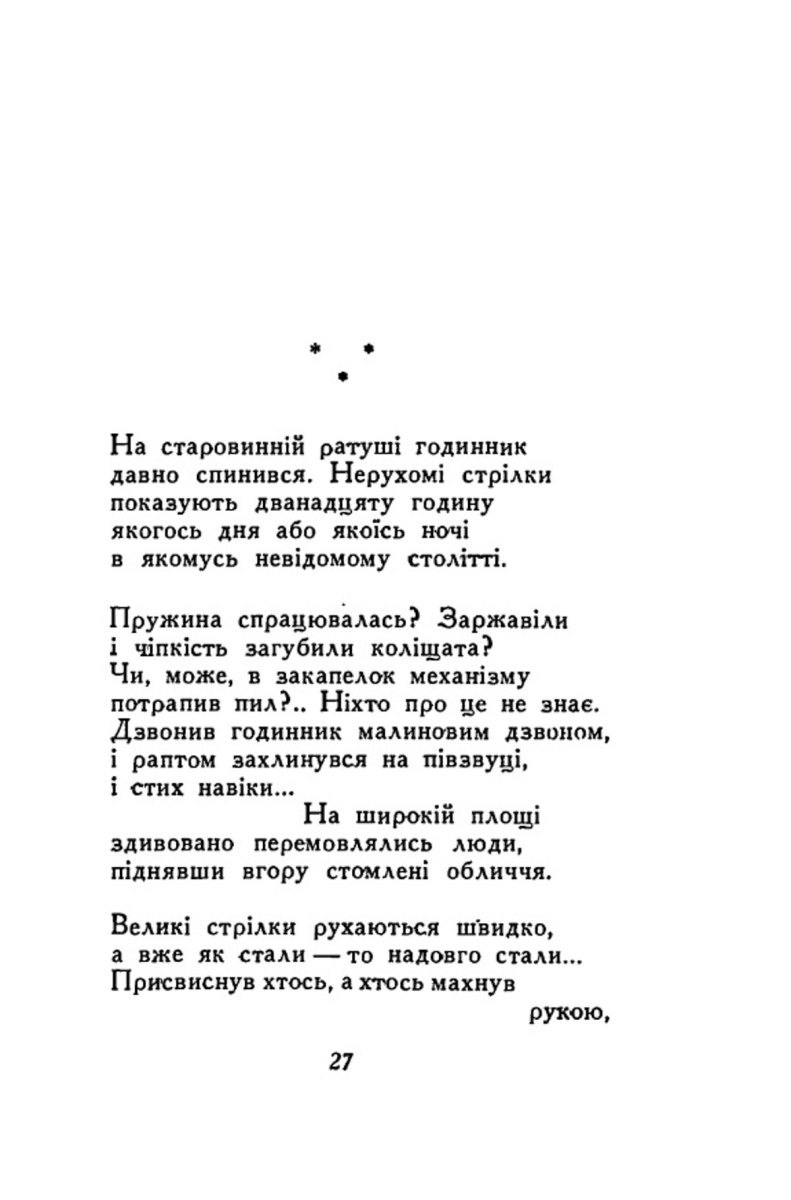
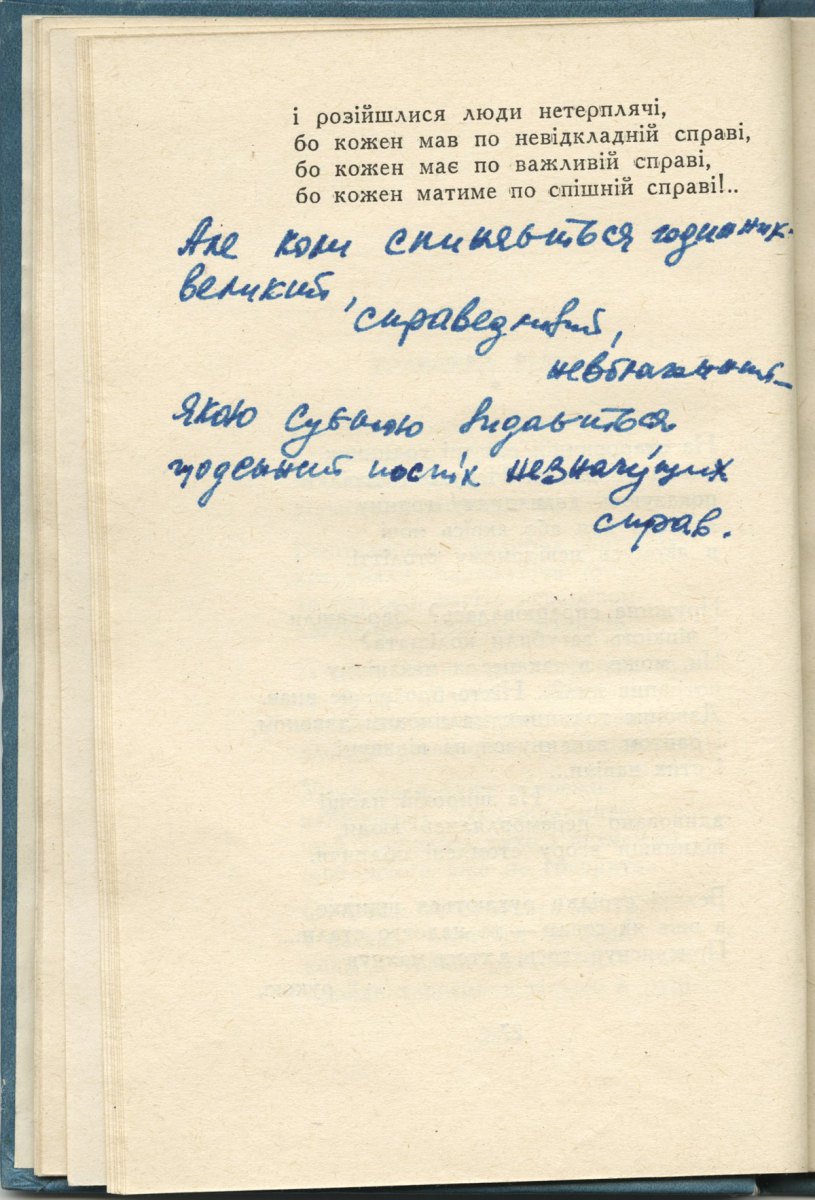
And now let us clearly set out the four lines crossed out by the censors and rewritten by Lina:
But when the clock stops,
great,
just,
relentless —
how futile seems
the daily haste over insignificant affairs.
It turns out that the author’s original intention was not merely to portray and reflect on human inertia and our absorption in everyday affairs. It also contained a transparent hint at an entire system with a broken mechanism — at least in terms of time. And that was intolerable for Soviet censorship.
Although the author’s version does away with the triple elegance of the censored ending printed in the book, this does not, it seems, invalidate Briukhovetskyi’s argument about the aphorism being “organically spread throughout the entire poem”.
Someone with an aesthetic eye might nevertheless ask: was the version printed in the book and approved by Glavlit not actually better? (Censorship is often the sister of ambiguity, and the fashion for it never seems to go away.) I don’t know, I really don’t know… Personally, I find these four crossed-out lines important and creatively productive. They were written at the very beginning of the Thaw, in an era of hopeful dreams. Even before the chronological beginning of the Sixtiers movement, they foreshadowed the sombre moods of Kostenko’s poetry in the second half of the 1960s, when the screws began to be tightened. It was then that the very sight of the “indifferent, colourful human mass” that “surged” along Khreshchatyk, unwilling to know about dissidents or the intensifying repression, could bring the poet to tears.
“Granite Fish”. Who needs to know about them and why
Now for the third and final censored poem in the collection. It is probably the most discussed and best-known of those we are examining. Even before the “Riga version”, which we will soon encounter, it had the greatest number of alternative endings.
Granite Fish first appeared in the July 1957 issue of the literary journal Zhovten. But that version of the ending was indeed somewhat imprecise; Lina Kostenko subsequently reworked it radically, so we will not reproduce it here.
Let us look at the scan from the book
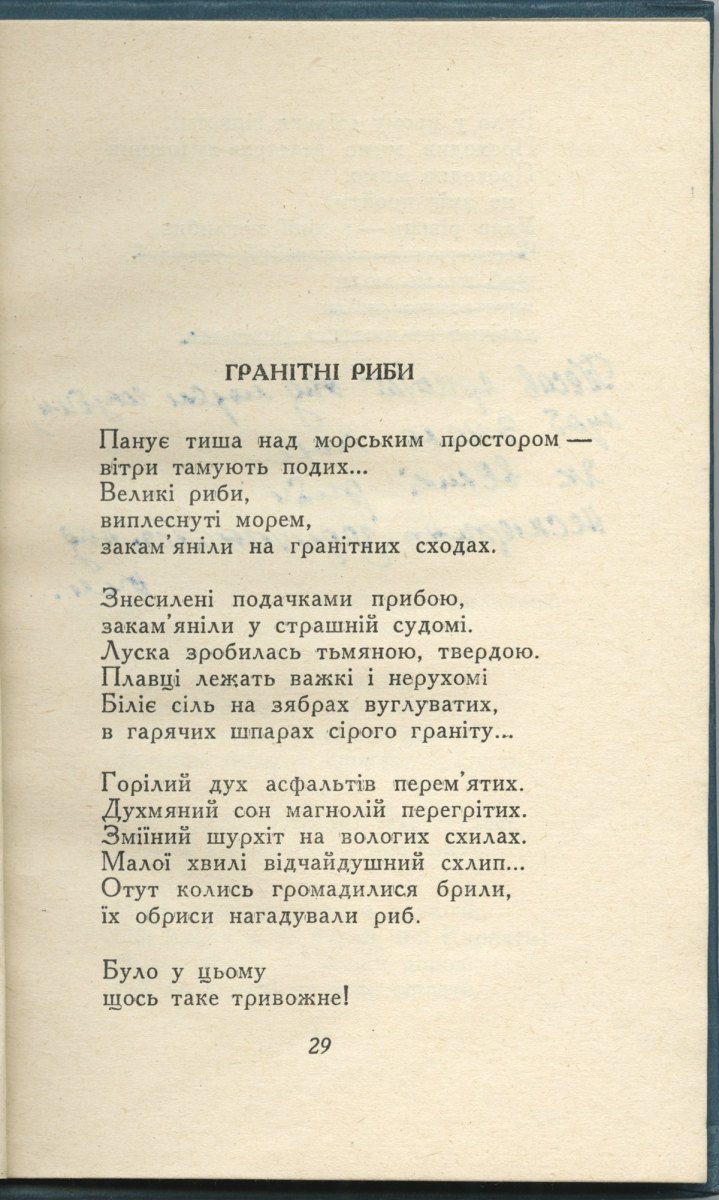
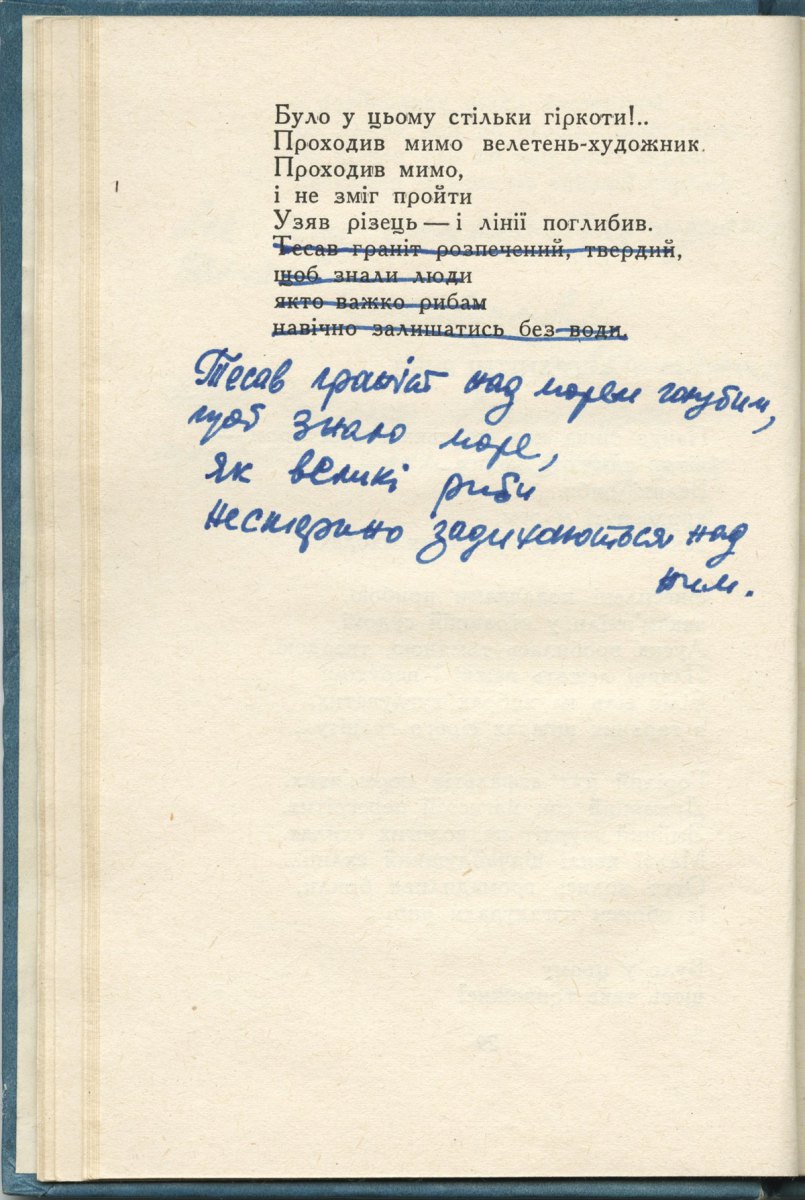
We can see two versions of the ending here — the “book” version and the “Riga” version.
Another, slightly different version of the final lines is also often published. It is quoted in Dziuba’s study mentioned at the beginning:
I took the chisel — and deepened the lines.
I carved the red-hot, solid granite,
so that people would know
how unbearable it is for fish
to remain above the sea without water.
Here, the direction of the editing compared with the “book version” is clear. First, the almost neutral “hard” is replaced by the painful “unbearable”. Second, instead of the striking but declarative “forever”, we get the more tangible “above the sea”. And the source of the pain is made explicit: being left without water while so close to the sea, directly above it.
Having understood this, we can decipher and clearly set out the “Riga version”:
I took the chisel — and deepened the lines.
I carved the granite above the blue sea,
so that the sea would know
how the great fish
unbearably gasp for breath above it.
The changes may seem minor, but they transform the poem profoundly. First and foremost, there is the verb “gasp” — how searing it is compared with the earlier “remain without water”, whether “hard” or even “unbearable”. Thus, at the beginning of the poem we see the horrifying end of a process: “Exhausted by the breakers’ handouts, / they turned to stone in a terrible convulsion.” At the end, the essence of that process is revealed: a picture of unbearable suffocation, the impossibility of breathing. Of course, the censors saw an allusion to the Soviet atmosphere in this — and could not tolerate it.
It is also important that the uncensored “Riga version” removes “people” and “water”. They become unnecessary within this system of imagery… Ivan Dziuba, working with the version containing “people and water”, wrote: “Art connects the ‘suffering of nature’ with the inner world of the individual.” And that was fair — for that particular version. Without “people” and “water”, however, the metaphorical structure of Granite Fish changes radically: the “great fish” are the people themselves. Great people! And it is the “sea” that must know about their tragic existence and non-existence. The “sea” itself becomes a thinking universe, a human Solaris — that unceasing human sea above the “crumpled asphalt” (presumably smoothly laid).
How often this sea knows nothing of the great fish above it, gasping for breath.
This is a peculiar continuation — using different material and a different system of imagery — of the theme begun in The Clock on the Old Town Hall. Read without censorship, the two poems, placed one after the other by the author, describe two interconnected phenomena. In the first case, the mechanism of mass indifference; in the second, the difficult fate of the rare people who refuse to be indifferent.
Postscript. Knowledge without imperial mediation
In empires, including the Soviet one, enormous efforts were made to ensure that all forms of communication ran through the centre — Moscow and St Petersburg. This applied particularly strongly to the cultural sphere, through systems of funding, the structure of creative unions, festivals, congresses and forums. That is why, even today, after so many years of independence, we know one another less than we should, despite having the same adversary — the imperial centre.
Another problem is that Russia, the aggressor state, keeps its archives closed, making humanitarian research and scholarly investigations more difficult. Those archives contain a great deal of material accumulated from territories once under its control. All the more reason to value the fact that archives remain open in democratic countries such as Ukraine and Latvia. They can yield a great deal of fascinating material — for both sides.
***
Thanks for advice provided during the preparation of this article to poet and translator Māris Salējs and Vizma Belševica’s son, poet and translator Jānis Elsbergs.