




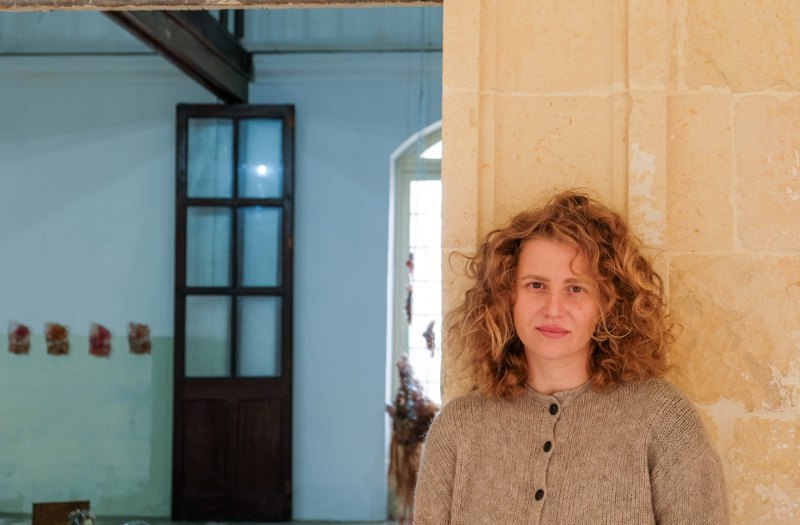
I will start with something simple and complex at the same time. You have had an interesting and challenging life journey, with a great deal of reflection on identity. Who is Maria Kulikovska today? What is she about?
It is a return to myself. A process of remembering myself. I was very broken; I was going through trauma. And now I am probably a wiser person. That’s Grandma Maria.
Please tell me more about your project at the Malta Biennale. As I understand it, it consists of several series, right? And how does it all come together? When a person enters the site, what will they see?
Everything I do is like a field where everything is about one thing, but from different angles. In fact, each part of the project contains a central theme. One project flows into another, reinforcing and communicating with the previous one. Although you can see different techniques and materials, everything is consistent.
I am currently writing a research project at university, and it is based on practice, so my participation in the Malta Biennale is part of my ongoing exploration of the boundaries of corporeality and embodiment through art, through an interdisciplinary approach.
When I applied for this scholarship at the university two years ago, I was in a very depressed state — like a person who had been completely broken and no longer remembered who she was or where she came from. There was prolonged depression, postpartum depression, anxiety, the start of the full-scale war, relocation again — this time with a small child — and the collapse of my health. In other words, I was truly on the verge of non-existence. And then I realised that in order to survive in this terrible, rather toxic industry of contemporary art, I had to adapt. My supervisor advised me on how to apply correctly so that I would be accepted.
My statement at the time was this: I have three disciplines — it all starts with watercolour, then sculpture, and then performance with these sculptures. But the industry and the market — whether academic or artistic — want to see us as very clearly defined. Like, this is Maria Kulikovska, and this is what she’s about. You can’t be strange or restless. I can say that any art market is as conservative as possible. It is probably one of the most conservative industries.
And also — through six handshakes, someone knows someone, and everything works that way. But I already have my place, so I can afford to say what I really think. Back then, in my desperate state, I wrote the description the way they wanted it. But it wasn’t mine. And now I’m just throwing it away because I’ve built up my muscles — in every sense. Here come the crutches, the broken sculptures that I will “heal” during the opening. And I feel that this is not just a metaphor.
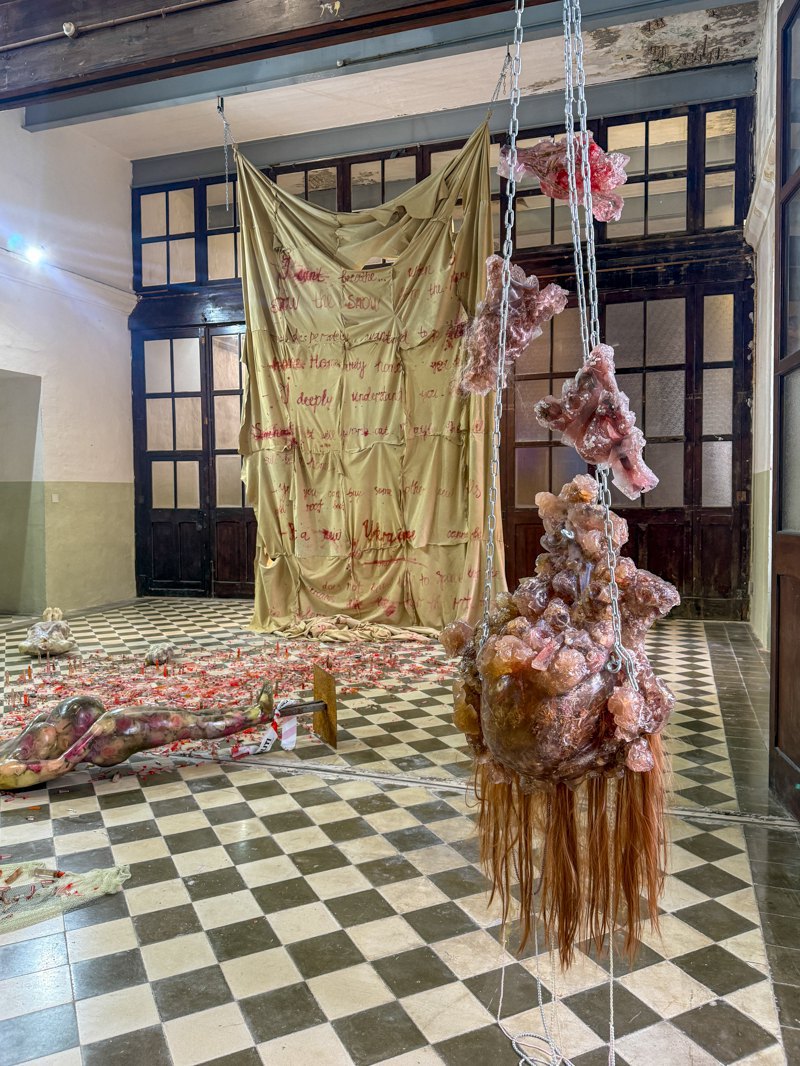
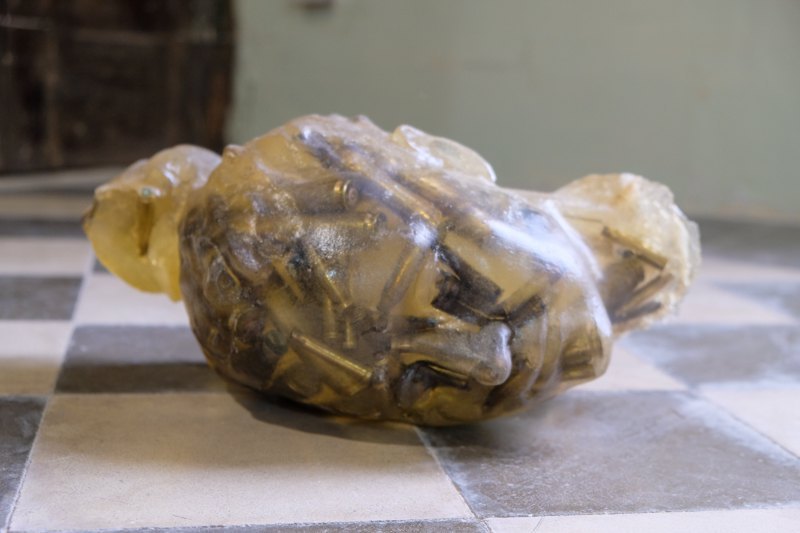
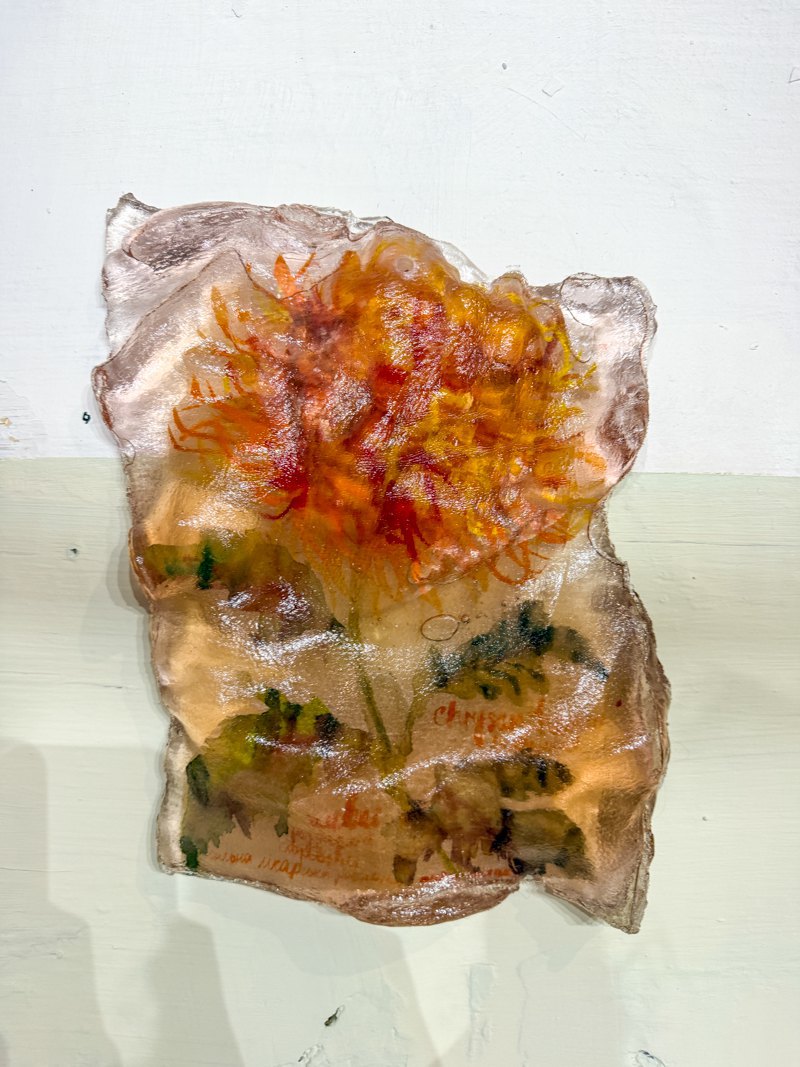
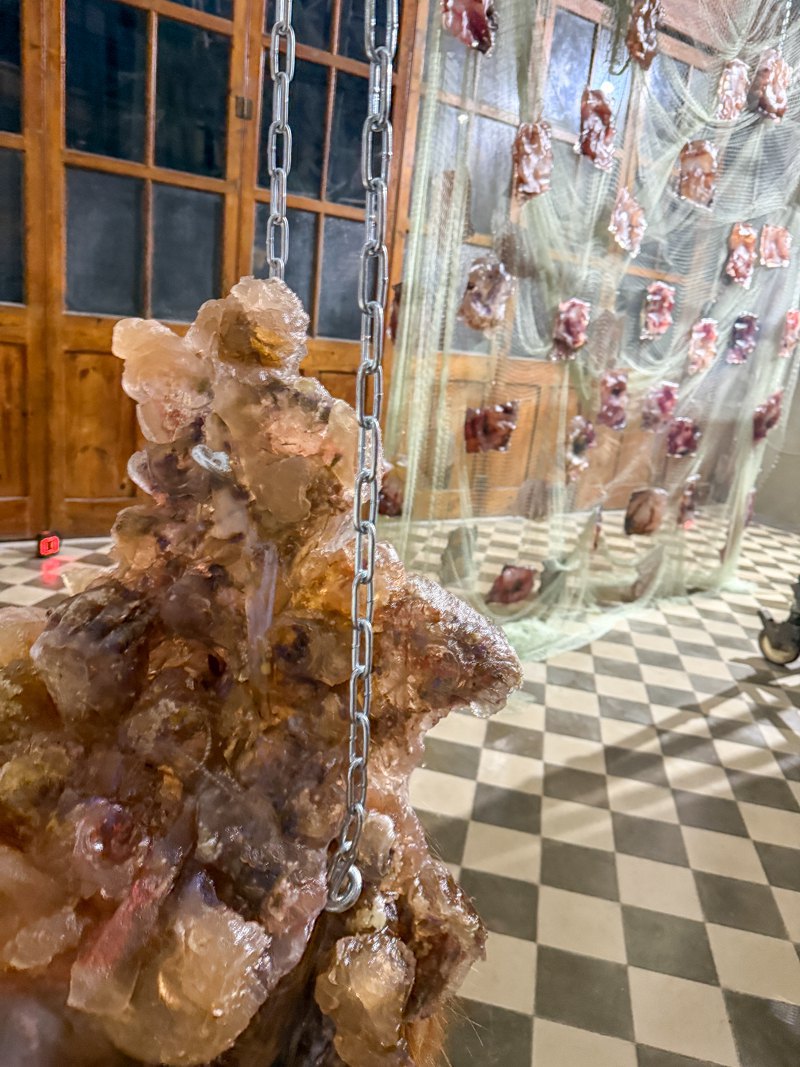
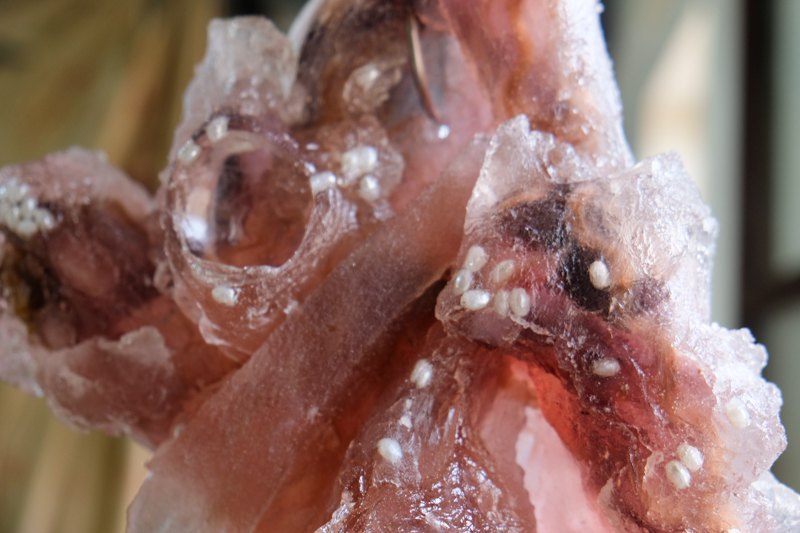
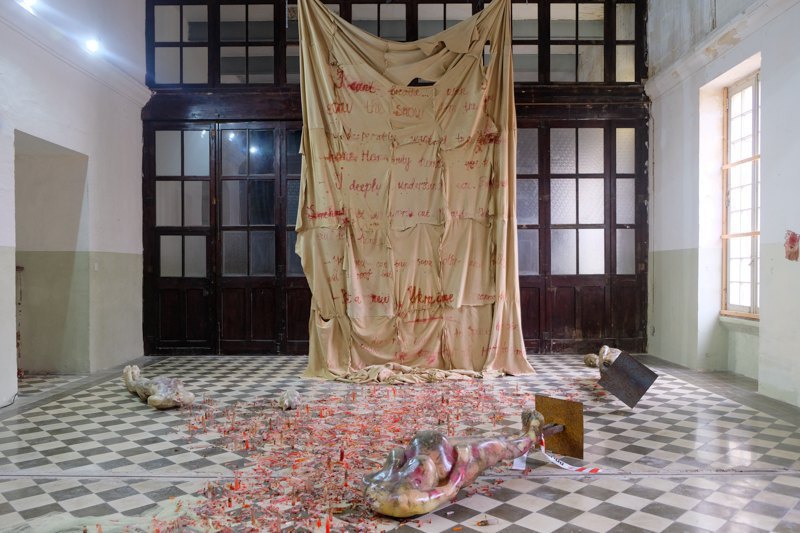
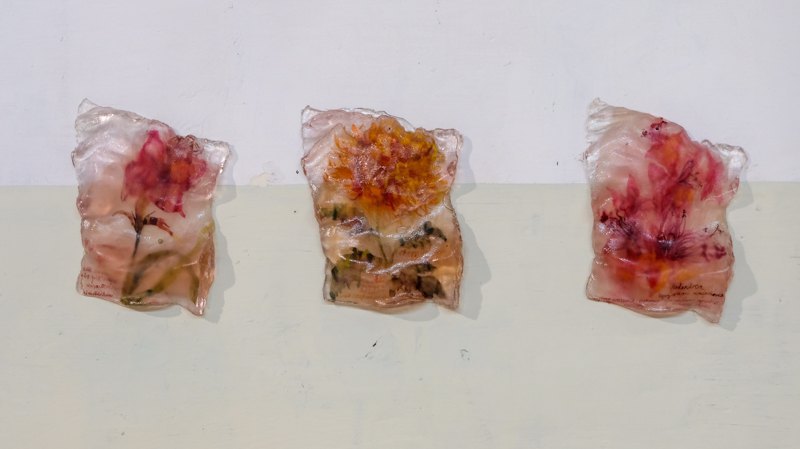
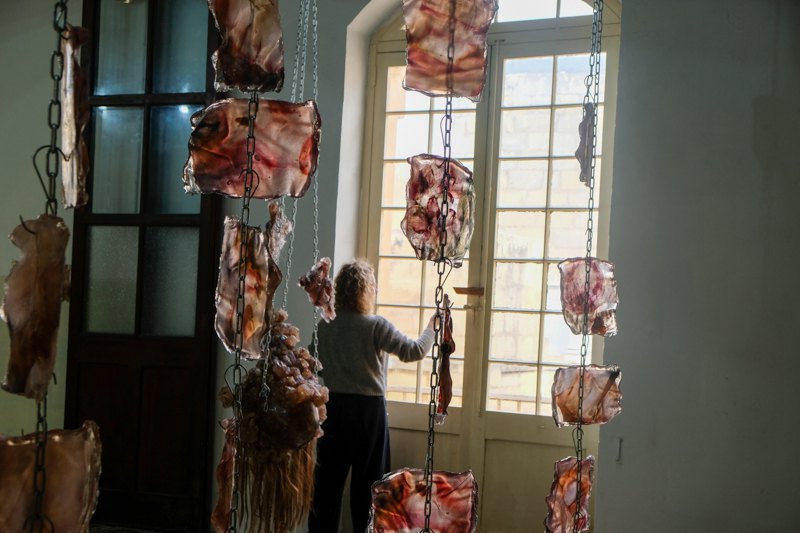
All the components of my project create a whole. For example, my sculptural objects are real casts of skin, and inside them are my watercolours. So they’re not separate watercolours on the wall — they’re hidden inside the sculpture.
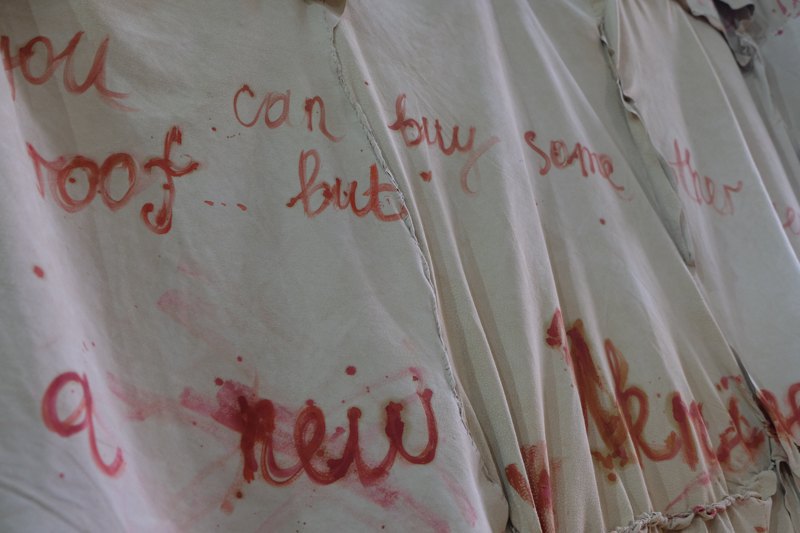
The fabric is not just fabric; it is the skin from which I took the casts. So even these objects are connected to each other.
The crutches and sticks are casts of the ones my husband used when we met. At the time, he had his leg stitched up and was literally learning to walk again. Our “bouquet period” consisted of me helping him get back on his feet. And now I need this myself — to get back on my feet, because I’ve been crushed by these geopolitical and social games.
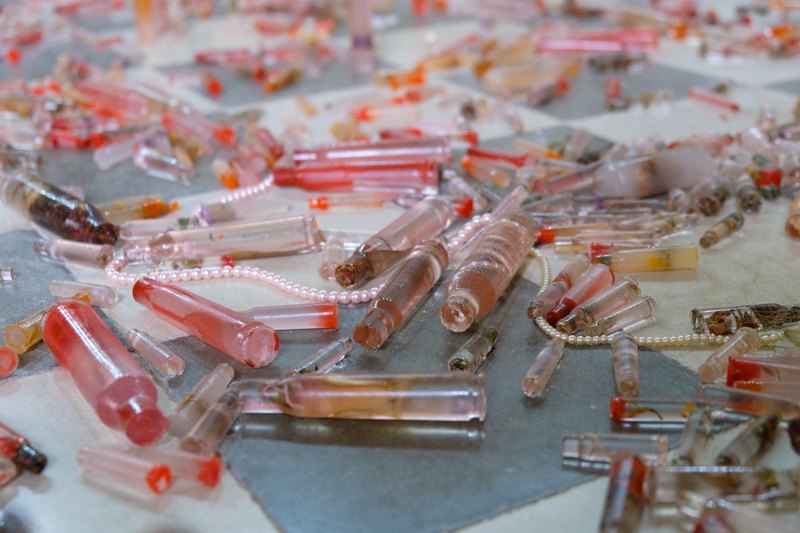
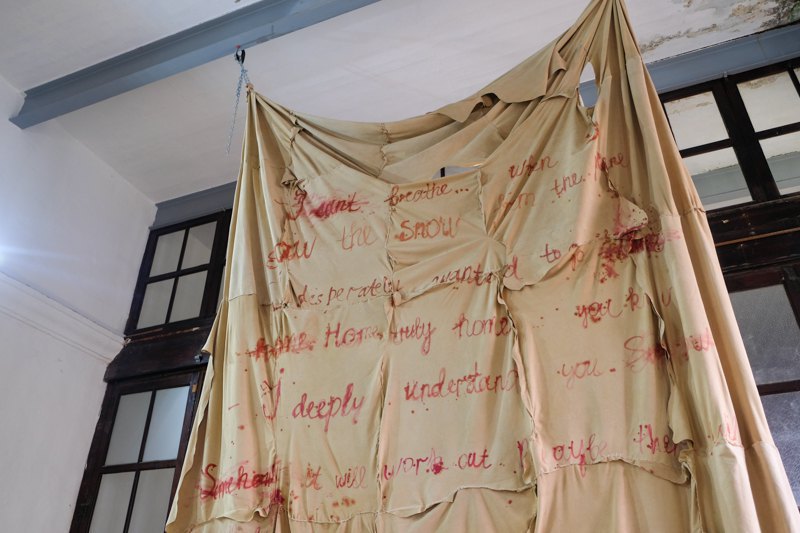
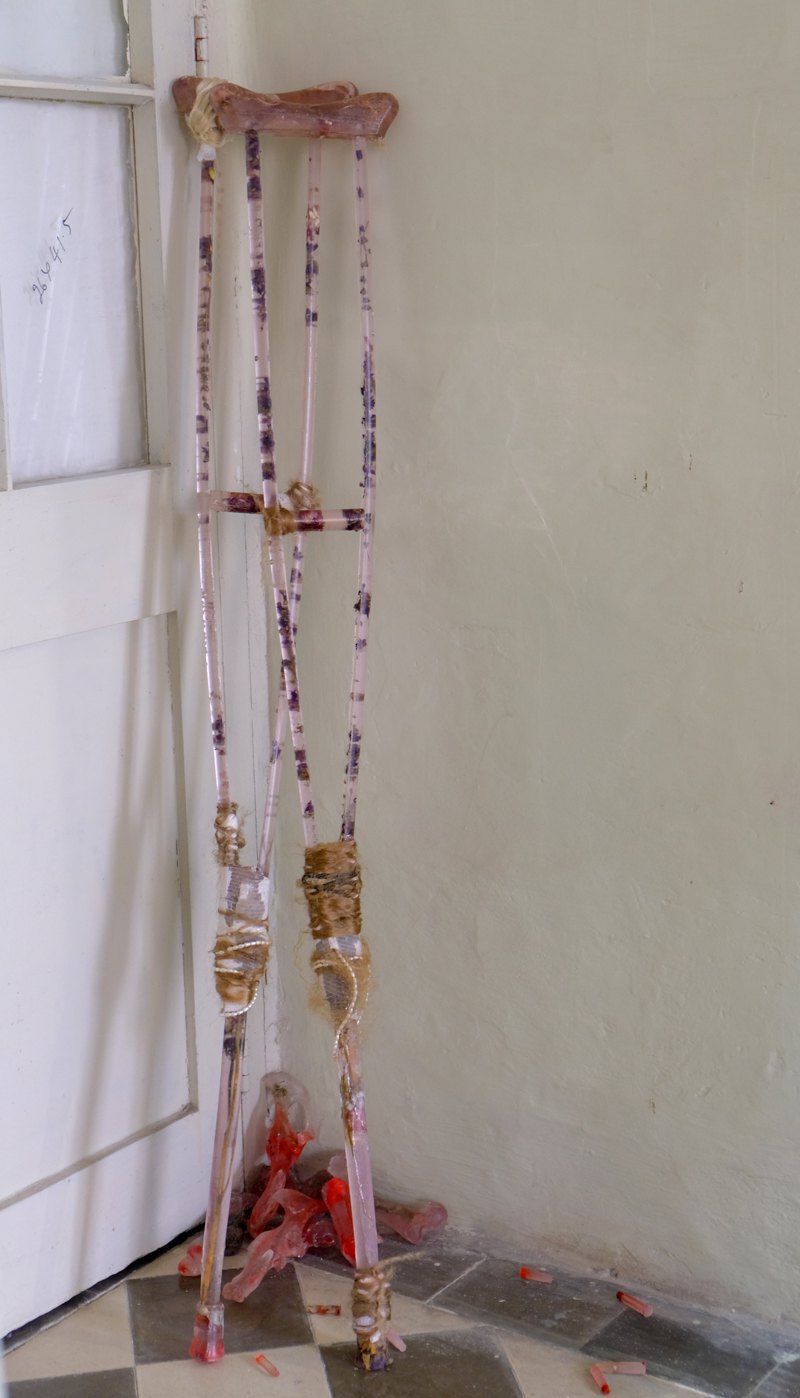
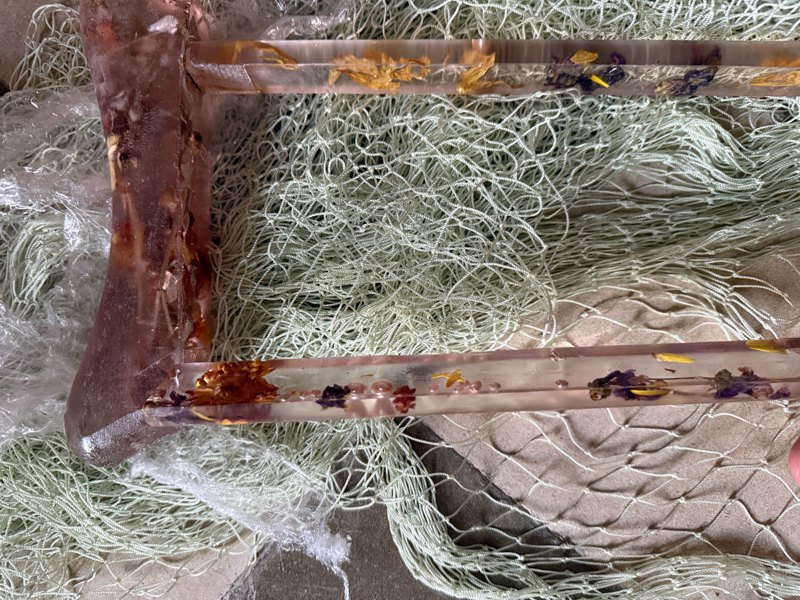
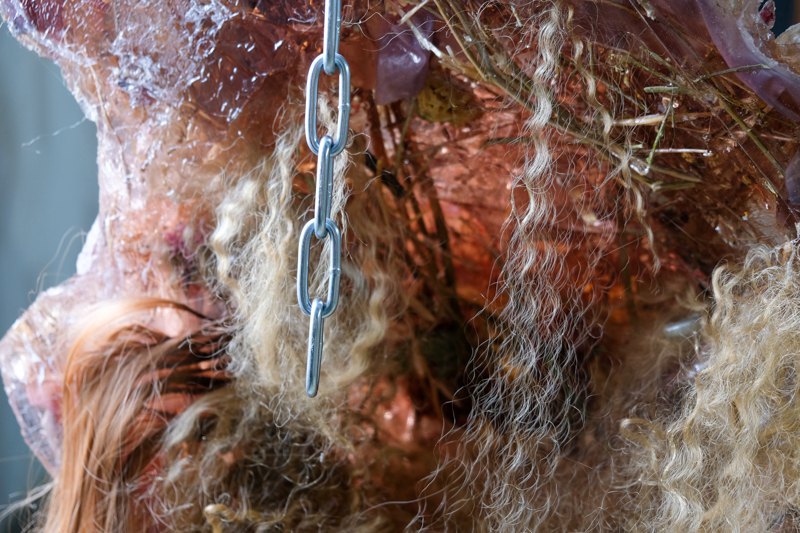
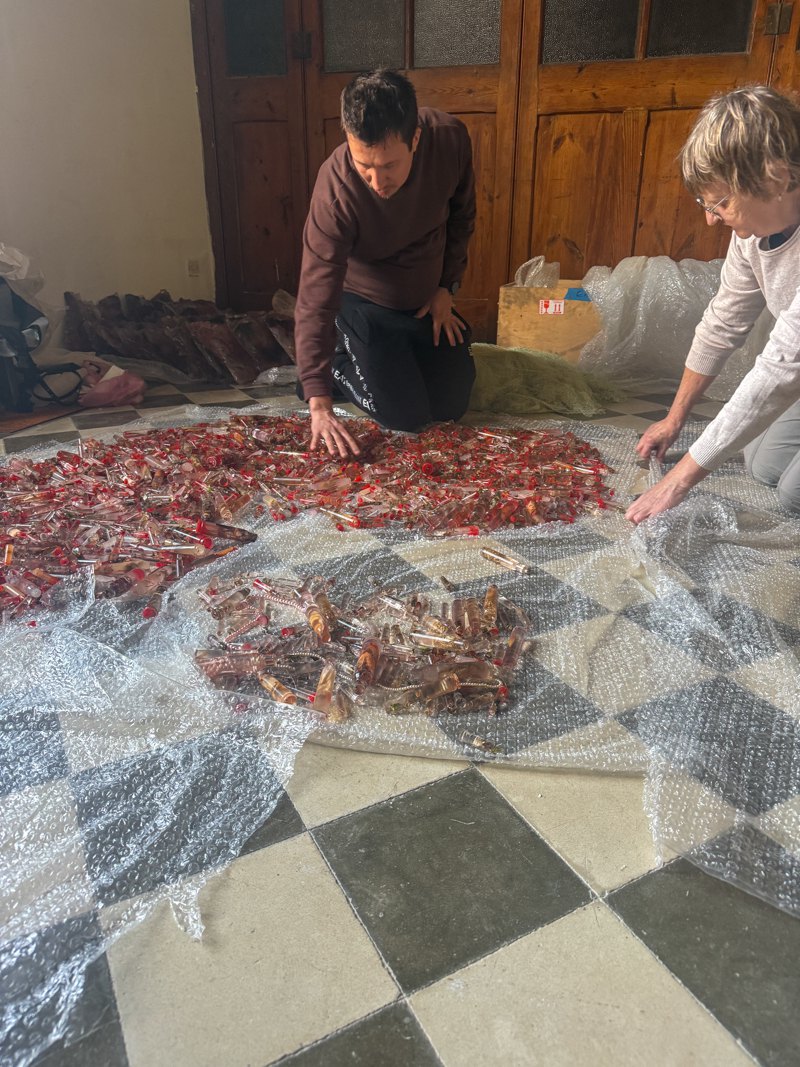
I also use herbs in the project. And they are not random either. There is nothing artificial there: herbs, sticks — these are all things my mother grew in the village where my grandmother was born. This was before she moved to Crimea. And now, during the great war, my mother found herself back in the village where her mother was born. On the slopes there, we grew the herbs that my grandmother taught me to gather. These are the voices of generations of women who were all displaced and carried this transgenerational trauma. And perhaps they never even spoke about it, because we were never given the right to talk about it. My mother is participating with me in the editing of the project. She came especially after my grandmother's death to do this editing with me.
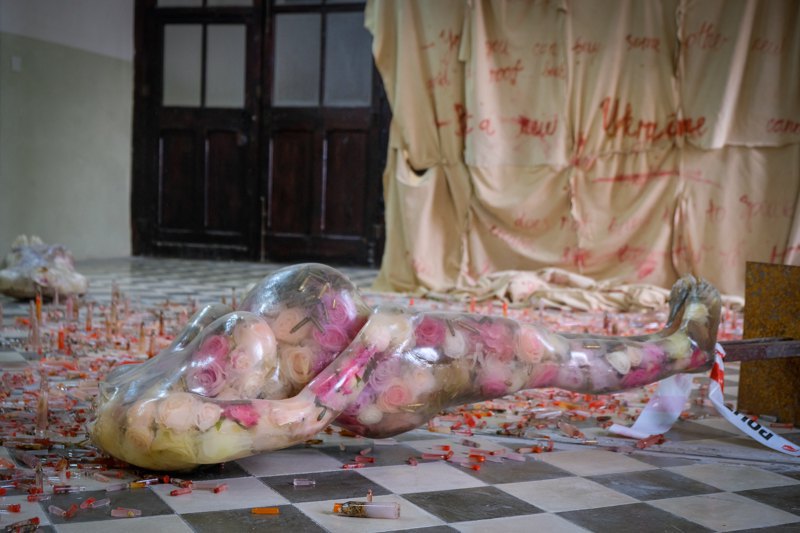
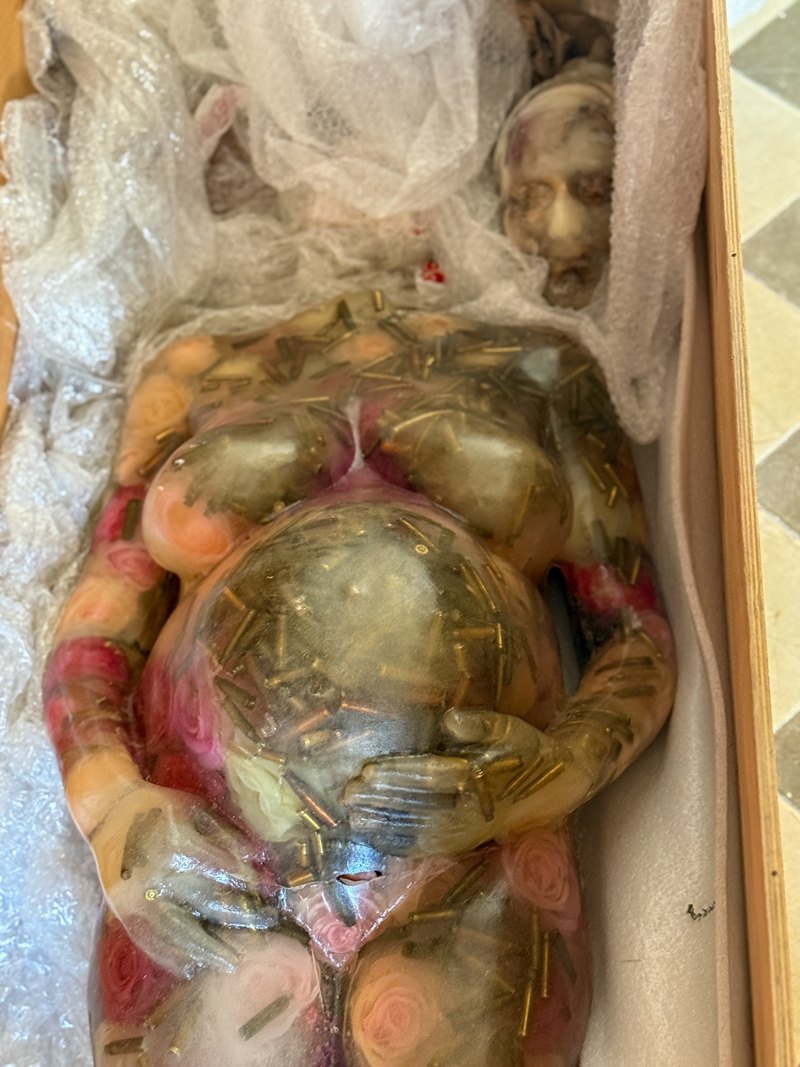
The bullets are also with us, they are part of the concept, and each one was cast separately, I added herbs to them. Just imagine: from 11 January to 27 February — two months of daily, continuous work. Then I will put a corset on the pregnant sculpture, the one that once held my belly when I was pregnant. Every detail there has meaning, and nothing is accidental.
I am often cast — without even being asked — in the role of a victim. Not only because I am a woman, but also because I was not born in a place where it is "cool" to be born. More precisely, it was cool to be born, but it is as if it were my sin, which I did not choose and did not commit. And because of this, sometimes I have no control over my own life — over who I am, where I come from, and how I present myself.
But it is in this fragile, semi-transparent, mirage-like house that I create in the pavilion that careful, supportive control becomes possible.
Even the paints and oils I use are products of a Ukrainian company registered and manufacturing in the city of Lyubeshiv. I have never been there. But that is where my mother was born.
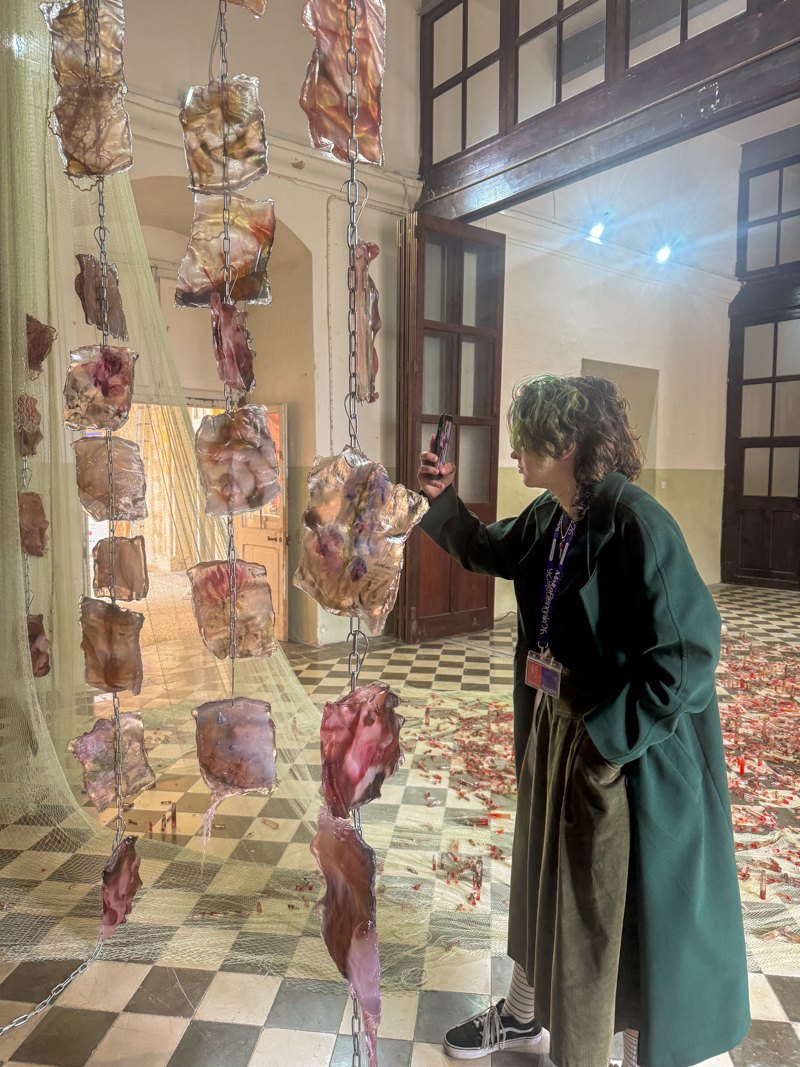
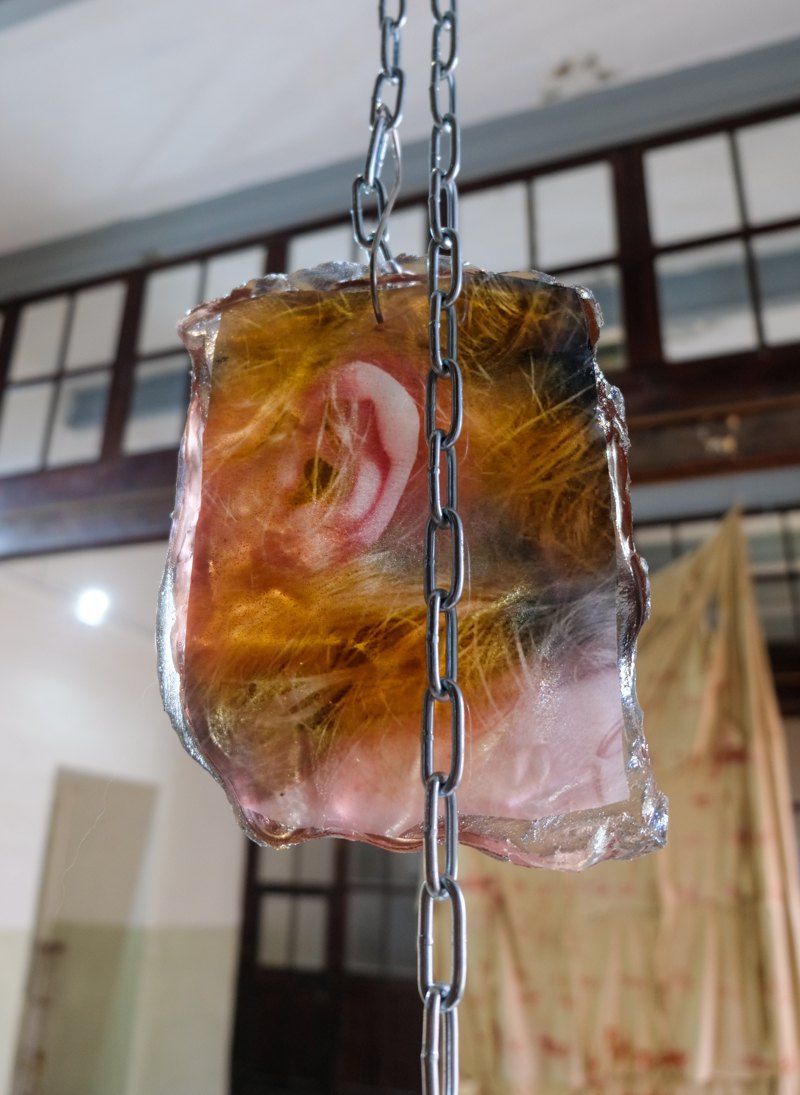
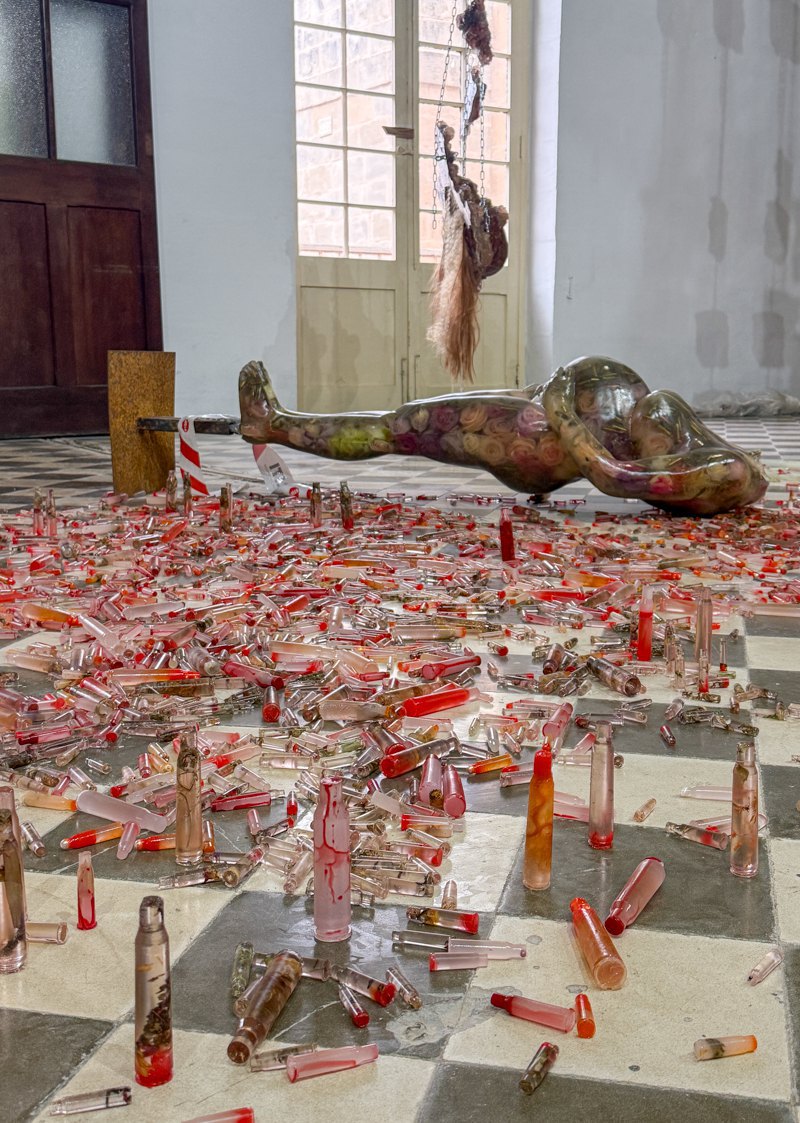
Incredible cyclicality.
My grandmother studied fashion design at Kyiv University of Technology and Design. But then the war started, and no one needed fashion designers anymore. She was sent to work as a milkmaid, then she began to study agronomy and entomology — plant protection. And she became a very cool scientist who studied plants. After World War II, she was sent to Western Ukraine to help restore the land. She was forced to go there — and that's where my mother was born. The circumstances were not very pleasant, because my grandmother was actually a dissident. And she had to flee again to avoid being killed. Against the backdrop of this stress, she gave birth to my mother a little earlier than expected. This happened in Lyubeshiv.
My mother never returned there after her birth, because when she was four or five months old, they were already in Crimea.
And I think these are also very important moments — details that may not be immediately obvious in my work, but they are the backbone that I work on. When the full-scale war began, my daughter Eva was also five months old. And my mother came to help take her away. We travelled through western Ukraine — and my mother found herself there for the first time since her birth.
That is why I paint my watercolours and write a manifesto, where I say that it may be possible to build and buy new walls and a roof, but it is impossible to buy a new Ukraine, and it is also impossible to buy a new self. I do this with paints created in Lyubeshiv, where my mother was accidentally born and then taken to Crimea, which I can no longer visit. And my Eva will most likely never get there either.
These are moments of this fragile home that only I know about. But as a visual artist, with these narratives and constructions, I create another world from them. Perhaps it will not give the viewer ready-made answers, but somehow it will give a sense of living this fragility.
The Malta Biennale is a UNESCO platform. Ukrainians have many questions about this organisation. Tell me, aren't you afraid of getting caught up in certain moments of opportunism or communicating with people who say the right words about trauma and war for very high salaries?
Oh, I can tell you a funny story — as they say, it’s a laughing-stock. I didn't put much effort into my application for the competition. I sent my portfolio and texts — and somehow I was selected.
Initially, there was supposed to be a different project. I was supposed to do it in collaboration with another Ukrainian artist, but she left the project. I think it was because the conditions for participation were very difficult: we had to find funding and there was very little time for everything. We received information that we had been selected before New Year's Eve. That meant we had two months to find the money and do the entire production. It was very stressful.
The director called me and asked me not to withdraw my participation. They put us at the centre of the entire pavilion, and it was very important for them to have Ukraine as the focus. So that's how we got involved and are working on it. In general, I very rarely apply for competitions — I'm too old for that now (laughs).
But I liked the fact that the Malta Biennale is billed as a platform for decolonisation. And it's very queer compared to other biennales. So that's okay with me.
You had a story about your sculptures being vandalised in Copenhagen. It is also a very symbolic story, unfortunately in a sad way. Please tell us, has there been any follow-up to this story? Is there an investigation, or do you have any hypotheses about who could have done it?
I still can't say everything because the police are investigating. We have a video, and it's terrible because it shows that it was a very clearly planned action.
This person arrived on a bicycle and knew where to park it. They approached and knocked over the sculptures with one hand. Then they walked around. Another man approached them, and they talked about something. The first one left, and the second one walked around a bit more, looked at everything, and also disappeared. I have some guesses as to who it might be. I gave the information to the police, and we are waiting. If my suspicions are confirmed, I will talk about it, and it could have a big impact. But while the investigation is ongoing, I have no right to say more.
Although, to be honest, I think the police may just cover up this story because they protect their citizens, and to them, I am just a tourist.
And this is, in fact, also a case for Denmark — to pay attention to what is happening.
Because there are facts of inaction in Western countries, where they protect their citizens, but when you are a woman and a refugee, you do not feel protected. So, most likely, this story will be hushed up, unfortunately.
Why do you think women, as independent beings with a different physicality and sexuality, are still so inconvenient? So much so that people want to enslave, control, destroy and abuse them? Why is this happening?
Perhaps it is precisely about our strength through vulnerability. Because we can allow ourselves to be non-aggressive, sensitive, empathetic, supportive, and we can unite.
Today, for example, we were riding the bus. A woman with a baby got on. My mother, a person with a disability who can hardly see, and other women immediately made room for her and supported her. We didn't even understand her language, she didn't understand us, she had a different skin colour, but it didn't matter. I held the baby's head so that it wouldn't get hurt in the bus jostle. In other words, everyone immediately showed this innate gesture of support and protection for one another. Perhaps that is why we are uncomfortable — because we pay attention to these "microcracks" and can support one another.
And at the same time, being a woman is, in essence, unpaid work.
In the Western world today, on the one hand, there is much discussion about the blurring of gender boundaries and binary thinking. Some even claim that men and women are the same. But at the same time, we are born with a clearly defined female physicality that cannot be denied. The body defines us. Don't you see a contradiction between what society declares and what the body says?
I think that, in general, these contradictions exist in contemporary art. And sometimes I feel a certain tension in contemporary Western feminism. It seems to me that in some of its forms there is no room for femininity. It is as if a woman must constantly prove that she is as aggressive and resilient as a man.
But for me, equality does not mean that we have to be the same. Our experiences of physicality are different, and that is normal. For example, during the creation and installation of the pavilion, there were things that required different physical strength, so I worked together with the technical team. For me, it is not about weakness or strength, but about cooperation and trust. I also see that my communication with my daughter differs from my husband Olen’s approach. He speaks from his own experience, and I speak from mine. And these experiences are naturally different. This is partly due to the society we live in, but also because we simply experience our bodies and our roles differently.
During my pregnancy and after the birth of my daughter, I went through a very difficult physical period and was completely dependent on my husband's help. It was an experience of great vulnerability. And even now, I know that I can realise my ideas because I have help with the child.
Therefore, for me, this issue is much broader — it is a question of human relationships. I think we need to change the very language of communication and learn to accept our differences with more empathy.
I have been in the feminist movement for many years, but sometimes I think it is important not only to fight, but also to live, to exercise the rights we have already gained and to continue to expand them. And one more thing: I don't want to achieve equality through the language of patriarchy. Sometimes we start to reproduce the same language of power and harsh domination that patriarchy has historically used. And then we risk continuing the same logic of conflict instead of looking for other ways of coexistence.
And we remain on the path of revenge: some are better than others and vice versa.
It seems to me that sometimes we simply forget that it is okay to ask for help and support each other. I do not think that equality means that we all have to do the same thing or prove our strength in the same way. For example, I don't have to prove my independence by doing any physical work on my own. At the same time, this does not mean that I cannot learn to do it or that women are incapable of doing it.
For me, it's more a question of interaction: we experience our bodies differently, we have different experiences and different abilities, and there is nothing wrong with that.
You and your husband, Oleh Vinnichenko, do a lot of joint projects, interact, and feel like partners in life. But outside of this bubble, do you see a big gap in the world between the development of women and men? Women actively remember their identity, and it is diverse, while men's emotional sphere often remains underdeveloped. Are you interested in exploring what masculinity means through art?
Actually, Oleh and I are doing almost nothing together right now. Because of this damn war — practically nothing. And that causes me immense pain, because it breaks our fragile, delicate connection. But he still helps me — as a coach, as a technologist, as an engineer, and just as a great organiser.
I can say frankly: when we met, I was in complete chaos. My life was more of a disaster than a life. He just saw how difficult it was for me with people, how difficult it was with this world. I couldn't find myself at all. It was even difficult for me to communicate because I live in my own dimension — with my inflated moral principles. I was on the verge of completely withdrawing from this world. But my husband, who was often the producer of my projects, always sorted through this chaos, put everything in order, and took action. Before the war, it looked like this: I would come up with something, run to him, tell him my idea — and then run off again to come up with something else. And he would be silent, silent, thinking — and then find a way to make it happen. And together we did something very interesting, beautiful, with new things constantly appearing. Now there is almost none of that. Now I organise more myself.
In our war situation, I sometimes see a paradoxical thing: women today can be more mobile than men, who are often restricted in their movement due to mobilisation. And in this sense, we have more responsibility for implementing our own ideas and projects. In my case, this means that I just take action and do it. Of course, I consult with Oleh, but all the organisational responsibility now lies with me.
That is, sometimes there is no romantic illusion of an artist who simply creates ideas. Whether you like it or not, you have to go, organise, work, look for resources, and negotiate.
At the same time, I see that women today have many more opportunities for self-realisation than they did a hundred years ago. We no longer live in the Middle Ages. But sometimes I think it's important not only to talk about rights, but also to exercise them — to take responsibility and realise your own ideas, even though it's still very difficult at times.
But I often feel pain when I think about Ukrainian men. Because we are used to the fact that we are at war, and we automatically see men through this prism. It's as if it's their parish. But not all men want to fight. Definitely not all of them. Many want to have the right to travel, grow something, be a father, invest in their children, develop themselves, hold exhibitions, create pavilions.
Even on a domestic level: everyone has aggression. Both us and them. It just manifests itself differently.
War changes the very atmosphere of society. People live in a state of constant tension, fear and uncertainty, and this affects the language we use to talk to each other. There are a lot of harsh words and mutual accusations in the public sphere, but for me, this is more a symptom of the deep trauma that the whole society is experiencing. The war affects every family, and this tension inevitably manifests itself in how people react to each other.
That is why I try to look at it not through the prism of aggression or accusation, but through an understanding of how vulnerable we all are right now. And perhaps that is why we need even more empathy and caution in how we talk about each other.
Let's return to the Malta Biennale. Are there any mandatory conditions for participants? How does the process work in general?
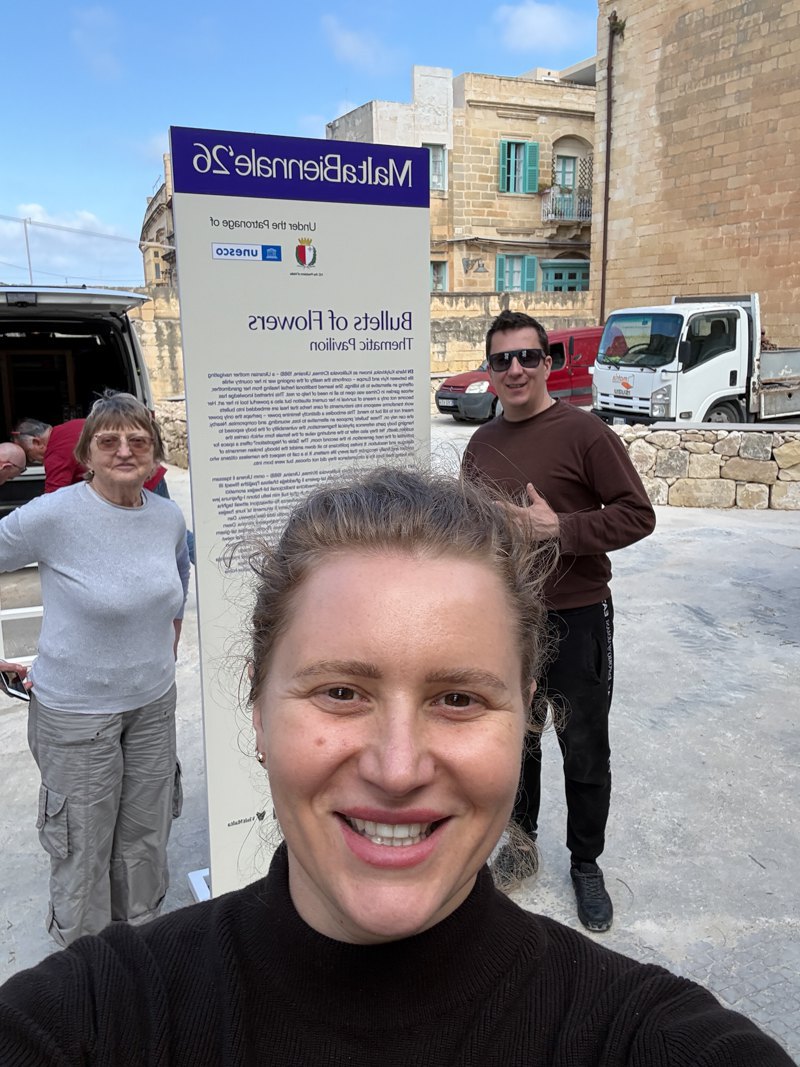
The Malta Biennale gala opening took place on 10 March on the island of Valletta, in the historic Mediterranean Conference Centre building. It was attended by the President of Malta, representatives of the Maltese government and Ministry of Culture, the president of the biennale and the biennale curator. It was a very solemn event with a musical programme and performances.
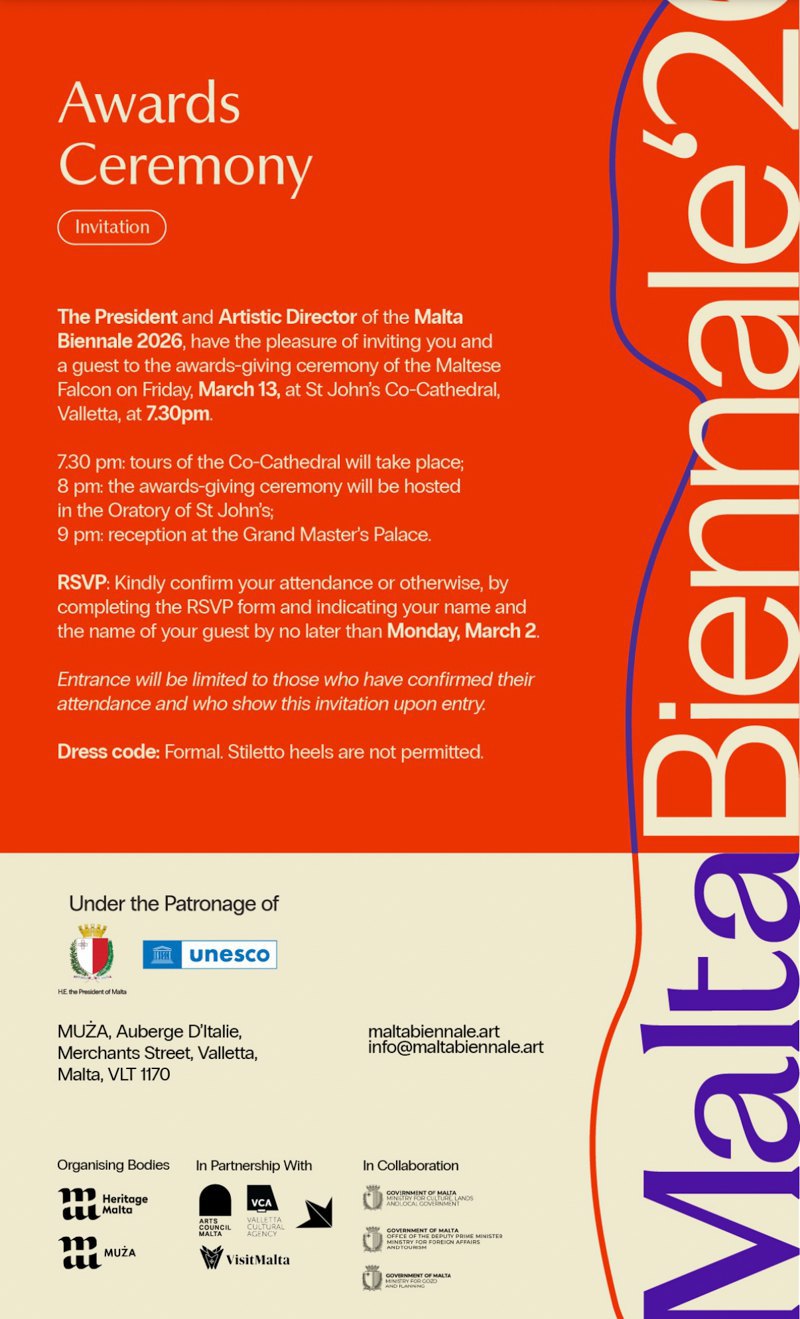
Next, from 11 to 13 March, there will be preview days for the jury, curators and invited guests. The award ceremony will take place on the evening of 13 March. From 14 March, the biennale will be open to the general public and will run until 29 May.
The grand opening of my pavilion will take place on 12 March at 3:45 p.m. Maltese time. This is a symbolic moment, because it was at 3:45 p.m. that I was born 38 years ago.
The opening will be attended by the pavilion's commissioner, Mariana Dzhulay, curator Eszter Csillag, who flew in from Hong Kong, as well as our main sponsor, Roza Tapanova, and guests who came to support the project from Ukraine and various parts of the world. A video message from Ukrainian Minister of Culture Tetyana Berezhna is also planned.
During the opening, I will perform with my sculptures, which were damaged during the previous exhibition in Copenhagen. It will be a gesture of their treatment and healing — a process of working with a wounded body, which for me can be an opportunity to recover from trauma.
Do you have the opportunity to do artist talks?
To be honest, I don't feel a great need for the classic artist talk format. I am in the pavilion every day, working with my objects. I bandage them, treat them, change them. In fact, this is a form of live conversation with the viewer, just not in the format of a lecture, but through the process itself.
At the same time, the organisers are very interested in interacting with the Ukrainian diaspora on the island. It is small but very active. Therefore, during my performance on 12 March at 3:45 p.m., a live online broadcast is planned so that the Ukrainian community can join in and see the opening of the pavilion and the performance itself. It is important to me that Ukrainians are present and visible even from a distance.
Overall, the atmosphere at the Biennale is very relaxed, which I really like. There is no feeling of pressure or fierce competition here. On the contrary, there is a lot of openness and support. If you want to organise additional events or involve your community, the organisers are all for it.
Are you affected by the scandal surrounding the Venice Biennale and Russia's return to the exhibition? Or do you try to remain detached, if possible?
I think that what makes the Malta Biennale interesting right now is that it offers a different atmosphere. It is also an event connected with historical architecture and cultural heritage, but at the same time it seems very open and modern.
It is also important to me that there is no Russian pavilion here, and I feel safe in this environment.
There are very different projects here. For example, the neighbouring pavilion works with people from the local prison — they spent six months creating an art project. And during the installation, these guys were here alongside artists, curators and technicians from all over the world. Next to them is an elegant paper installation from South Korea. And then there are my broken sculptures. Somewhere, Poles are creating delicate textile works, somewhere else, harsh techno music is playing.
And all this diversity coexists in one space in a strange way. It creates a very lively atmosphere — a bit like an art camp for adults, where everyone works with their own language and their own world.