





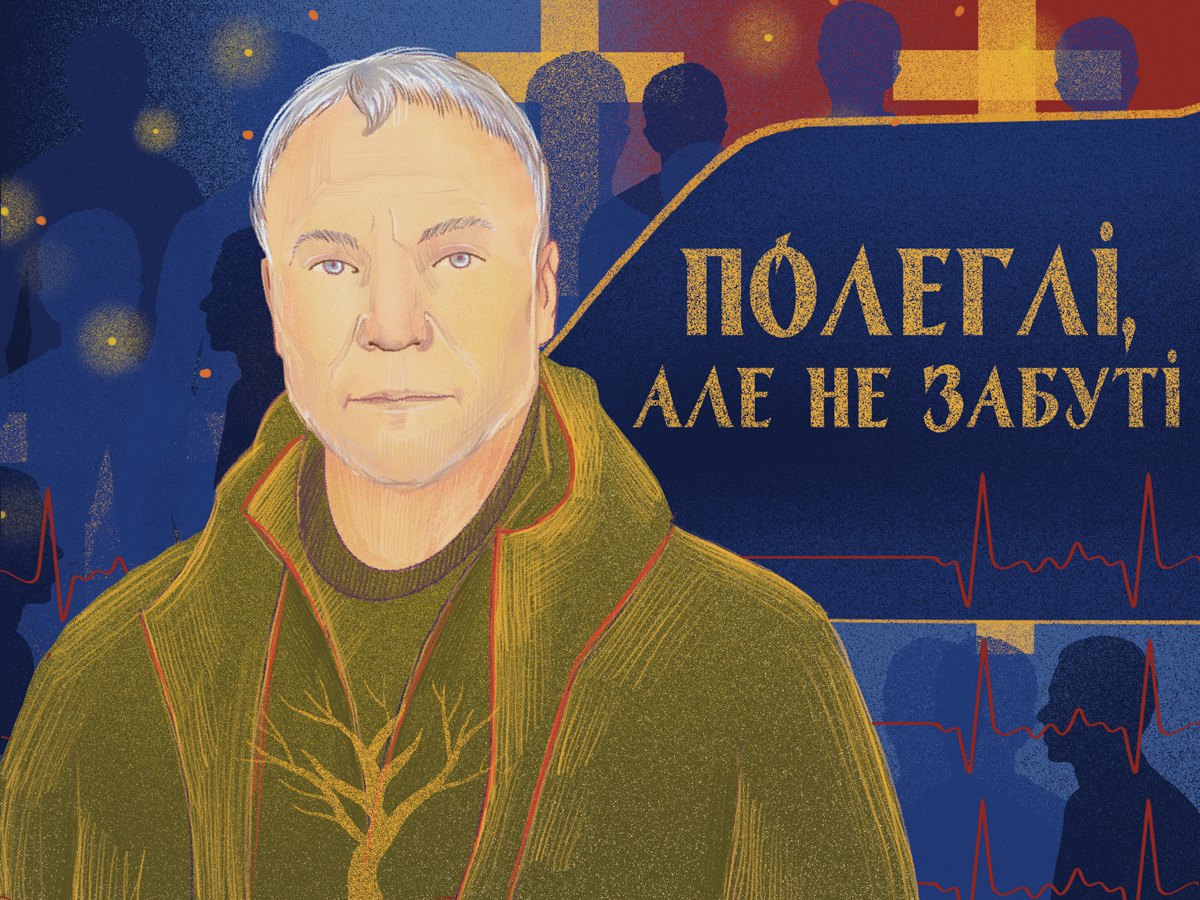
“Serhiy, I’m tied up with things right now, I’ll be there later. Go up to the priest and also find the funeral director,” a woman’s voice says on the phone, giving instructions.
“Yana, I’ll sort everything out,” Serhiy replies from behind the wheel of the minibus. He is a few dozen metres from a cemetery in Kyiv.
Large inscriptions are written on both sides of the vehicle: “Fallen but not forgotten”, “They died defending Ukraine”. At the back is the licence plate reading “Hospitallers”. On the window: “On the Shield. Evacuation of the fallen”.
Serhiy is quiet, self-assured.
The call came from Yana Zinkevych, commander of the Hospitallers — a volunteer medical battalion that has been involved in the Russo-Ukrainian war since 2014.
Late the previous evening, Serhiy transported the body of 26-year-old Lana Chornohorska (Sati), a UAV operator killed by an enemy drone strike, from Zaporizhzhya to Kyiv. At 7:00 a.m., he brought her to the morgue, where the soldier was given makeup.
It is now almost 9:00 a.m. In a few minutes the farewell ceremony will begin. After that, Mishchenko will once again travel 550 kilometres back to Zaporizhzhya, where the defender will be buried — her parents live there.
For now, he calls the priest. The priest is already there, waiting. The vehicle carrying the fallen soldier moves toward the crematorium. Snow is swirling; people with flowers push through the wind, heads bowed. When the car draws level with them, they stop and place the fist of their right hand over their heart. Serhiy does the same when, on his command, the coffin is carried out of the vehicle.
Serhiy goes on “On the Shield” evacuation missions every two weeks. He has been with the Hospitallers since 2018.
About the final journey of soldiers, the duties during the mission, and reflections on life, death and memory — in Serhiy’s monologue recorded by the Memorial platform as part of the special project People Who Work with Death. All materials from the project can be read via the link.
And when the headquarters once again asked, “Can you do it?”, I could
At the start of the 2000s, I witnessed a car accident. Dawn, traffic light, intersection. One car hit another. People were thrown through windows and doors. Blood, moans, a wounded man blinking his eyes as life drained from him. I just stood there, shocked and helpless.
Since then, I wanted to learn how to provide help. When the war began in 2014, I took multiple tactical medical courses with Israeli instructors, though they lasted only a day or two. In 2018, I came across a Hospitallers announcement offering a week-long course. That’s how I met the instructors, and after training, when they offered me to stay and go on rotations with the military for evacuations, I agreed. I became a paramedic.
Once, I transported a fallen soldier on a final mission. After that, the role kept coming to me. I’ve gone through this cycle several times: taking a body from the field all the way to burial. And each time headquarters asked, “Can you do it?” — I could.
That doesn’t mean I don’t perform other duties. Service in the battalion is multifaceted: driving wounded soldiers to rehabilitation centres, meeting relatives of the injured, assisting medics or veterinarians (military personnel evacuate abandoned cats, dogs, and other animals from areas near the frontline).
When I’m not on rotation and at home in Dnipro, I carry out tasks related to the country’s defence — specifically with the Unmanned Systems Service.
Since 2018, I’ve accompanied almost all the fallen from our battalion and the battalions of the Ukrainian Volunteer Army (the Hospitallers are a structural unit of the UDA) on their final journey. I remember everyone, not because it’s traumatic, but because each case is unique.
My first encounter with death was a soldier killed near Avdiivka. She was brought to the morgue. The doctor who knew her, who had spoken to her that very morning as she went to her position, was crying.
“My dear girl, how did this happen?” he murmured near her. “Forgive me, sweetheart, I still have to check here and here.”
He was examining what had caused her death. Shrapnel from an under-barrel grenade launcher had entered under her chin, severing blood vessels.
The doctor handled her with immense care and gentleness. I was struck by his attitude: a military medic, at war since 2014 — speaking to the fallen as if she were still alive.
It felt like a continuation of life — a conversation between two people, only one could no longer respond. And it was overwhelming.
People ask me, “Could he have survived?”

Communication with relatives often begins in the car. Here is one case. A fellow soldier once called me:
“His wife has arrived in Dnipro. Can you take her to the morgue?”
She had come from Poland and called me:
“I need your help. My beloved has been killed, his body is in the morgue — could you pick me up?”
She got into the car. I didn’t ask any questions. There is no point in rushing — everything has already happened. I treat her simply as a person who needs someone beside her. Someone to support her.
We are driving. The woman is talking, but her thoughts are not here. Near the morgue I ask how she is feeling, because a person’s legs may give way, they may fall or faint; for such situations I carry ammonia and wet wipes to place on the forehead. I ask whether she needs me to stay with her.
“Yes.”
We go inside, and the body is brought out in a bag. Her first words are: “Yes, it’s him.” And I realise that during the ride she had been thinking it might still be a mistake…
Then she looks at the fallen soldier and asks: “Could he have survived?” People ask that very often. Sometimes I remain silent, because my answers are not always needed.
When we travel with relatives in the van — sometimes we spend half a day together — they may ask whether I am connected to the unit, whether I was his comrade, whether I was nearby when he died, whether I know the details.
Usually I say that this loss is shared by all of us, that we mourn him deeply, and that he was someone who cannot be replaced.
Most often, I also have to take responsibility for organising the funeral.
The Hospitallers provide transport, fuel, a coffin and clothing for the fallen. I drive a refrigerated Mercedes Sprinter. Among my duties is also repairing the vehicle if it breaks down.
Besides rope, ammonia and wet wipes, I carry several body bags, gloves, antiseptics to clean the vehicle, straps to lower the coffin, and a cloth to cover the pedestal. I also have the battalion’s flag and the flag of the Ukrainian Volunteer Army.
I am always dressed in military uniform.
My work consists of different stages, depending on where I am when the need arises to take a fallen person on their final journey. Sometimes even from the place where they died, from the battlefield itself. Then the body must be taken to the nearest morgue and the official procedures completed — examination by a doctor, questioning by a police officer with me as a witness, and the necessary paperwork.
In 2018–2020, during the years of positional trench warfare, almost all the fallen were on the line of contact. We retrieved them from there. At that time there were no refrigerated vehicles yet — a medical vehicle transported the fallen to morgues in Avdiyivka or Mariupol.
In recent years the war has changed — the entire sky hums, and everything is being hunted. I wait until the soldiers bring the fallen fighter to a certain point, and from there I take over.
When a Hospitaller is killed, the battalion commander, Yana Zinkevych, personally informs the relatives. She gives me the phone number of someone in the family who is able to speak. I call them.
“Hello, this is Serhiy. I will accompany Mykhaylo (I never say ‘the body’) home.”
After that the work begins: to find out which day to bring him, whom to hand him over to. Sometimes I am met at the morgue, I transfer the fallen soldier — and that’s it, because someone has already taken responsibility for organising the funeral. But most often I have to do it myself. I need to determine the burial date, how many people will attend, which cemetery it will be at, what kind of ceremony will be held, and the person’s religious affiliation. Then I find the appropriate imam or priest — Catholic or Orthodox.
I also need to understand whether the relatives want to see the body or whether the coffin should remain closed. Sometimes I intervene here, because there are cases when the body is badly burned or the face is completely gone. Then I say it’s better not to see it — that he should remain in your memory as you knew him.
Sometimes relatives ask me, “Did you evacuate this soldier?” and show me a photo: summer, flowers, he is smiling. But I see a body in the earth, in the mud, twisted, torn apart… A living person and a dead person — they are different, very different.
The end of my mission is usually to stay at the cemetery until everything is over.
Sometimes a trip lasts three days.
I travel all across Ukraine — I’ve been to every major city, every region, from border to border.
Usually I have one fallen soldier in the vehicle, rarely more. But once I had to carry three: two were in bags, one in a coffin. To avoid traumatising the relatives — so they wouldn’t think “those bags aren’t yours, wait” — we arranged for the bodies to be collected at the morgue.
Some trips last three days. In some places we had to wait for relatives arriving from far away; in others, funeral rites did not allow burial on the same day.
The receiving side sometimes considers the crew and finds a place for us to stay overnight — sometimes they don’t. Once, after driving a thousand kilometres, at 11 p.m. I was told: “Thank you, we have local transport, we don’t need your vehicle.” And I had to urgently figure out where to go before curfew.
Every two weeks I have work. Before 2022 it was around the clock because there were not enough crews. Now the military is much better equipped — they have their own vehicles and medics who carry out their duties well.
As I drive, I sometimes speak in my thoughts with the fallen soldier — with his soul.
Once, some time ago, an experienced medic and I were retrieving a fallen soldier from a trench. We were carrying him at night. I said, “Listen, we’ve taken him, and you didn’t even look at him.”
He replied, “Why would I? I want to stay mentally and psychologically resilient and not carry all these deaths, all these stories inside me. My main focus is completing the mission. Emotional burden would only get in the way.”
There’s another story — about the first death I mentioned earlier. There, the fallen defender was spoken to as if she were the dearest, closest person. And my attitude toward the fallen became a mix of these two experiences.
On the one hand, I try not to break myself internally. On the other, I do want to know the circumstances in which a fighter — man or woman — was killed. In 90% of cases, relatives will ask how it happened.
It’s not always possible to avoid emotions. When the first meeting with relatives happens in a village, tears come to my eyes. And what overwhelms me — really chokes me — is when there are children. Children who have been left without their father. Their eyes, suddenly grown-up in an instant. It makes me want to hug them.
I see my mission this way: I am transporting a person whose body lies in the back of the vehicle. And I keep two things in focus — the body itself, which must be treated with care, and the person, their consciousness. It demands caution both in my thoughts and in my attitude.
As I drive, I speak in my mind to the fallen person, to their soul. Childishly, I try to comfort them. I say: “Listen, this is just the body. You still have your own tasks ahead, your own path. Tell us, the living, how we can help you.”
Once I needed to be beyond Lviv by 5:00 a.m. I desperately wanted to sleep — I had already been driving for a full day. I prayed, asking: “Help me. I must arrive on time and not let people down, because the entire village will come out at dawn to greet him with candles.”
There is a tradition: a road of candles becomes the light by which the soul finds its way to the other world. And when there were about 70 kilometres left, I physically could no longer continue. Suddenly, a young man — a relative of the fallen soldier — got into the car. “I know all these roads,” he said. “Let me drive.”
Sometimes the head of the morgue simply comes out and says: “There are no workers here. If you want, go find the body yourself.”
Bodies are not always released from the morgue “properly”. Sometimes the manager comes out and says: “Listen, there are no staff. If you want, go and look for the body.”
I ask, “Where?”
“In the container.” He hands me a key and gives me a number.
I go inside. Bodies are stacked chest-high. Blood on the floor, not yet frozen… And to get to “mine”, I have to move them aside, checking the numbers until I find the right one. I pull it out — sometimes the bag is torn. I transfer the body into another one. It is not disrespect. It is simply everyday life in a country at war.
In the morgue you do not focus on the smells or on the sight of the bodies. I do my work calmly, almost meditatively.
We dress the fallen soldier in a military uniform. If only remains are recovered, they are placed in the coffin inside the bag. Clothes and the flag are placed on top. Sometimes, at the request of friends or relatives, we add personal items — a knife, a watch, a phone.
If the coffin is open, the body must be made presentable. A few times I did the make-up myself, because in small towns morgues simply do not offer such a service. The damaged areas must be covered as much as possible. Once I covered a hole in the neck with a bandana and pulled the clothes higher. Bruises can be hidden with powder, and the lips sealed with glue.
The approach is always the same: no emotions, only concentration on the work — making what can be made beautiful.
You do not pray, you do not hope. You simply do this heavy work.
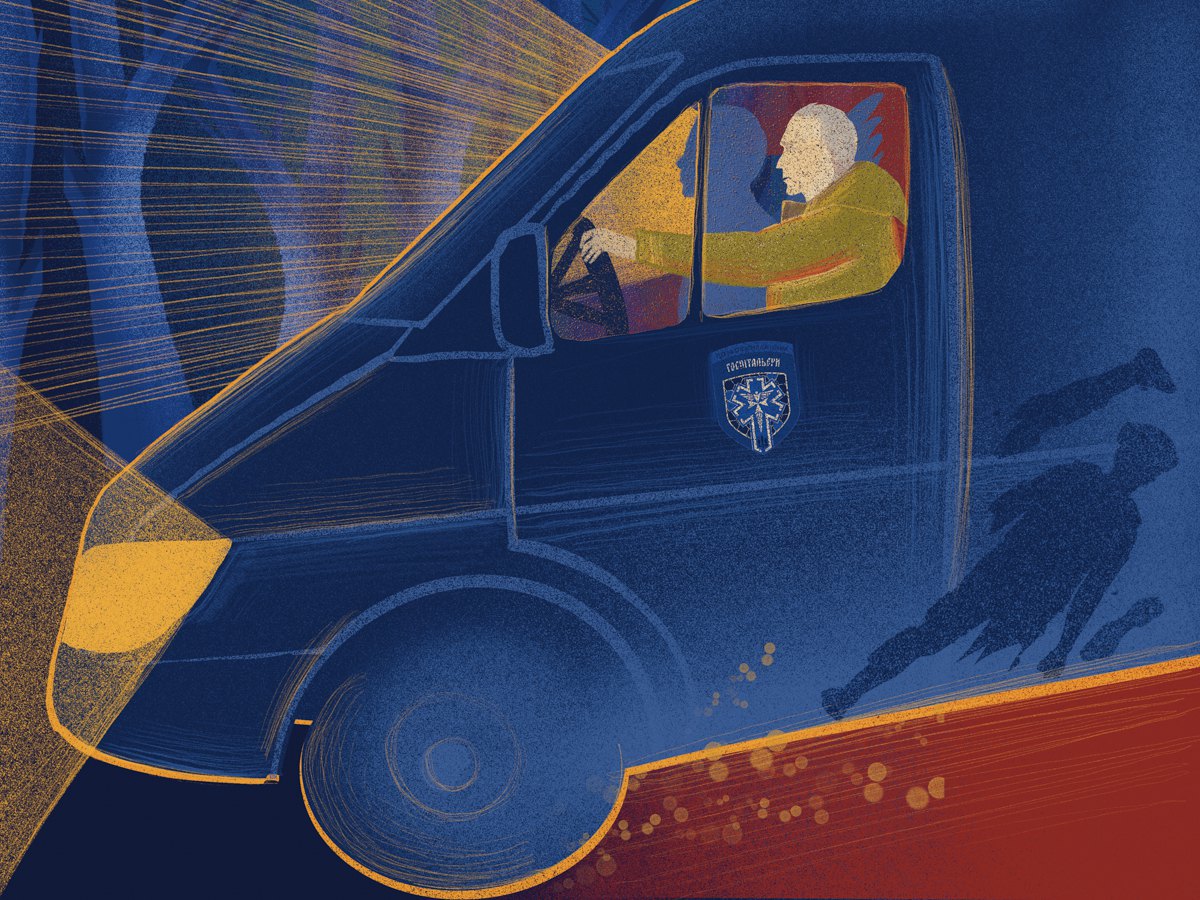
The hardest case in my experience was when some guys were on rotation and a shell hit their vehicle on the way. Two were killed. It was a day of explosions before and after. Our group of four had to evacuate them. The bodies were tangled in the cabin, intertwined with twisted metal. You can’t just pick them up and go. Every part has to be recovered; nothing can be left behind. The hardest part was carrying them. Stretchers are soft, but the field is full of holes, craters, anthills…
The body doesn’t obey, doesn’t hold a position, slips. That experience taught me you need rope — at least to tie the arms and legs so nothing gets lost.
We ran out of strength about 200 metres from our goal, but we had to keep going. And you don’t think about the danger: open field along the road, unprotected, and anything could come from the sky at any moment. You don’t pray, you don’t hope — you just do this heavy physical work.
We managed it: carried them out and delivered them to the morgue.
Over the years I’ve developed my own rules — behave in a way that doesn’t harm others and focus on what you can do for a person, alive or dead.
I know that we are given only what we can handle, that every situation comes to us with the expectation that we can face it with dignity, accept it, and move on.
Death, for me, is not the end.
Over time, my perception of death, of immortality, of who we are, of what our bodies are, has changed. Death is not the end. It’s a step into immortality. A person walks their path, and at some moment God calls them according to His will, because they have completed their earthly task. I feel respect for endless life, in whatever form it takes, and I care for the soul’s transition, to make the journey easy and free from pain.
I don’t experience burnout. What I feel is responsibility — service and the preservation of memory. Memory is not in stone, monuments, or inscriptions. I pray for each person so that the flow between the living and the dead doesn’t dry up, just as priests and relatives pray for souls. This is our care for those who have gone. And this responsibility requires great strength and energy.
In our battalion, there is a form where you can write how you want to be buried or cremated. As for me, I don’t care at all what happens to my body.
What I do know is that today I’m not ready to die. I don’t even want to think about it. I still have many tasks to complete.