





Object logic: repair and concreting of the DAP
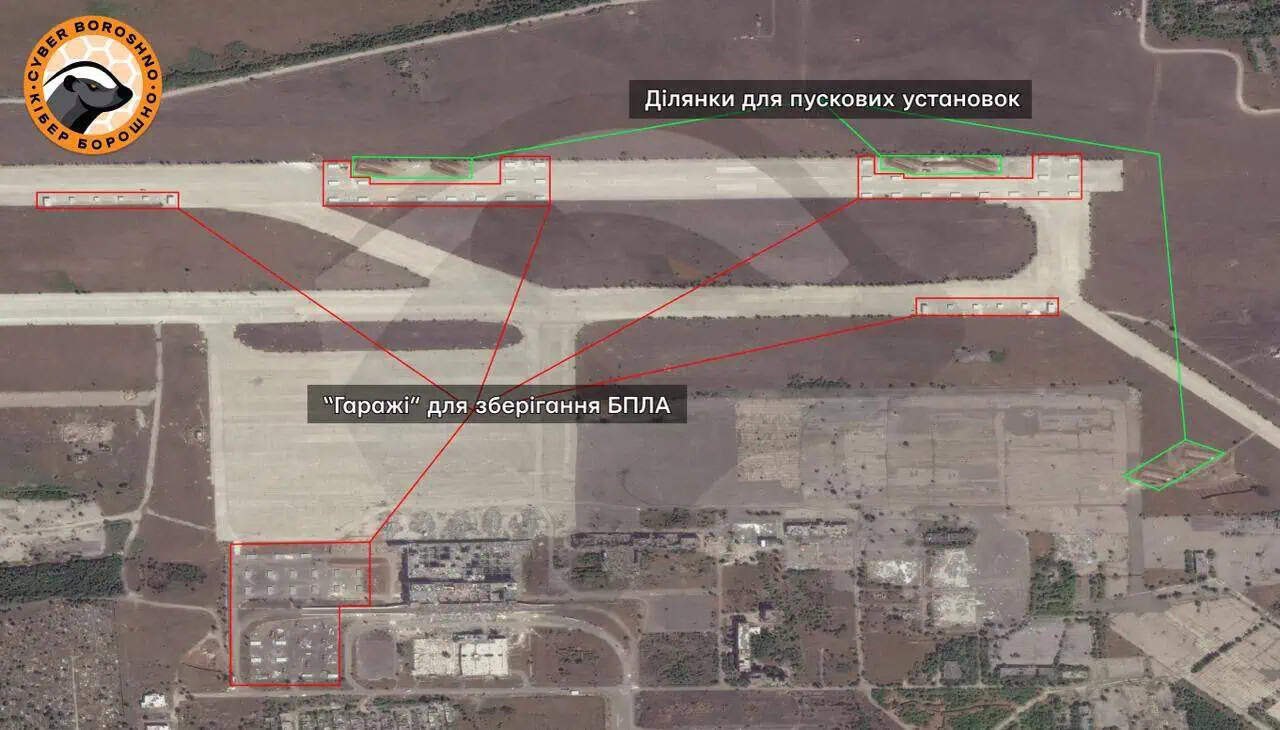
Active activity in the DAP (Donetsk Airport) area began around September–October 2025. The scope of the work clearly indicated that this was not an attempt to restore the airport for aviation. The Russians began actively pouring fresh concrete into the surviving underground communications, hangars and basements of the terminals. The main goal was to create workshops protected from shelling for the assembly, maintenance and final programming of drones directly on the front line.
The Russians hardly touched the runway in terms of major repairs for aircraft, as it has been completely destroyed since 2014–2015. However, the enemy carefully cleared several sections of the taxiways. This was necessary for the rapid deployment of mobile Shahed launch catapults mounted on trucks. They also replaced individual slabs to allow heavy equipment access to the new warehouses. Every bag of cement delivered to the site was observed, but it was not the construction crews that needed to be targeted — it was the purpose for which all this was being built.
Preventive work and enemy response
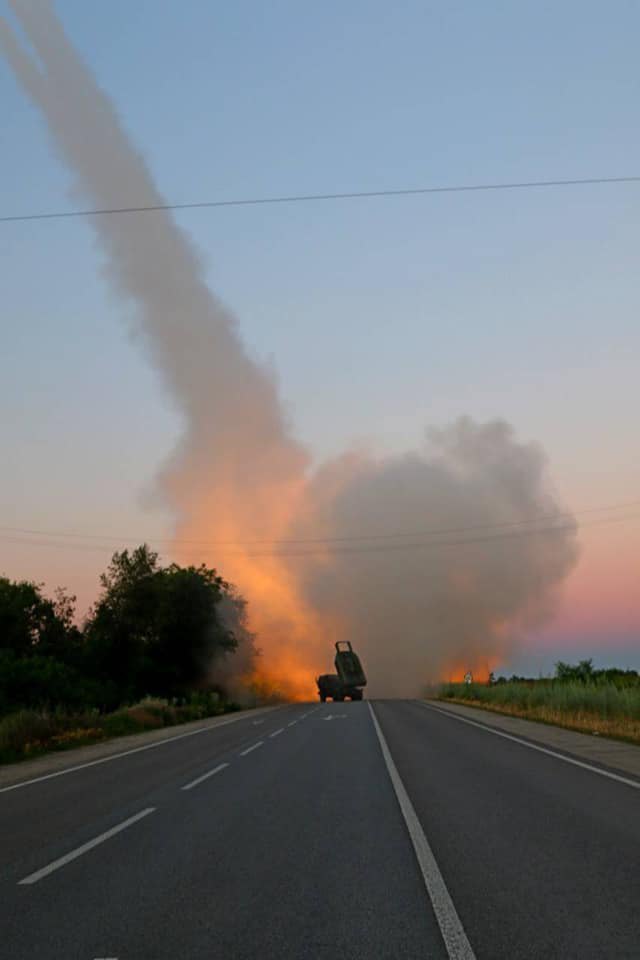
Defence Intelligence of Ukraine and pilots operating in the area recorded the arrival of the first large batches of containers, after which the first strike was carried out. Initial attacks targeted the area of the old terminal and underground fuel storage facilities. HIMARS systems using GMLRS rockets were mainly employed. As a result, the Russians suffered losses and temporarily suspended operations.
The Russians then drew what proved to be a fatal conclusion and began digging even deeper into the concrete. They apparently believed that a conventional missile would not reach them there. However, the logic is simple: if hundreds of litres of fuel and combat units for drones are hidden underground, sooner or later that volume will work against them and bury everything beneath the same concrete.
Operational motivation: why this location was chosen
The reasons why Russian forces clung so fiercely to the DAP lie in tactical considerations. They planned a rapid breakthrough towards Ukraine’s defensive belt and the new line of fortifications of the Armed Forces of Ukraine. In order to destroy pillboxes, fortified artillery positions and reinforced buildings, disable repeaters and various communication links, and strike bunkers, they urgently needed a substitute weapon. Since they lacked their own high-powered systems and no analogue to HIMARS had appeared, Shahed drones were considered suitable — equipped with thermobaric warheads containing 50–90 kg of explosives and offering sufficient accuracy to hit buildings, firing positions or groups of antennas.
A distance of 55 km to the line primarily means speed. When drones are launched from Crimea, flights take several hours, allowing azimuths to be determined in advance and targets to be tracked acoustically, visually and by radar. In such cases, mobile interception groups can be deployed, helicopters and fighters can be scrambled to intercept deeper inside the country, several Gepard systems can be concentrated to deliver dense fire, and, as a last resort, air defence missiles can be used.
Here, however, everything is too close — there is neither time nor sufficient secure territory to move air defence assets forward. The drones can take off and deliver a rapid strike. Aircraft cannot easily be used for interception at such close range to the line of contact, as they risk being hit by missiles from mobile air defence systems. This presents a highly specific challenge for which conventional responses are limited. In effect, a strategic tool becomes a tactical one in such conditions.
Work on the bunkers
Why did the Russians risk building a Shahed base just 55 km from the line of battle? Essentially, this corresponds to the operational radius of GMLRS rockets. For them, the DAP provided an ideal landscape of ruins where it was easy to hide among thousands of tonnes of broken concrete. They assumed that expensive ATACMS and Storm Shadow missiles would not be used against what appeared to be “ruins”. However, once the site became a direct threat to Ukraine’s strategic defence, a high-precision strike was carried out — employing unitary ATACMS missiles and several SCALP/Storm Shadow missiles.
The ballistic missiles carried monoblock warheads designed to penetrate the slabs and ceilings of the terminals, where the Russians had installed assembly stations, warehouses and laptops containing drone flight programmes.
Storm Shadow missiles acted as “surgeons”: their BROACH warhead operates in two stages — the first charge penetrates the concrete, while the second detonates inside underground bunkers, destroying everything within.
The mathematics of damage and the systemic effect
Judging by the detonations, debris and fires that burned for hours, the damage occurred simultaneously across the site. The material losses alone — a month’s supply of Shahed drones for active operations (approximately 200–300 units) — amount to roughly $6–10 million for airframes, engines and spare parts.
The technological sector suffered even greater damage. Professional JBC or Weller soldering stations, digital microscopes, oscilloscopes, programmers, rugged Panasonic Toughbook laptops and specialised communications equipment intended as alternatives to Starlink terminals were destroyed. Establishing such a facility typically costs between $3 million and $5 million.
However, the most significant loss concerns personnel. The elimination of teams of experienced engineers responsible for programming drones immediately before launch — adjusting routes in response to Ukrainian positions — represents a loss that cannot quickly be compensated with money. Replacing such specialists will take months.
In addition, the engineering infrastructure suffered heavy damage: concrete reinforcements, sealed basements, complex ventilation systems and secure communications lines were destroyed by fires and detonations — losses estimated at another $2–3 million.
Yet the issue is not merely financial. Ukrainian forces identified the threat, mapped the facility’s role along the front line and neutralised it for months to come.
At the same time, strikes were carried out in parallel and synchronously on the Tochmash facility in Donetsk, destroying an ammunition depot (with the NRK workshop also hit), as well as a large logistics hub in Mariupol. At both locations, powerful fires and heavy detonations were observed, confirming the success of the strikes.
The Russian Federation is currently preparing for its spring–summer campaign, while Ukrainian forces are conducting pre-emptive strikes — destroying command and control centres on the ground and eliminating forward UAV bases. The enemy sought to gain an advantage at short range, but instead suffered the destruction of its infrastructure through a high-precision Western strike. Judging by the number of launches, Western supplies appear to have replenished Ukrainian arsenals once again.