






Childhood
Lina Kostenko was born on 19 March 1930 in the town of Rzhyshchiv, Kyiv Region, into a family of teachers.
Her mother, according to the poet, was “woven from poetry and music.” She acted in amateur theatre, loved the arts, and dreamed of studying philology. However, her father advised her to choose a profession as far removed from ideology as possible. She became a chemist, though her love of literature stayed with her throughout life.
Her father was a man of encyclopedic knowledge who knew several languages. He was unafraid to voice his opinions about the Soviet authorities, for which he later suffered. As Kostenko recounted in a conversation with her daughter Oksana Pakhlevska (published in Harmony Through the Anguish of Dissonances…), when secret police raided their home, they asked where her father kept weapons. He got angry and pointed to the cradle where seven-month-old Lina lay: “Here is my weapon.” For this boldness, he was arrested, and her mother was repeatedly summoned for questioning.
Her father was released after thirteen months, but the label of “unreliable” remained. He struggled to find steady work, as he could no longer teach. Eventually, he managed to secure a position as a planner-economist in the regional education department.
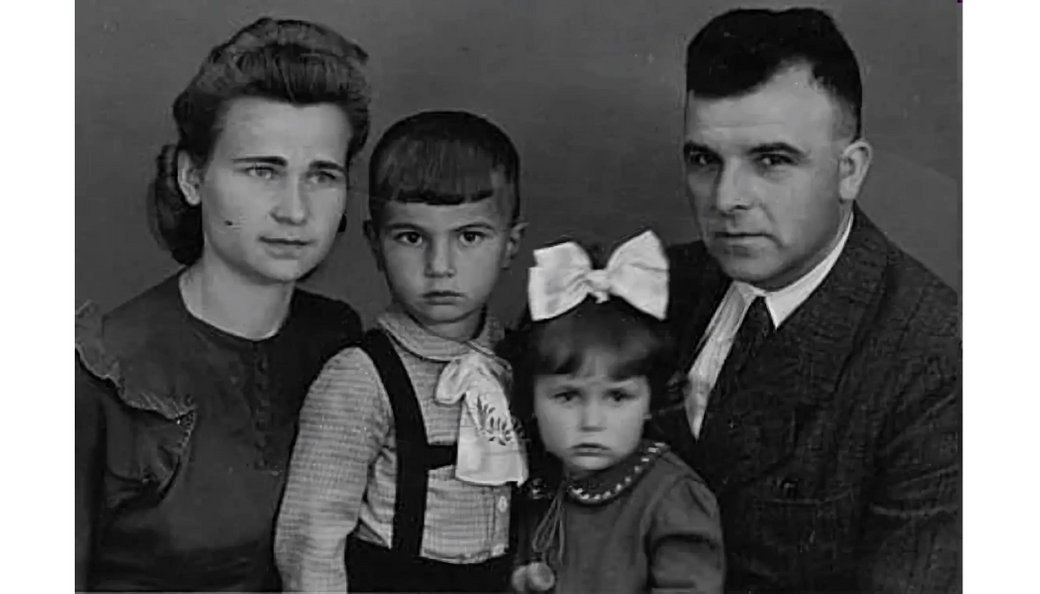
Until the age of six, Lina Kostenko grew up in Rzhyshchiv mostly with her grandmother, whom she lovingly called her “elder mother” throughout her life. As a child, she was extremely restless, and for her constant attempts to run off, her grandmother nicknamed her Shura-Bura.
In 1936, the family moved to Trukhaniv Island, then known as Kyiv’s Venice. Before the Dnipro was dammed by the Kyiv Hydroelectric Station, the island flooded every spring, turning streets into actual canals. Almost all houses had a special compartment under the first floor for boats, allowing residents to get around during floods. Red waterlines were even marked on the walls to show the level of the catastrophic 1931 flood.
Kostenko completed her first four school grades at School No. 100, but her studies were interrupted by the war. In autumn 1943, the Nazis burned down the workers’ settlement on Trukhaniv Island, including the school. She later reflected on these events in her poem I Grew Up in Kyiv’s Venice.
Her first poem, written at age eleven, was carved with a piece of dry branch into the clay wall of a trench during the Battle of the Dnipro, the large letters etched under the roar of shells. This episode later inspired her lines: “My first poem was written in a trench, / on that crumbling wall hit by explosions, / when my childhood, killed by the war, / lost its stars in the horoscope.”
Despite a weak heart, her father was mobilised as a quartermaster at a hospital. During the rapid German advance, he was trapped in a cauldron near Lokhvytsya. The hospital was bombed, the commander shot himself, and Vasyl Kostenko managed to reach his own forces on foot. As the poet bitterly notes, this was her father’s first “crime” against Soviet authorities — he survived.
After the war, the family settled in the Kurenivka district, and Lina continued her studies at School No. 123, graduating with honours. In 1945, the school was visited by Pavlo Tychyna, then People’s Commissar of Education of Ukraine. Teachers encouraged the fifteen-year-old girl to gift her own poems to the guest, which she carefully copied into a notebook. Her poem Meeting won a prize in the competition Children’s Creativity About the War. She also attended the literary studio at Dnipro magazine, edited by Andriy Malyshko. Her debut poems were published in 1946.
Student years
As a teenager, Lina became fascinated by philosophy, reading Diderot, Helvétius, Plato, Aristotle, Rousseau, and Kant. Naturally, she applied to the philosophy faculty at Kyiv University. However, Soviet realities were harsh for children of the repressed — her father had been arrested a second time after the war and sentenced to ten years in labour camps. When Lina went to check the results of the admissions campaign, her name was missing from the accepted list. Instead, she was handed a note from a special department explaining curtly: “People like you are not accepted.”
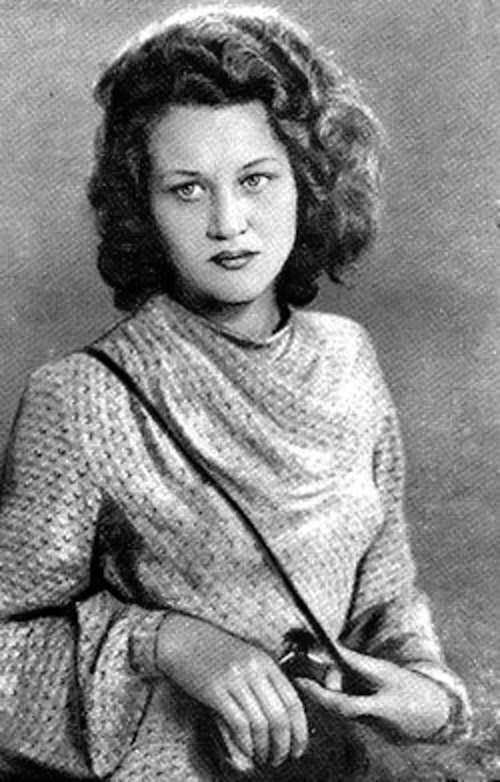
After another wave of arrests in Kyiv, the atmosphere was oppressive. Lina decided to apply to Chernivtsi University. She was welcomed and admitted, but the period proved short and physically exhausting. She was catastrophically short of money, even for basic necessities, and at one point fainted in the street from hunger.
After this, her mother persuaded her to return to Kyiv and contacted a distant relative working in the Ministry of Education. He helped Lina enroll at Kyiv Pedagogical Institute but imposed a strict condition: she must remain silent and not say anything that could compromise him.
Then fate took an unexpected turn. Lina received a letter from Kharkiv poet Volodymyr Fedorov, whom she barely knew. He advised her to apply to the Maxim Gorky Literary Institute in Moscow. Other acquaintances supported the idea. Lina sent her poems to a creative competition — and she was accepted.
The institute attracted students from over thirty nationalities, had a strong faculty, offered in-depth lectures in the humanities, and hosted creative workshops led by well-known writers.
Studying at the heart of the empire, under immense ideological pressure, many talented authors switched to Russian for the all-Union audience and approval from the authorities. Lina Kostenko, however, steadfastly refused to conform. She later recalled hearing remarks like, “You are an intelligent person. Why do you need this language of Indian tribes?” (in Russian). Interestingly, on Pavlo Tychyna’s personal instruction, the institute library received Ukrainian press for an entire year specifically for Kostenko.
Another telling episode, recalled in several interviews, took place in 1954 during preparations to mark the 300th anniversary of the Pereyaslav Council. The institute party secretary asked student Kostenko to design a poster for the event. Instead of the official ideological slogan, “300 years of Ukraine’s reunification with Russia,” she wrote: “300 years of joining.” Seeing this, the party secretary nearly lost his mind: “How could you write this?! It was reunification!”(in Russian). The young poet calmly replied: “Reunification is diffusion. Joining is honest — you can also separate.”
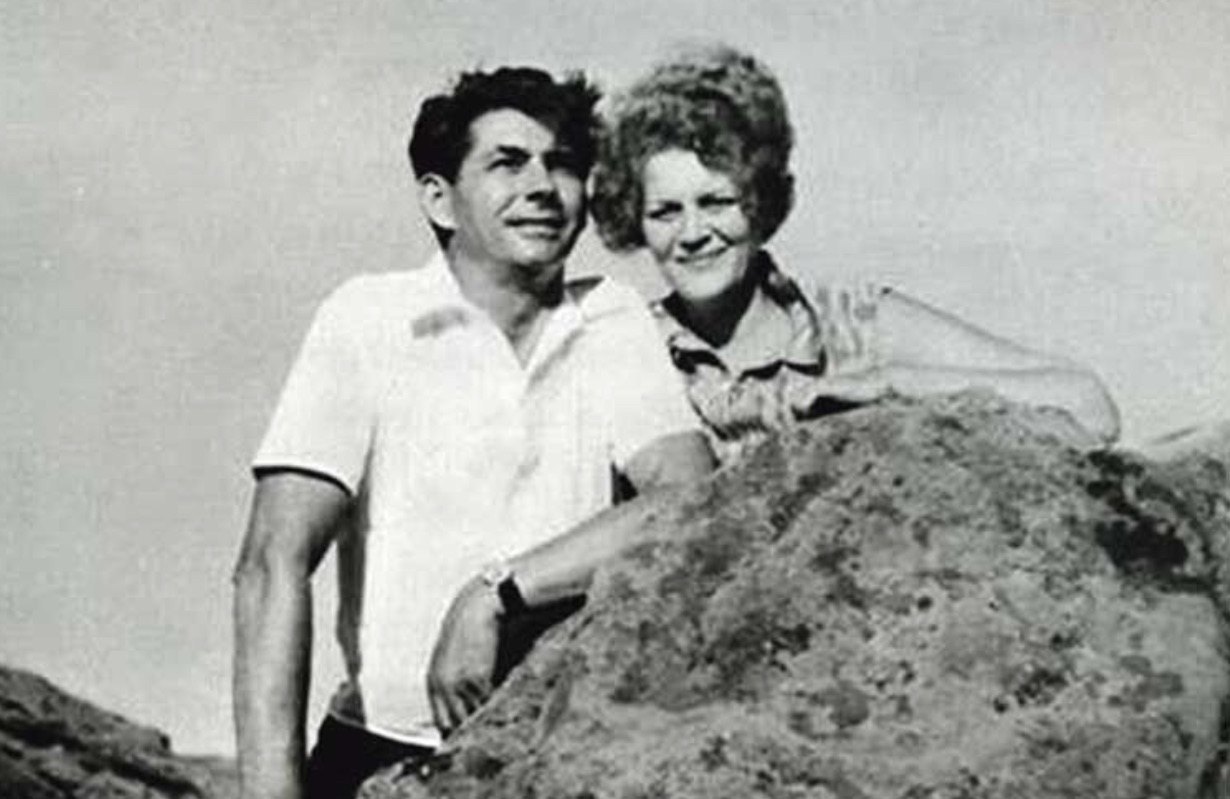
Finally, in 1956, Lina graduated from the institute with honours. Her classmate was Polish writer Jerzy Jan Pachlowski. They married, and their daughter Oksana was born the same year. However, the marriage ended two years later. Later, Kostenko had a relationship with writer and translator Arkadiy Dobrovolskyy, a former camp survivor, but that also did not last. Her second husband was Vasyl Tsvirkunov, head of Kyiv Dovzhenko Film Studio in the 1960s. They remained together until his death. In 1969, the couple had a son, Vasyl.
The Sixtiers (Shistdesyatnyky)
After Stalin’s death in 1953, the USSR entered the ‘thaw’. It was during this period that a new generation of Ukrainian national intelligentsia began to assert itself. Although many artists considered the term ‘Sixtiers’ overly general and somewhat artificial, it came to refer to a wide circle of poets, writers, critics, and artists, including Mykola Vinhranovskyy, Vasyl Symonenko, Vasyl Stus, Ivan Drach, Ivan Dzyuba, Yevhen Sverstiuk, Alla Horska, Lina Kostenko, and dozens of other prominent figures.
Despite superficial similarities with the Russian movement, Ukrainian Sixtiers followed a different path. Russian artists worked within the dominant culture, and their resistance had both political and aesthetic dimensions. The Ukrainian intelligentsia began as an artistic movement, hoping to reform the system from within, gradually shifting toward human rights activism and consistent national resistance. As Kostenko later put it: “We picked up this high-voltage line of spirit from the Executed Renaissance of the 1920s and wanted to pass it on to the next generation.”
However, the ‘thaw’ was short-lived. The authorities quickly realized that young, critically thinking artists posed a serious threat to totalitarian ideology. Strict censorship followed. Each person faced a choice: compromise and write to please the party, risk imprisonment, or choose emigration.
Lina Kostenko’s creative rise was swift. A year after graduating from the Literary Institute, her first collection, Rays of the Earth (1957), was published, followed by Sails (1958) and Journeys of the Heart (1961), which immediately established her as one of the most prominent figures of her generation. Her poems were memorised, copied, and recited at meetings of the Kyiv Creative Youth Club Suchasnyk.
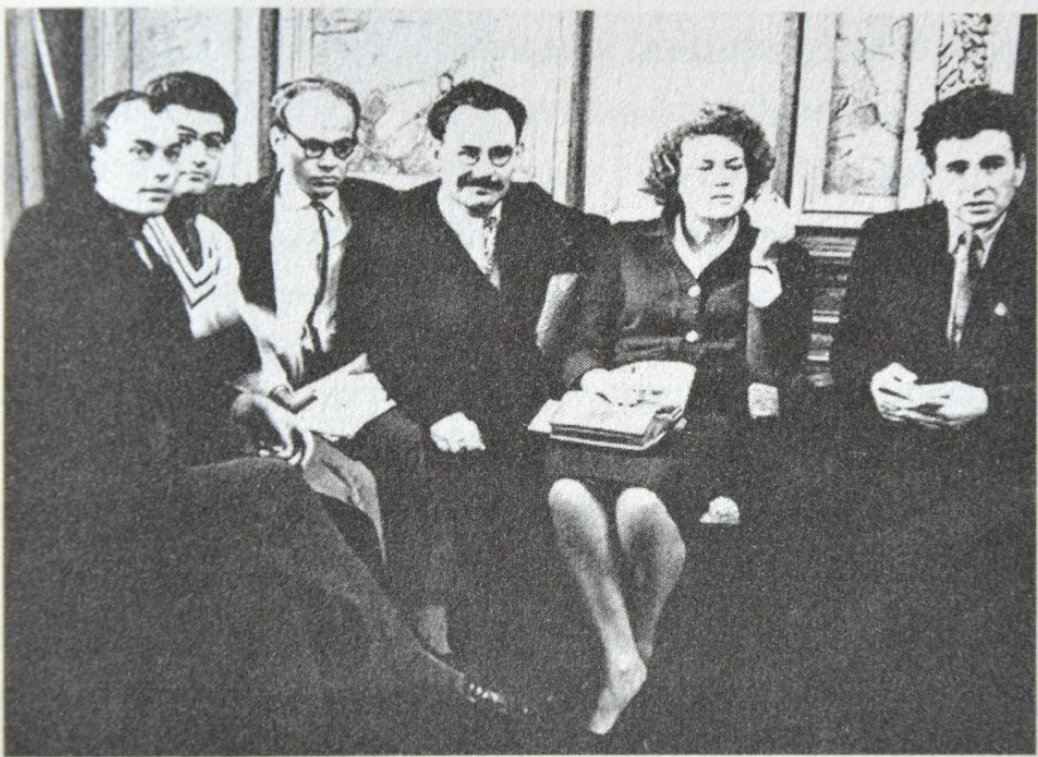
The poet did not belong to any dissident organisations, yet by 1963 she had already landed on the ideological blacklist: at the Republican meeting of creative intelligentsia, Central Committee secretary Andriy Skaba openly accused Lina Kostenko, Mykola Vinhranovsky, and Ivan Drach of “formal tricks with words” that supposedly obscured ideological meaning.
In 1965, the Soviet authorities began a wave of arrests targeting the Ukrainian intelligentsia. Lina Kostenko was among the audience at the historic premiere of Serhiy Parajanov’s film Shadows of Forgotten Ancestors at the Ukraina cinema, where Ivan Dziuba, Vyacheslav Chornovil, and Vasyl Stus staged an open protest. When the authorities turned on the sirens and people were herded into police vans, the poet beat the metal doors with her fists. That same year, she signed a collective letter against political repression, and in May 1966, at a Writers’ Union meeting, she took the podium to openly defend the arrested Ivan Svitlychnyy, Opanas Zalyvakha, Mykhaylo Kosiv, and the Horyn brothers.
She attended the trials of her dissident friends. According to Chornovil, during one trial she threw flowers to the convicted in the courtroom, after which she was removed and interrogated by police. She was among the initiators of the petition to vouch for the arrested Bohdan Horyn, and in 1968 she wrote an open letter defending Vyacheslav Chornovil and joined protests against the Soviet invasion of Czechoslovakia.
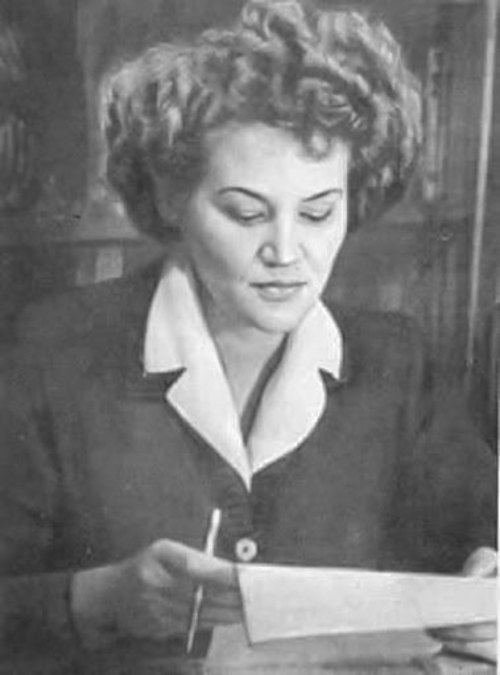
The system’s response to such defiance was harsh and methodical: the poet was completely pushed out of the official literary process. Critical articles appeared in the press, and collections already prepared for publication — Star Integral (1963) and Princely Hill (1972) — were destroyed in typesetting. For nearly sixteen years — from the early 1960s until the publication of Above the Banks of the Eternal River in 1977 — Lina Kostenko’s poetry scarcely appeared in Ukraine as standalone editions.
During these years of enforced silence, she lived very modestly, without fees at times with only twenty-eight kopecks in her pocket for a bottle of kefir. Yet she continued writing “for the drawer,” with no certainty that her work would ever be published. A breakthrough in those bleak years came with the release of a major collection, Poetry, in 1969 in the diaspora, thanks to publisher Osyp Zinkevych.
After the Chernobyl disaster in 1986, Lina Kostenko joined historical, cultural, and ethnographic expeditions to the exclusion zone, which from the early 1990s explored the traditional culture of Polissia. In abandoned villages, she spoke with self-settlers, recorded their memories, and preserved items of everyday folk life. For her, Chornobyl was not only an environmental tragedy but also a threat to the disappearance of an entire cultural world.
Present day
In March 2000, on the occasion of her seventieth birthday, Leonid Kuchma awarded Kostenko the Order of Prince Yaroslav the Wise (5th class), but she refused the honour. Later, during the presidency of Viktor Yushchenko, she also declined the title of Hero of Ukraine. Her phrase, “I do not wear political jewellery,” became iconic, symbolising her principled distance from the government.
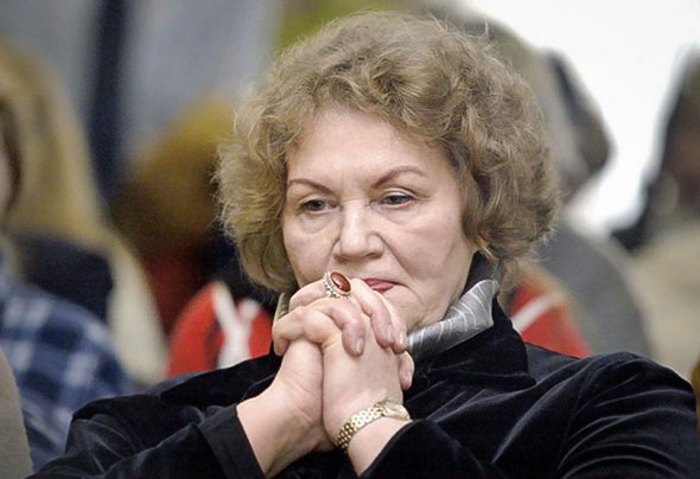
However, this distance did not mean indifference to society. During the Orange Revolution in 2004, Kostenko came to Maydan Nezalezhnosti. Her participation in civic events was always restrained. After the Revolution of Dignity and the start of the Russian–Ukrainian war in 2014, she joined the cultural initiative Second Front of the ATO: books by Ukrainian authors, including her poetry, were sent to the front line. In 2018, she signed an open letter in support of Oleh Sentsov, who was imprisoned in Russia.
When Russia launched its full-scale invasion on 24 February 2022, Lina Kostenko was ninety-one. According to friends and her publisher Ivan Malkovych, during the first month of the war she followed the news almost continuously and refused to leave her native Kyiv. Under shelling and between air-raid sirens, she continued to write.
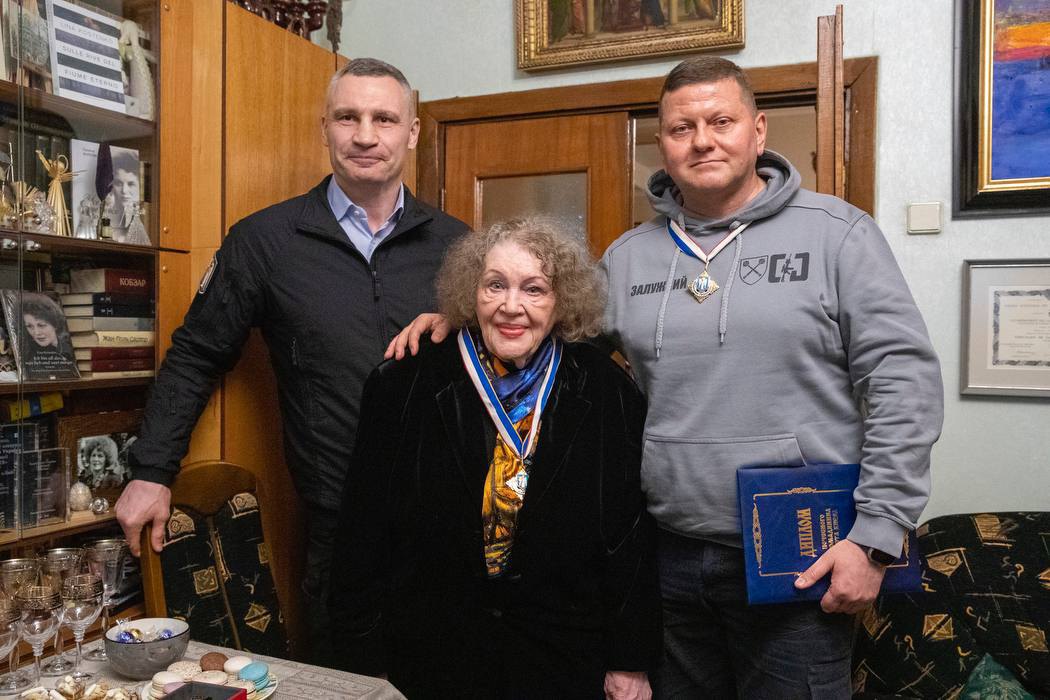
On 14 July 2022, France’s National Day, Ambassador Étienne de Poncins presented Lina Kostenko with the Legion of Honour — the highest state award of the French Republic. Accepting the decoration, the poet dedicated it to Ukrainian soldiers. In 2024, by decision of Kyiv City Council, Lina Kostenko, together with General Valeriy Zaluzhnyy, was named an honorary citizen of Kyiv.
An important moment was Lina Kostenko’s interview with Serhiy Zhadan for Radio Khartiya, recorded in November 2024 and January 2025. After a decade and a half of media silence, it was more a thoughtful conversation between two generations. In it, the poet dissects the roots of Russian imperial thinking, reflects on Ukraine’s role in the creation of the Russian Empire, and predicts its downfall. Kostenko speaks about Ukrainians with both admiration and pain: “This is a heroic people… there is no nation more worthy than Ukrainians today.” At the same time, she is deeply affected by the deaths of young people in the war — especially young poets. Lines by one of them — “I am not yet killed. I am still praying” — are, in her words, something she “cannot come to terms with.” Another thread is the tragedy of the Sixtiers and debates within the translation school, with figures like Mykola Lukash, Hryhoriy Kochur, and Mykola Bazhan at the centre. Kostenko recalls how the Sixtiers discovered “our twenties” — the generation of the first brave. And she reminds: “A poet has two wreaths: one of laurel, the other of thorns.”
Works
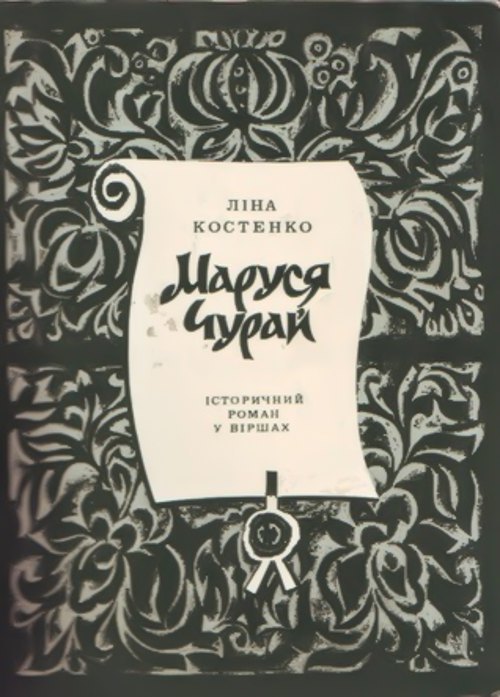
A true triumph after years of silence came with the publication in 1979 of the historical novel in verse Marusia Churai. The first print run of 8,000 copies sold out instantly, prompting an additional 100,000 to be printed. In 1987, for this novel and the collection Uniqueness, Lina Kostenko was awarded the Shevchenko State Prize. The work entered the school curriculum and became one of the most widely read during the years of independence.
The plot of Marusia Churai is based on a legend about a 17th-century Poltava folk singer accused of poisoning her unfaithful lover. Through the fate of one young woman, Kostenko unfolds a panorama of the national liberation war led by Bohdan Khmelnytskyy. It is a deeply philosophical work about the nature of creativity and the conflict between idealism and pragmatism. Marusia’s trial transforms into a metaphorical trial of Ukraine itself and its moral code.
Historical themes in Lina Kostenko’s work are never mere accounts of the past — they are always tools for analyzing the present. This is vividly evident in her verse novel Berestechko (work on which began in 1966, published as a standalone book in 1999). It is one of her epic works, centered not on triumph but on defeat. Kostenko treats the 1651 battle as a symbolic representation of national trauma, compelling the nation to confront the harsh mirror of its own history.
A similar depth can be found in the poems Scythian Odyssey (1987), where the author situates Ukrainian lands within the context of Mediterranean antiquity, and Snow in Florence (1987), which explores the complex relationship between artist and authority through the life of a Renaissance sculptor.
In 2010, Kostenko published her first major prose work — the diary-novel Notes of a Ukrainian Madman. The book caused a sensation, with its print run surpassing 80,000 copies within a year. Through the perspective of the protagonist, a Kyiv-based programmer, the author diagnoses the world of the early 21st century — globalised, overloaded with information noise, and rife with manipulation.
Subsequently, the world saw the release of the poetry collection River of Heraclitus (2011), the collection Madonna of Crossroads (2011) dedicated to her daughter Oksana, and the anthology Three Hundred Poems: Selected (2012), which summarised several decades of her creative work.
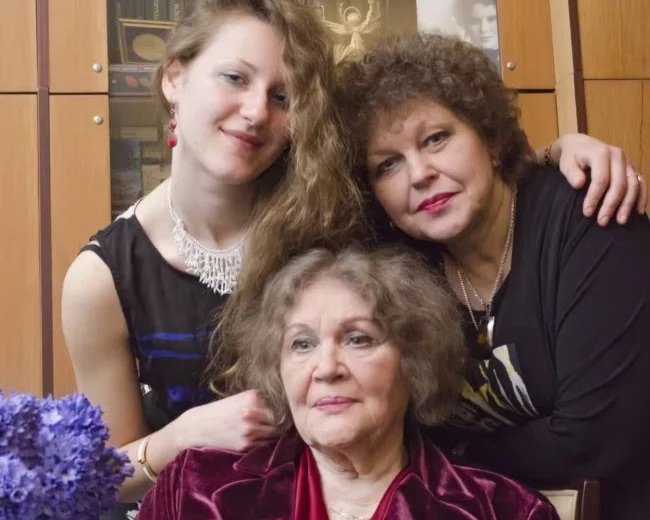
Lina Kostenko remains active creatively. Among her upcoming projects are a memoir titled The Strange Garden of Ivashkevych, a collection of essays Beyond Dal, and new volumes of poetry. Additionally, she is working on a major prose work related to the Hetmanate period, exploring the complex role of Ukrainians in the formation of the Russian Empire.
Kostenko’s poetry is built on a strong conceptual framework and a clear ethical stance. Her texts, rich in sharp aphorisms, offer readers moral guidance. While critics sometimes note a certain declarative quality in her style, it is precisely this confident, unwavering voice that serves as a lifeline for society during turbulent times. Kostenko possesses a vast linguistic arsenal: the semantics and stylistic richness of her vocabulary create a unique cross-section of Ukrainian literary language. In an interview with Serhiy Zhadan, the poet mentioned that she once even compiled her own card index of Ukrainian words.
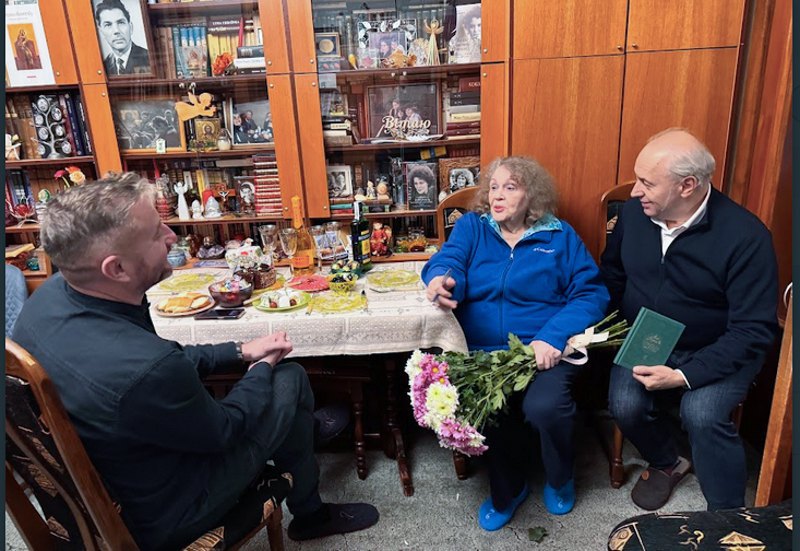
The source of Kostenko’s artistic power lies in her rare capacity for empathy and her constant intellectual engagement with the world around her. Inspiration for reflection could come from historical events and legends, the biographies of remarkable people, works of art and literature, a museum photograph, an unusual life situation, or even a sporting spectacle.
Although Kostenko never wrote plays, her works possess strong dramaturgy, which has repeatedly served as the basis for theatrical productions. This year alone, two performances are being staged based on her poetry: on 27 March, the Rivne Regional Academic Music and Drama Theatre will premiere the poetic drama Snow in Florence, and on 4 April, the Ivano-Frankivsk National Academic Drama Theatre named after Ivan Franko will present Marusia Churai.
Lina Kostenko is a phenomenon that goes far beyond the purely literary realm. Her poetry and prose record the historical experience of Ukrainians, while imbuing it with philosophical depth and transforming national traumas into lessons of dignity. By maintaining her restraint in the public sphere, Kostenko remains an influential figure of the present day, whose words can unite the nation — both in times of artistic exploration and in the darkest periods of existential crisis.
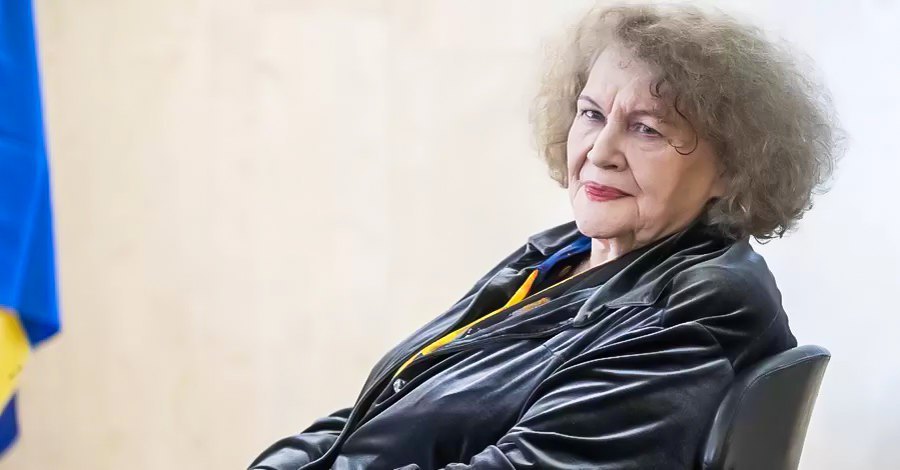
The project Territories of Culture is produced in partnership with the company Persha Pryvatna Brovarnia and is dedicated to exploring the history and transformation of Ukrainian cultural identity.